Artificial intelligence shows potential for assessment, development, and prediction in medical questionnaires
AI in Medical Questionnaires: Scoping Review
Systematic scoping reviewBenefit found
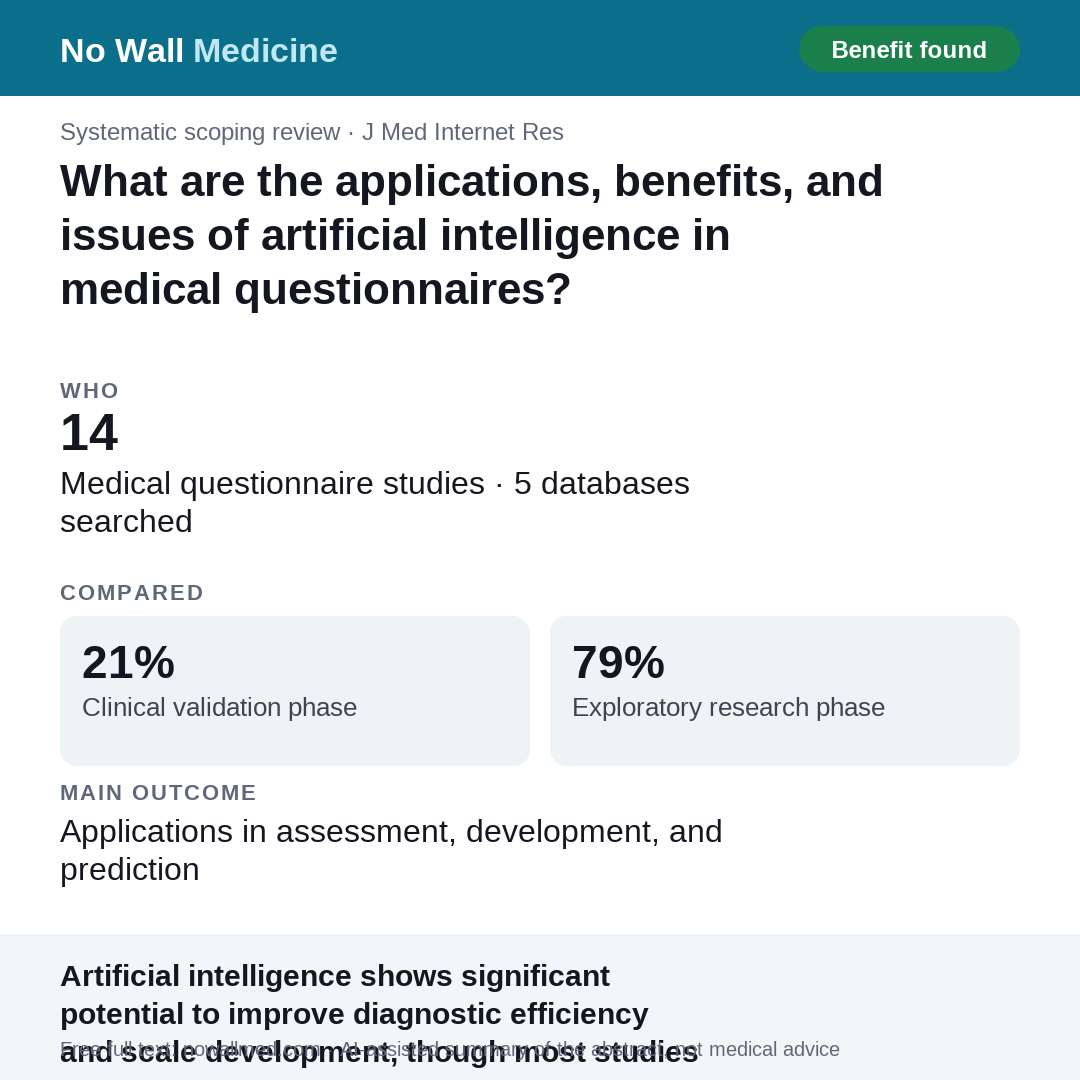
What are the applications, benefits, and issues of artificial intelligence in medical questionnaires?
Who
14
Medical questionnaire studies · 5 databases searched
Compared
21%Clinical validation phase (3/14)
79%Exploratory research phase (11/14)
Main outcome
Applications in assessment, development, and prediction
Bottom line: Artificial intelligence shows significant potential to improve diagnostic efficiency and scale development, though most studies remain in the exploratory phase.
Limitation: Lack of control groups, incomplete follow-up data, and inadequate validation systems.
J Med Internet Res · 2025-06-23Download image
Clinical question: What are the applications, benefits, and issues of artificial intelligence in medical questionnaires?
Why it matters: Commonly used clinical questionnaires can lead to inaccurate diagnoses due to overlapping symptoms and a lack of professional supervision during administration.
Key points
- Researchers reviewed 14 studies from 49,091 publications to evaluate artificial intelligence in medical assessment, questionnaire development, and disease prediction.
- One study used artificial intelligence to distinguish chronic fatigue syndrome from long COVID-19 with 92.18% accuracy.
- While 24 technologies were identified, only 21% (3/14) of the studies had reached the clinical validation phase.
Headline and key points written with AI from the paper’s abstract, with every number checked against it. Read the paper before relying on them.
Topics
Cite this article
Luo X, Li Y, Xu J, Zheng Z, Ying F, Huang G. AI in Medical Questionnaires: Scoping Review. J Med Internet Res. 2025. doi:10.2196/72398
Spotted a mistake? Suggest a correction
Top studies every Monday
The week’s key trials and guidelines in your specialties, by email. Free.
Get the weekly digest