AI models predicted discharge disposition after knee replacement surgery fairly well
AI Predictive Models for Discharge Disposition in Patients Following Primary Total Knee Arthroplasty: Systematic Review and Meta-Analysis
Meta-analysis of 5 studiesBenefit found
AI models for discharge disposition after knee arthroplasty
Who
175042
adult patients undergoing primary total knee arthroplasty · United States
Compared
Machine Learning
Deep Learning
Main outcome
discharge disposition
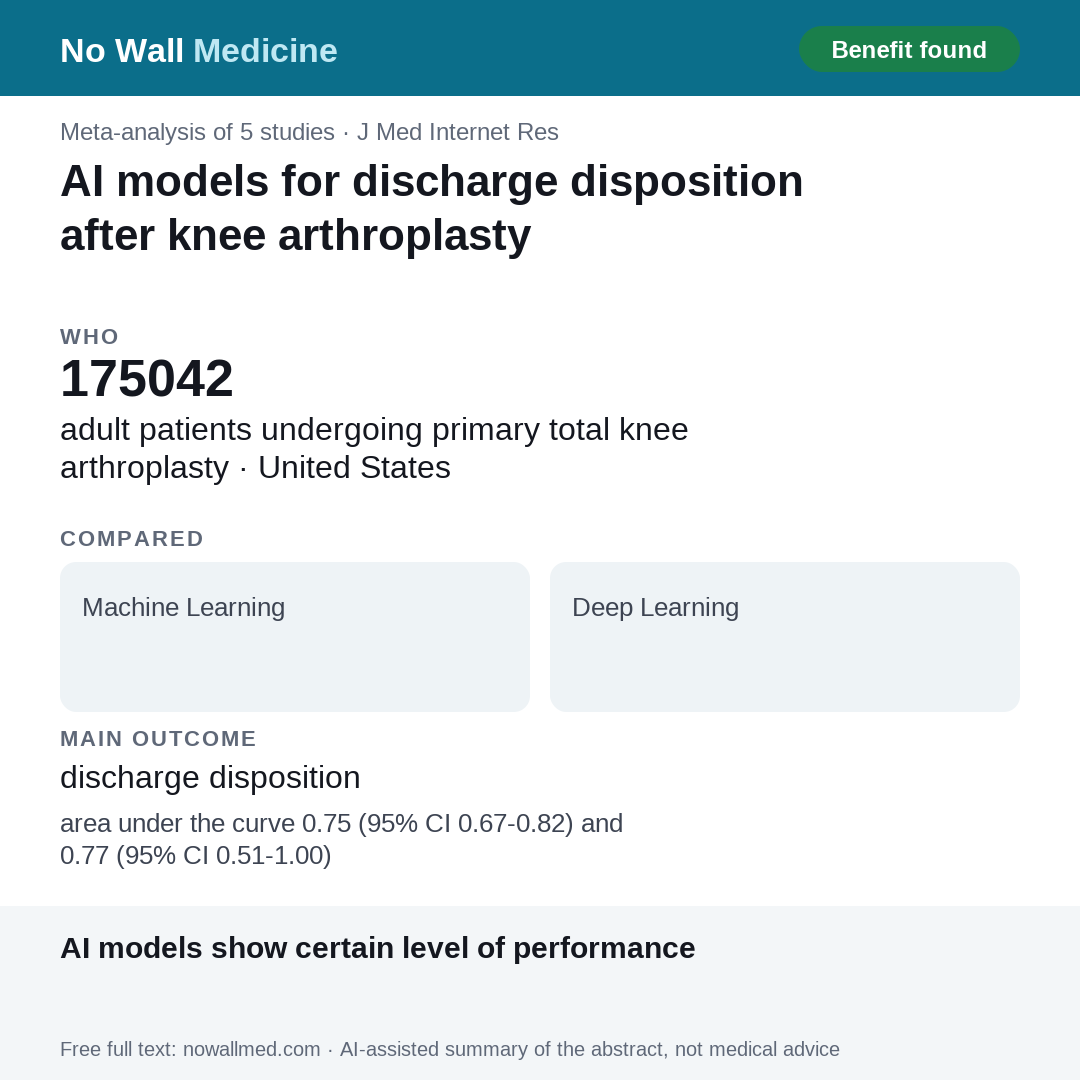
Result: area under the curve 0.75 (95% CI 0.67-0.82) and 0.77 (95% CI 0.51-1.00)
Bottom line: AI models show certain level of performance
Limitation: high risk of bias and heterogeneity
J Med Internet Res · 2026-11-16Download image
Why it matters: The performance and quality of AI predictive models for discharge disposition after knee replacement surgery remain unclear
Key points
- Five US studies with 175,042 to 434,550 patients were analyzed for AI model performance.
- The models' pooled area under the curve was 0.75 for internal validation and 0.77 for external validation.
- No difference was found between machine learning and deep learning models.
Limitation the authors note: All included studies were at high risk of bias and conducted in the United States, limiting generalizability
Headline and key points written with AI from the paper’s abstract, with every number checked against it. Read the paper before relying on them.
Topics
Cite this article
Xie D, Chen R, Yue C, Liu X, Cao G, Jiao R. AI Predictive Models for Discharge Disposition in Patients Following Primary Total Knee Arthroplasty: Systematic Review and Meta-Analysis. J Med Internet Res. 2026. doi:10.2196/94936
Spotted a mistake? Suggest a correction