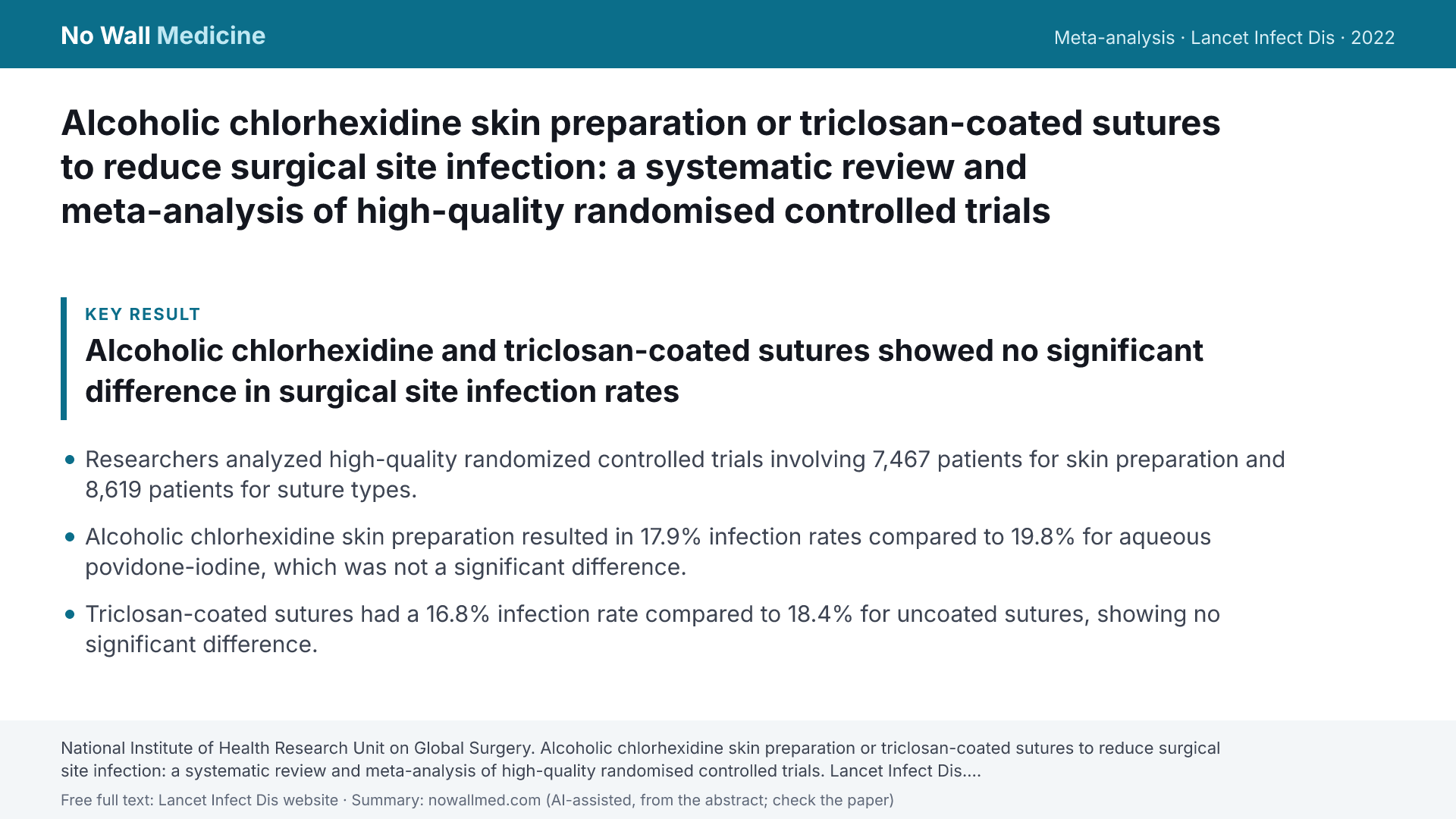
Alcoholic chlorhexidine and triclosan-coated sutures showed no significant difference in surgical site infection rates
Alcoholic chlorhexidine skin preparation or triclosan-coated sutures to reduce surgical site infection: a systematic review and meta-analysis of high-quality randomised controlled trials
Why it matters: Current global and national guidelines recommend alcoholic chlorhexidine and triclosan-coated sutures, but previous meta-analyses included studies at high risk of bias.
Key points
- Researchers analyzed high-quality randomized controlled trials involving 7,467 patients for skin preparation and 8,619 patients for suture types.
- Alcoholic chlorhexidine skin preparation resulted in 17.9% infection rates compared to 19.8% for aqueous povidone-iodine, which was not a significant difference.
- Triclosan-coated sutures had a 16.8% infection rate compared to 18.4% for uncoated sutures, showing no significant difference.
Headline and key points written with AI from the paper’s abstract, with every number checked against it. Read the paper before relying on them.
Was this summary helpful?
Abstract
Background
WHO and the UK's National Institute for Health and Care Excellence recommend alcoholic chlorhexidine skin preparation and triclosan-coated sutures to prevent surgical site infections (SSIs). Existing meta-analyses that include studies at high risk of bias, combined with the recent publication of large, randomised trials, justify an updated meta-analysis of high-quality randomised controlled trials (RCTs). We aimed to test the rates of SSI according to skin preparation solutions (ie, alcoholic chlorhexidine vs aqueous povidone-iodine) and types of sutures (ie, coated vs uncoated). Methods
In this systematic review and meta-analysis, we searched MEDLINE, Embase, Pubmed, and Cochrane Library databases, with no language restrictions, to identify high-quality RCTs testing either alcoholic chlorhexidine skin preparation (vs aqueous povidone-iodine) or triclosan-coated sutures (vs uncoated sutures), or both, published from database inception to Sept 1, 2021. Patients who received clean-contaminated, contaminated, or dirty surgery were included. We predefined the characteristics of a high-quality trial through an expert consensus process to develop an enhanced Cochrane risk of bias-2 tool specifically for RCTs with a primary outcome of SSI. Data were extracted from published reports. Meta-analysis was performed using a random-effects model and heterogeneity was assessed using the I2 statistic. This systematic review and meta-analysis was prospectively registered in PROSPERO, CRD42021267220. Findings
Of 942 studies identified, 933 were excluded. Four high-quality RCTs (n=7467 patients) were included that tested alcoholic chlorhexidine. No significant difference in SSI rates was noted between alcoholic chlorhexidine and aqueous povidone-iodine (17·9% [667 of 3723 patients] vs 19·8% [740 of 3744 patients]; odds ratio 0·84 [95% CI 0·65-1·06]; p=0·21, I2=53·1%). Five high-quality RCTs were included that tested triclosan-coated sutures (n=8619 patients), with no significant difference noted between triclosan-coated and uncoated sutures (16·8% [733 of 4360 patients] vs 18·4% [784 of 4259 patients]; OR 0·90 [95% CI 0·74-1·09]; p=0·29, I2=36·4%). Interpretation
Contrary to previous meta-analyses, this study did not show a benefit from either alcoholic chlorhexidine skin preparation or triclosan-coated sutures, both of which are more expensive than other readily available alternatives. Global and national guidance should be reconsidered to remove recommendations for their routine use. Funding
National Institute for Health Research (NIHR) Global Health Research Unit.
Abstract reproduced under the article’s CC BY licence.
Subject terms
Headline, design, result, key points, caveat and citation as plain text.
Cite this article
National Institute of Health Research Unit on Global Surgery. Alcoholic chlorhexidine skin preparation or triclosan-coated sutures to reduce surgical site infection: a systematic review and meta-analysis of high-quality randomised controlled trials. Lancet Infect Dis. 2022;22(8):1242-1251. doi:10.1016/S1473-3099(22)00133-5
Spotted a mistake? Suggest a correction