Algorithm-based modular psychotherapy showed higher remission rates than standard cognitive-behavioral therapy in depressed patients
Algorithm-based modular psychotherapy vs. cognitive-behavioral therapy for patients with depression, psychiatric comorbidities and early trauma: a proof-of-concept randomized controlled trial
Proof-of-concept randomized controlled trialMixed results
Is algorithm-based modular psychotherapy more effective than cognitive-behavioral therapy for depression with comorbidities and trauma?
Who
70
70 adult outpatients with major depressive disorder, comorbidities, and early trauma
Compared
Cognitive-behavioral therapy: 11.4% remission
Algorithm-based modular psychotherapy: 29.4% remission
Main outcome
Hamilton Rating Scale for Depression-24 score at post-treatment
Result: odds ratio 3.2 (95% CI 0.9-11.6)
Bottom line: Algorithm-based modular psychotherapy showed feasibility and higher remission rates, though superiority over cognitive-behavioral therapy was non-significant.
Limitation: Potential interindividual heterogeneity and need for fully powered confirmation trials.
World Psychiatry · 2024-05-10Download image
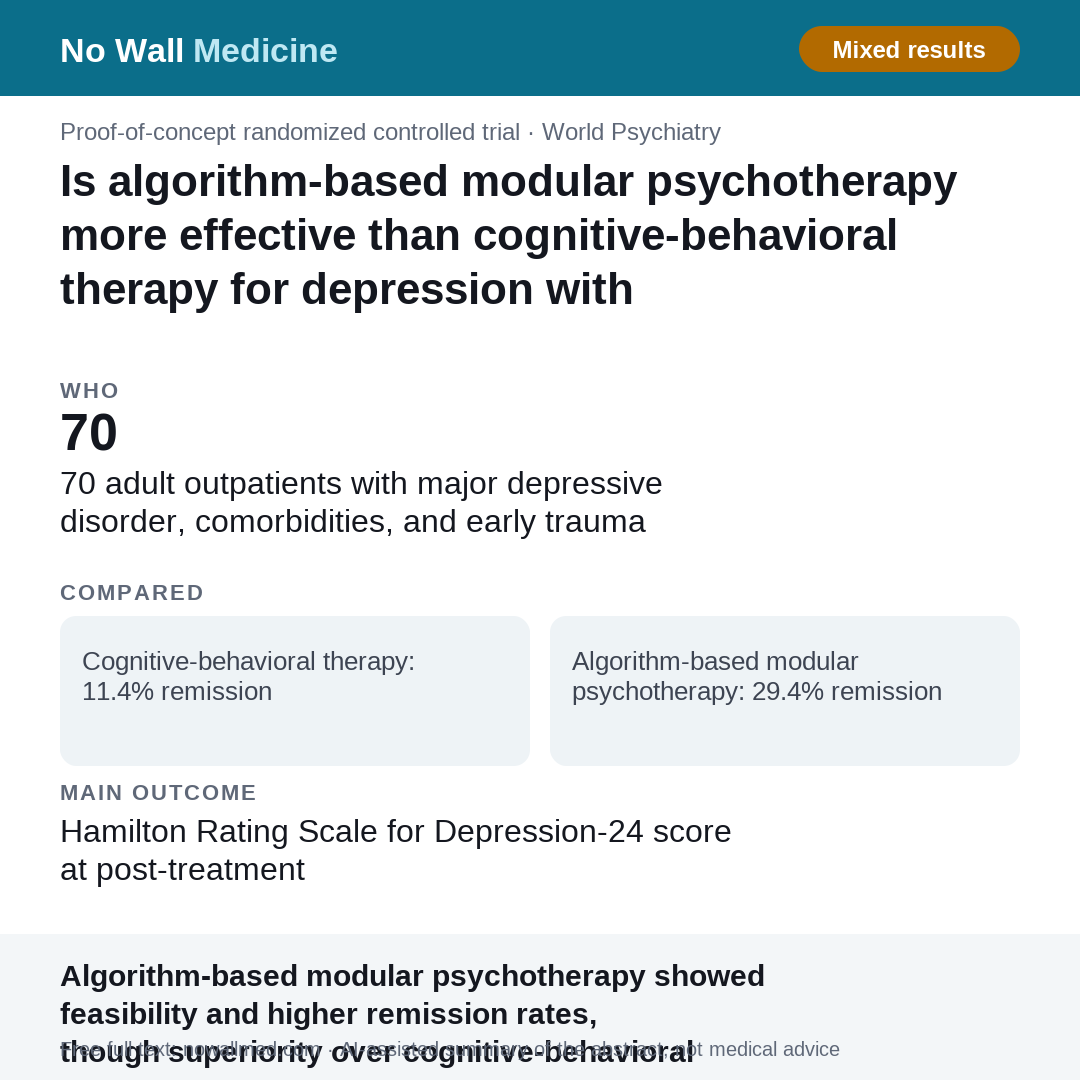
Clinical question: Is algorithm-based modular psychotherapy more effective than cognitive-behavioral therapy for depression with comorbidities and trauma?
Why it matters: Evidence is lacking regarding the feasibility and efficacy of using a personalized treatment algorithm to guide modular-based psychotherapy for patients with depression and early trauma.
Key points
- The study randomized 70 adult outpatients with major depressive disorder, psychiatric comorbidities, and early trauma to receive either 20 sessions of standard cognitive-behavioral therapy or a personalized modular approach.
- Patients using the modular approach were nearly three times as likely to achieve remission, with 29.4% compared to 11.4% in the standard group.
- The modular approach was associated with higher satisfaction, better therapeutic alliance, and fewer adverse events, though its superiority in reducing depressive symptoms was not statistically significant.
Limitation the authors note: The authors state that potential clinical advantages and differences in treatment outcomes require investigation in fully powered confirmation trials.
Headline and key points written with AI from the paper’s abstract, with every number checked against it. Read the paper before relying on them.
Was this summary helpful?
Cite this article
Schramm E, Elsaesser M, Jenkner C, Hautzinger M, Herpertz SC. Algorithm-based modular psychotherapy vs. cognitive-behavioral therapy for patients with depression, psychiatric comorbidities and early trauma: a proof-of-concept randomized controlled trial. World Psychiatry. 2024. doi:10.1002/wps.21204
Spotted a mistake? Suggest a correction
Top studies every Monday
The week’s key trials and guidelines in your specialties, plus any topics you follow. By email, free.
Get the weekly digest