Electronic health record defaults increased palliative care visits for patients with advanced cancer
Algorithm-Based Palliative Care in Patients With Cancer: A Cluster Randomized Clinical Trial
2-arm cluster randomized clinical trialBenefit found
Do algorithm-based electronic health record defaults increase completed palliative care visits?
Who
562
patients with advanced lung or noncolorectal gastrointestinal cancer · 15 urban or rural clinics in Tennessee
Compared
43.9%intervention group
8.3%control group
Main outcome
completed palliative care consultation within 12 weeks of enrollment
Result: adjusted odds ratio 8.9 (95% CI 5.5-14.6)
Bottom line: Algorithm-based electronic health record defaults increased completed palliative care visits and decreased end-of-life systemic therapy.
JAMA Netw Open · 2025-02-03Download image
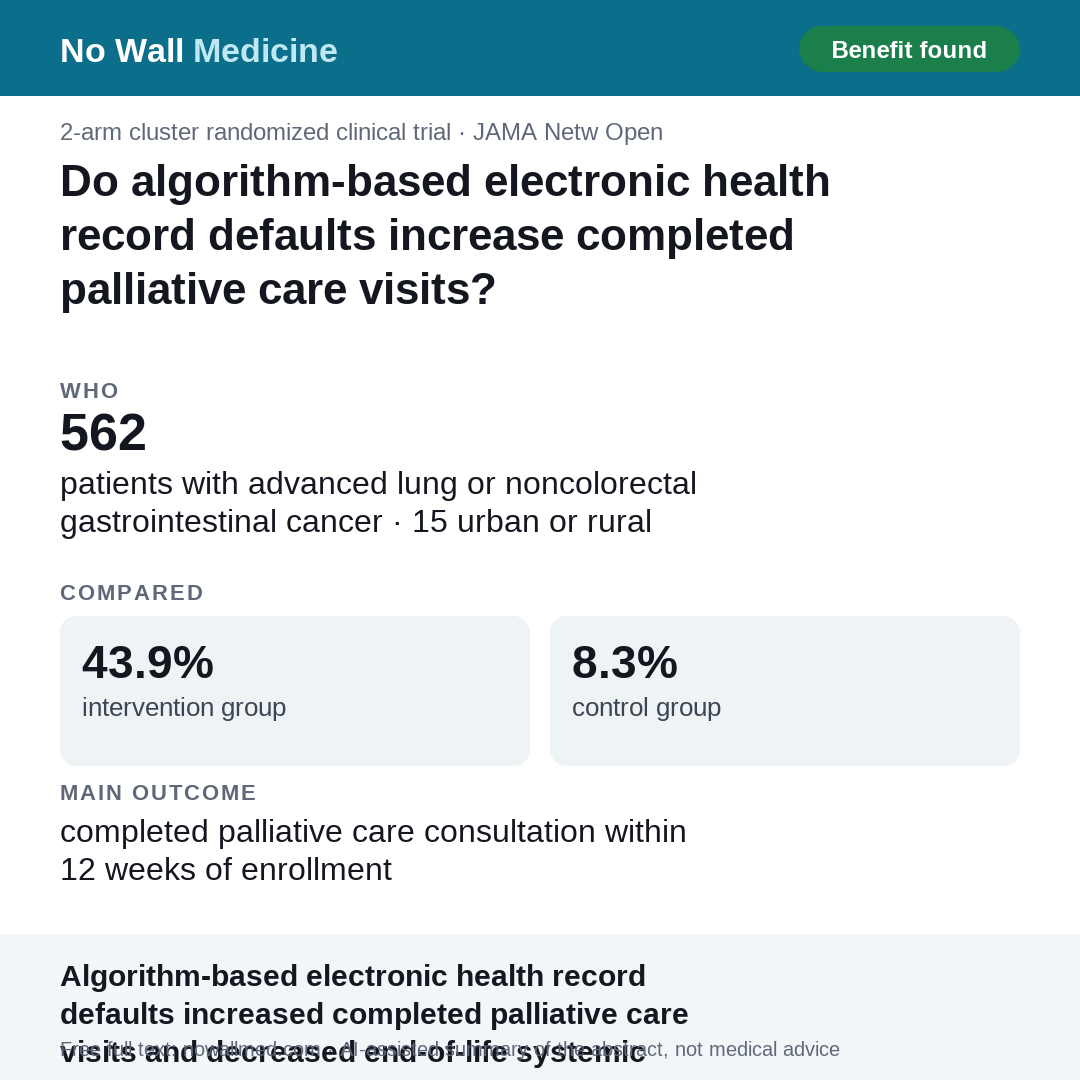
Clinical question: Do algorithm-based electronic health record defaults increase completed palliative care visits?
Why it matters: Strategies to increase access and effectiveness of specialty palliative care in community oncology settings are currently lacking.
In absolute numbers
intervention group: 43.9% · control group: 8.3% → a difference of 35.6 percentage points, so about 3 people would need the treatment for 1 more to benefit (number needed to treat) over the trial’s follow-up.
Worked out by us from the two group results above, not reported by the authors. Check the paper for the exact outcome and timing.
Key points
- Researchers conducted a cluster randomized trial involving 562 patients with advanced lung or noncolorectal gastrointestinal cancer across 15 clinics.
- The intervention group had 43.9% of patients complete palliative care visits compared to 8.3% in the control group.
- Among 179 patients who died, 6.5% in the intervention group received systemic therapy within 14 days of death compared to 16.1% in the control group.
Headline and key points written with AI from the paper’s abstract, with every number checked against it. Read the paper before relying on them.
Topics
Cite this article
Parikh RB, Ferrell WJ, Li Y, Chen J, Bilbrey L, Johnson N. Algorithm-Based Palliative Care in Patients With Cancer: A Cluster Randomized Clinical Trial. JAMA Netw Open. 2025. doi:10.1001/jamanetworkopen.2024.58576
Spotted a mistake? Suggest a correction
Top studies every Monday
The week’s key trials and guidelines in your specialties, by email. Free.
Get the weekly digest