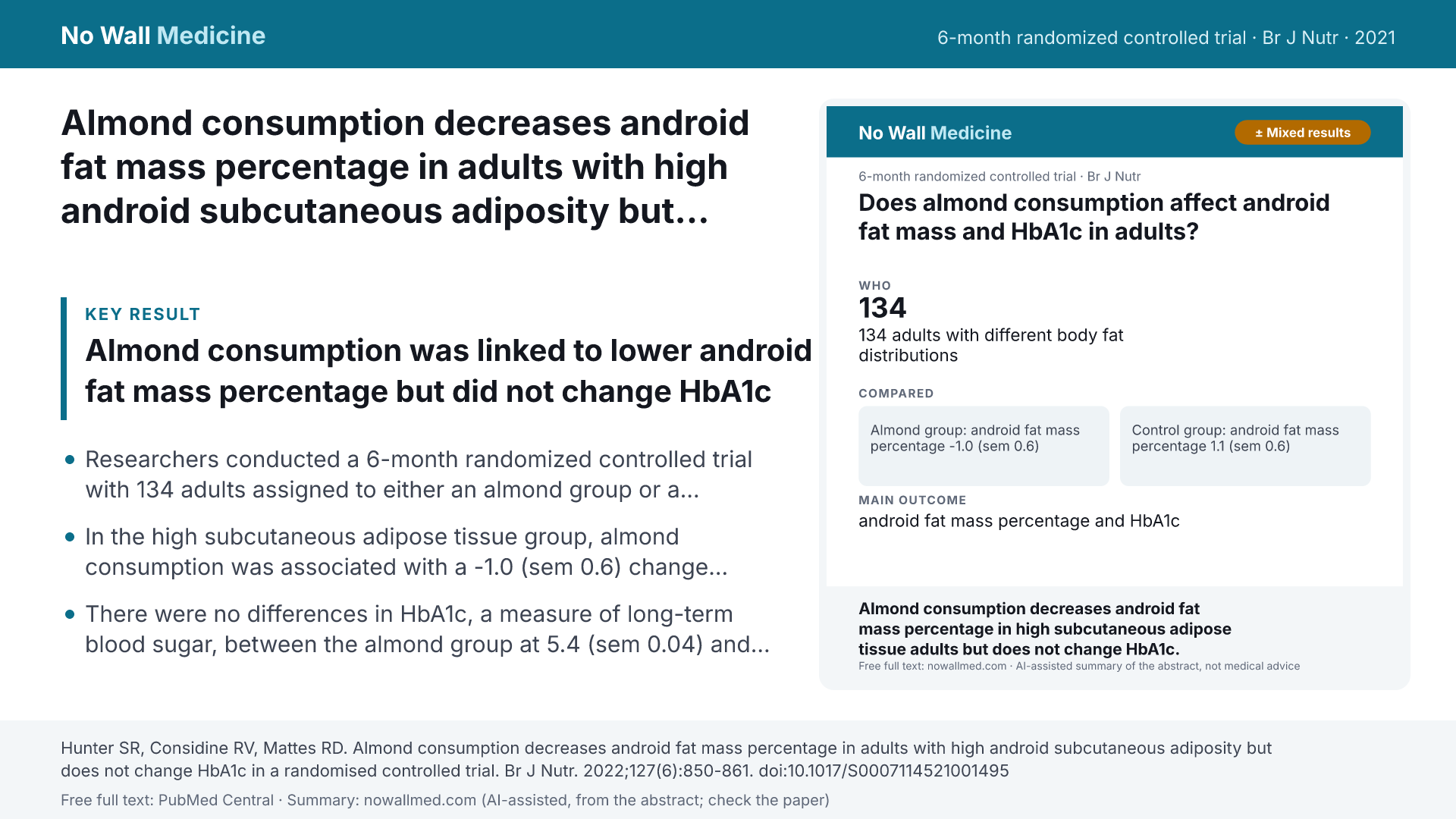
Almond consumption was linked to lower android fat mass percentage but did not change HbA1c
Almond consumption decreases android fat mass percentage in adults with high android subcutaneous adiposity but does not change HbA1c in a randomised controlled trial
6-month randomized controlled trialMixed results
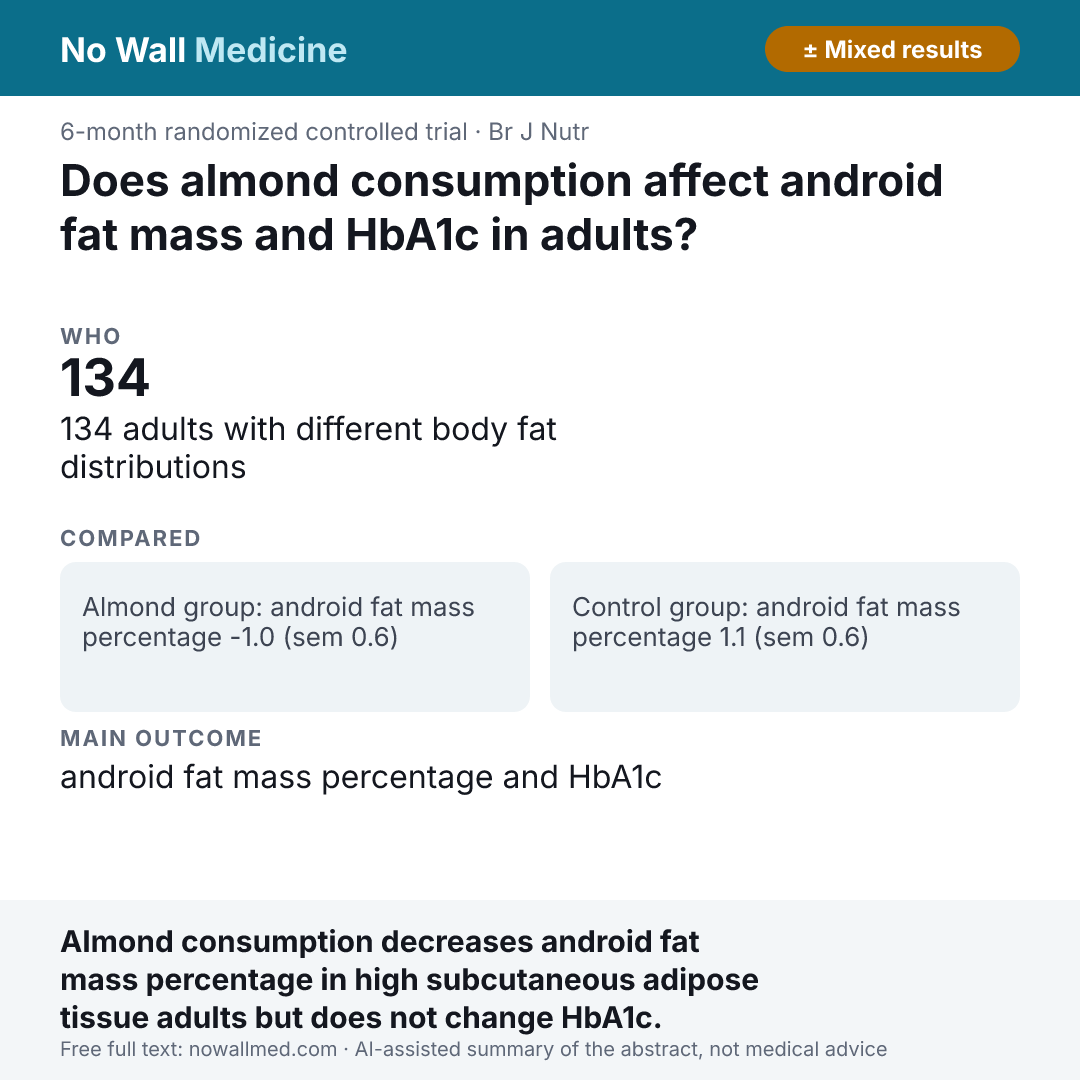
Does almond consumption affect android fat mass and HbA1c in adults?
Who
134
134 adults with different body fat distributions
Compared
Almond group: android fat mass percentage -1.0 (sem 0.6)
Control group: android fat mass percentage 1.1 (sem 0.6)
Main outcome
android fat mass percentage and HbA1c
Bottom line: Almond consumption decreases android fat mass percentage in high subcutaneous adipose tissue adults but does not change HbA1c.
Br J Nutr · 2021-05-06 · Save PNG
Clinical question: Does almond consumption affect android fat mass and HbA1c in adults?
Key points
- Researchers conducted a 6-month randomized controlled trial with 134 adults assigned to either an almond group or a control group based on body fat distribution.
- In the high subcutaneous adipose tissue group, almond consumption was associated with a -1.0 (sem 0.6) change in android fat mass percentage compared to 1.1 (sem 0.6) in controls.
- There were no differences in HbA1c, a measure of long-term blood sugar, between the almond group at 5.4 (sem 0.04) and the control group at 5.5 (sem 0.04).
Headline and key points written with AI from the paper’s abstract, with every number checked against it. Read the paper before relying on them.
Was this summary helpful?
Subject terms
Headline, design, result, key points, caveat and citation as plain text.
Cite this article
Hunter SR, Considine RV, Mattes RD. Almond consumption decreases android fat mass percentage in adults with high android subcutaneous adiposity but does not change HbA1c in a randomised controlled trial. Br J Nutr. 2022;127(6):850-861. doi:10.1017/S0007114521001495
Spotted a mistake? Suggest a correction