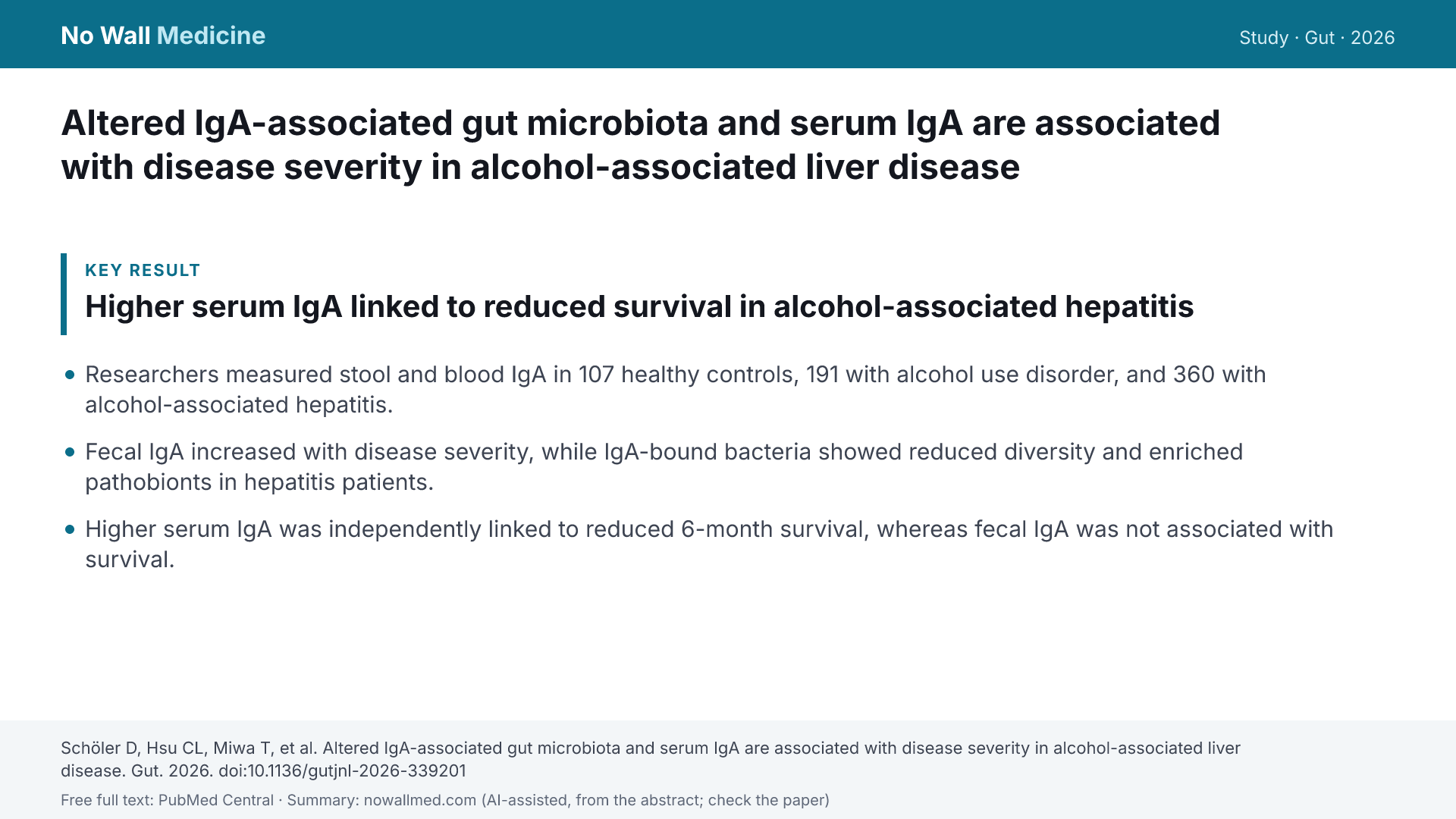
Higher serum IgA linked to reduced survival in alcohol-associated hepatitis
Altered IgA-associated gut microbiota and serum IgA are associated with disease severity in alcohol-associated liver disease
Why it matters: Applies to individuals with alcohol-associated liver disease; suggests serum IgA may serve as a prognostic biomarker for short-term survival.
Key points
- Researchers measured stool and blood IgA in 107 healthy controls, 191 with alcohol use disorder, and 360 with alcohol-associated hepatitis.
- Fecal IgA increased with disease severity, while IgA-bound bacteria showed reduced diversity and enriched pathobionts in hepatitis patients.
- Higher serum IgA was independently linked to reduced 6-month survival, whereas fecal IgA was not associated with survival.
Study type: Observational study: it can show a link, but not prove that one thing causes another.
Headline and key points written with AI from the paper’s abstract, with every number checked against it. Read the paper before relying on them.
Was this summary helpful?
Headline, design, result, key points, caveat and citation as plain text.
Cite this article
Schöler D, Hsu CL, Miwa T, et al. Altered IgA-associated gut microbiota and serum IgA are associated with disease severity in alcohol-associated liver disease. Gut. 2026. doi:10.1136/gutjnl-2026-339201
Spotted a mistake? Suggest a correction