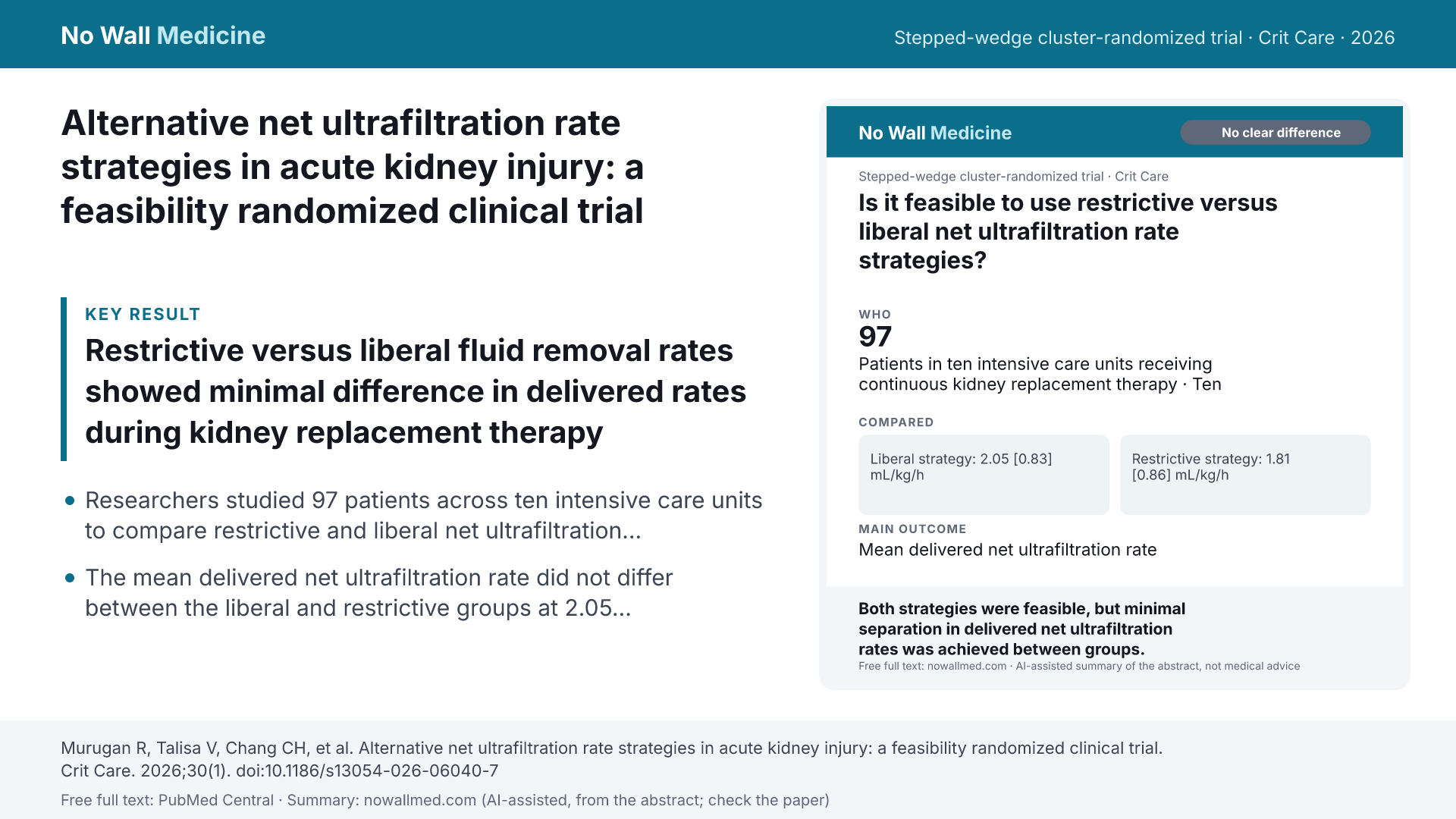
Restrictive versus liberal fluid removal rates showed minimal difference in delivered rates during kidney replacement therapy
Alternative net ultrafiltration rate strategies in acute kidney injury: a feasibility randomized clinical trial
Stepped-wedge cluster-randomized trialNo clear difference
Is it feasible to use restrictive versus liberal net ultrafiltration rate strategies?
Who
97
Patients in ten intensive care units receiving continuous kidney replacement therapy · Ten intensive care units across two healthcare systems
Compared
Liberal strategy: 2.05 [0.83] mL/kg/h
Restrictive strategy: 1.81 [0.86] mL/kg/h
Main outcome
Mean delivered net ultrafiltration rate
Result: 2.05 [0.83] vs. 1.81 [0.86] mL/kg/h; adjusted P = 0.4
Bottom line: Both strategies were feasible, but minimal separation in delivered net ultrafiltration rates was achieved between groups.
Crit Care · 2026-04-22 · Save PNG
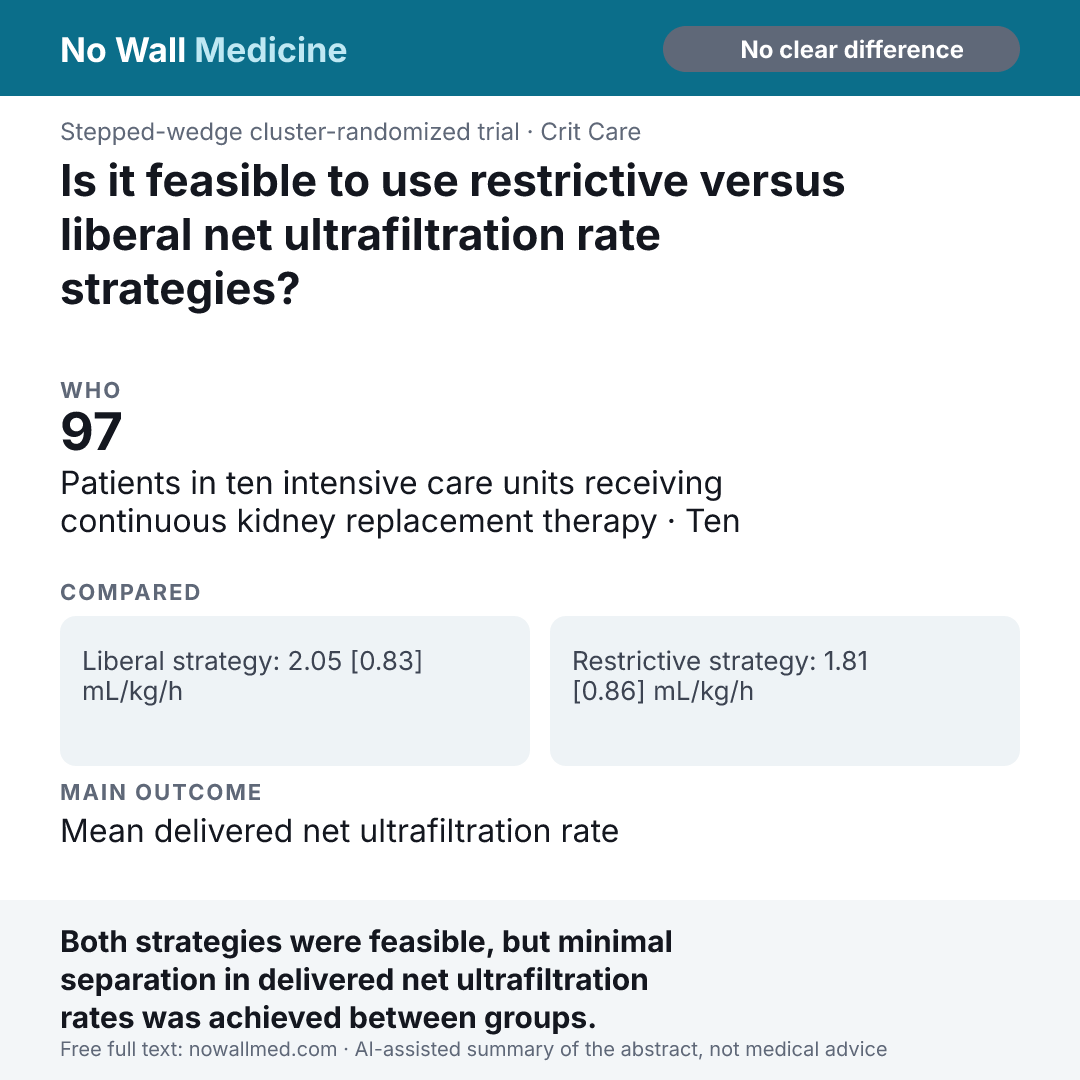
Clinical question: Is it feasible to use restrictive versus liberal net ultrafiltration rate strategies?
Why it matters: Observational studies have linked high net ultrafiltration rates during continuous kidney replacement therapy to increased mortality.
Key points
- Researchers studied 97 patients across ten intensive care units to compare restrictive and liberal net ultrafiltration rates during continuous kidney replacement therapy.
- The mean delivered net ultrafiltration rate did not differ between the liberal and restrictive groups at 2.05 [0.83] versus 1.81 [0.86] mL/kg/h.
- The restrictive group had a higher rate of rescue net ultrafiltration at 66.7% compared to 14.5% in the liberal group.
Limitation the authors note: The authors state that maintaining distinct targets is challenging because fluid removal is often driven by dynamic patient physiology rather than fixed protocols.
Headline and key points written with AI from the paper’s abstract, with every number checked against it. Read the paper before relying on them.
Was this summary helpful?
Subject terms
Headline, design, result, key points, caveat and citation as plain text.
Cite this article
Murugan R, Talisa V, Chang CH, et al. Alternative net ultrafiltration rate strategies in acute kidney injury: a feasibility randomized clinical trial. Crit Care. 2026;30(1). doi:10.1186/s13054-026-06040-7
Spotted a mistake? Suggest a correction