Alzheimer's Disease THErapy With NEuroaid (ATHENE): A Randomized Double-Blind Delayed-Start Trial
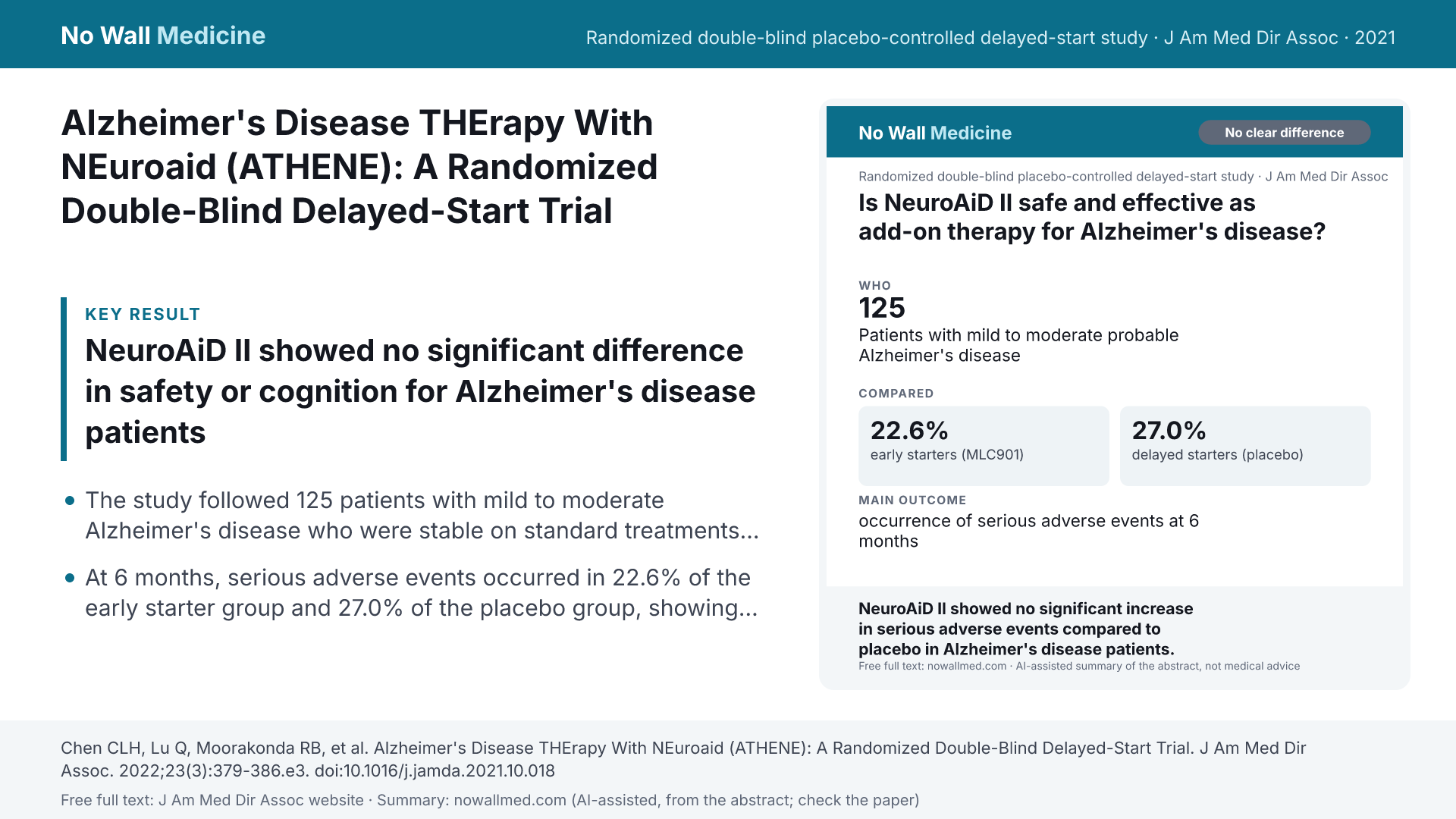
Key result: NeuroAiD II showed no significant difference in safety or cognition for Alzheimer's disease patients
Randomized double-blind placebo-controlled delayed-start studyNo clear difference
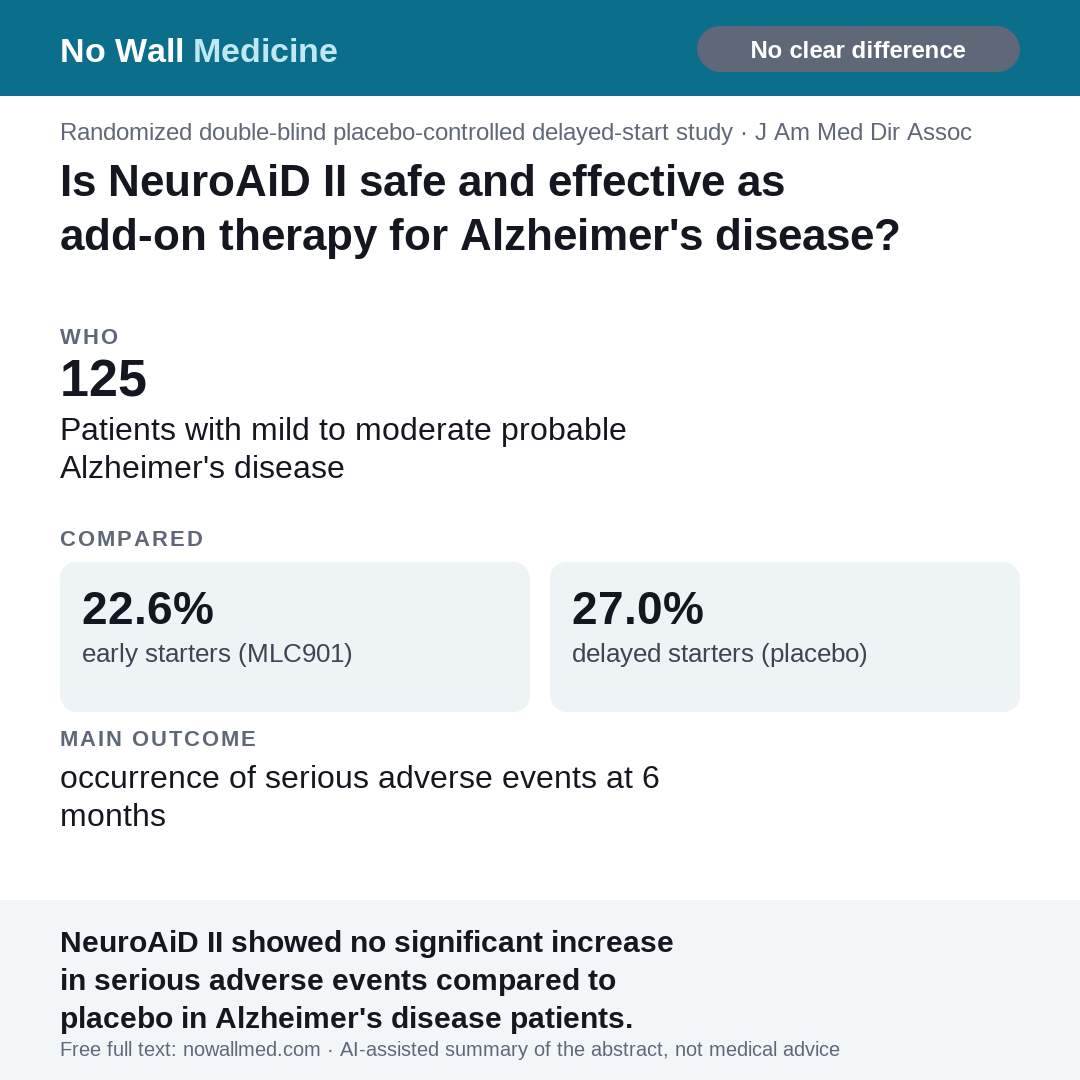
Is NeuroAiD II safe and effective as add-on therapy for Alzheimer's disease?
Who
125
Patients with mild to moderate probable Alzheimer's disease
Compared
22.6%early starters (MLC901)
27.0%delayed starters (placebo)
Main outcome
occurrence of serious adverse events at 6 months
Result: risk difference -4.4%, 90% CI -16.9% to 8.3%
Bottom line: NeuroAiD II showed no significant increase in serious adverse events compared to placebo in Alzheimer's disease patients.
J Am Med Dir Assoc · 2021-11-29Download image
Key points
- The study followed 125 patients with mild to moderate Alzheimer's disease who were stable on standard treatments like acetylcholinesterase inhibitors or memantine.
- At 6 months, serious adverse events occurred in 22.6% of the early starter group and 27.0% of the placebo group, showing no significant difference.
- Cognitive assessment scores using the Alzheimer's Disease Assessment Scale-Cognitive subscale showed no significant difference between groups at 6 months or 12 months.
Discussion prompts
- Would these patients look like yours? Who was left out?
- Is the main outcome one that matters to patients?
- Is the difference large enough to change what you do?
Cite: Chen CLH, Lu Q, Moorakonda RB, et al. Alzheimer's Disease THErapy With NEuroaid (ATHENE): A Randomized Double-Blind Delayed-Start Trial. J Am Med Dir Assoc. 2021. doi:10.1016/j.jamda.2021.10.018
Free full text: J Am Med Dir Assoc website · Summary and visual abstract: nowallmed.com/a/alzheimer-s-disease-therapy-with-neuroaid-athene-a-randomized-double-dkfhub/ (AI-assisted from the abstract; check the paper before relying on it).