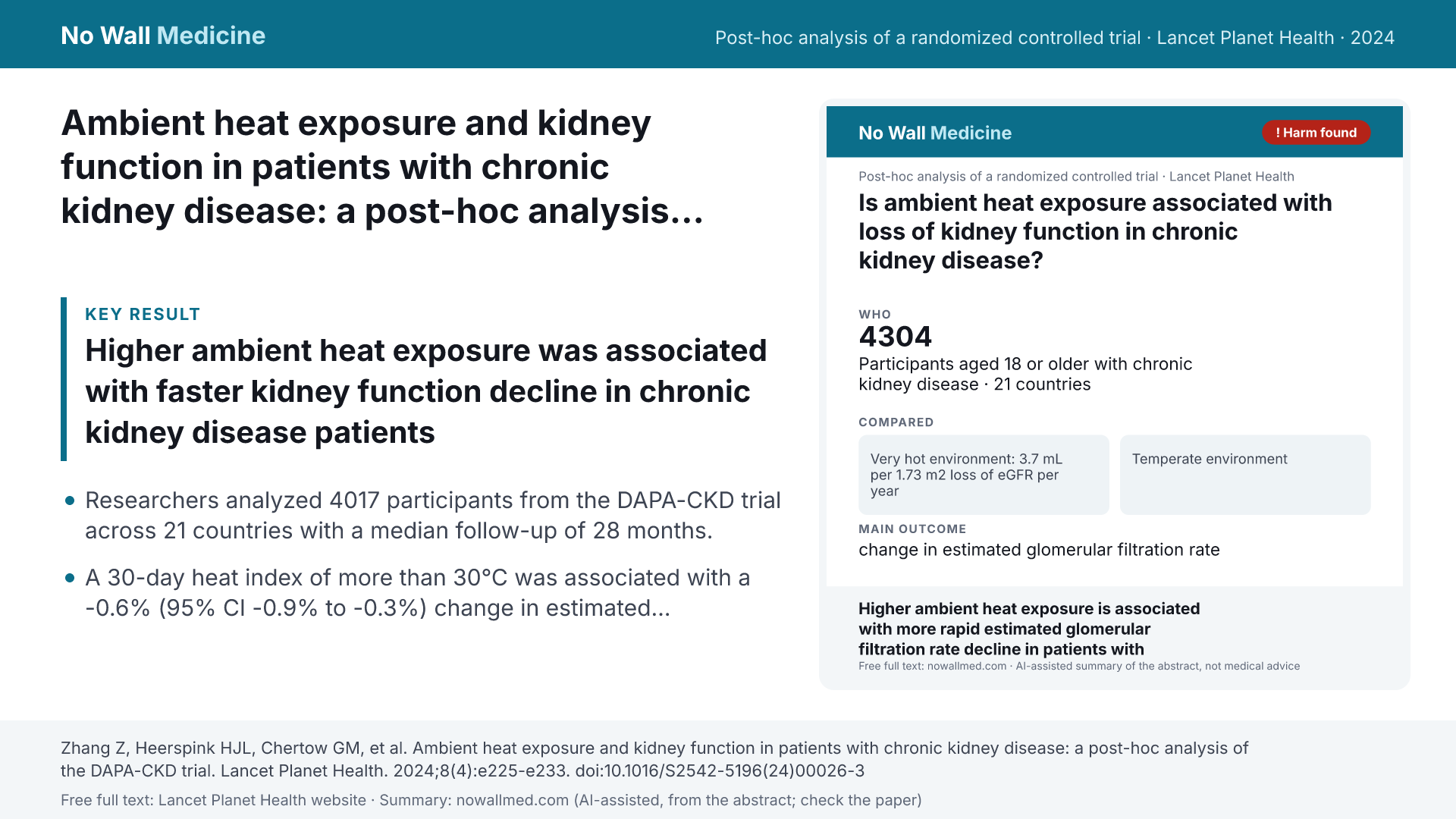
Higher ambient heat exposure was associated with faster kidney function decline in chronic kidney disease patients
Ambient heat exposure and kidney function in patients with chronic kidney disease: a post-hoc analysis of the DAPA-CKD trial
Post-hoc analysis of a randomized controlled trialHarm found
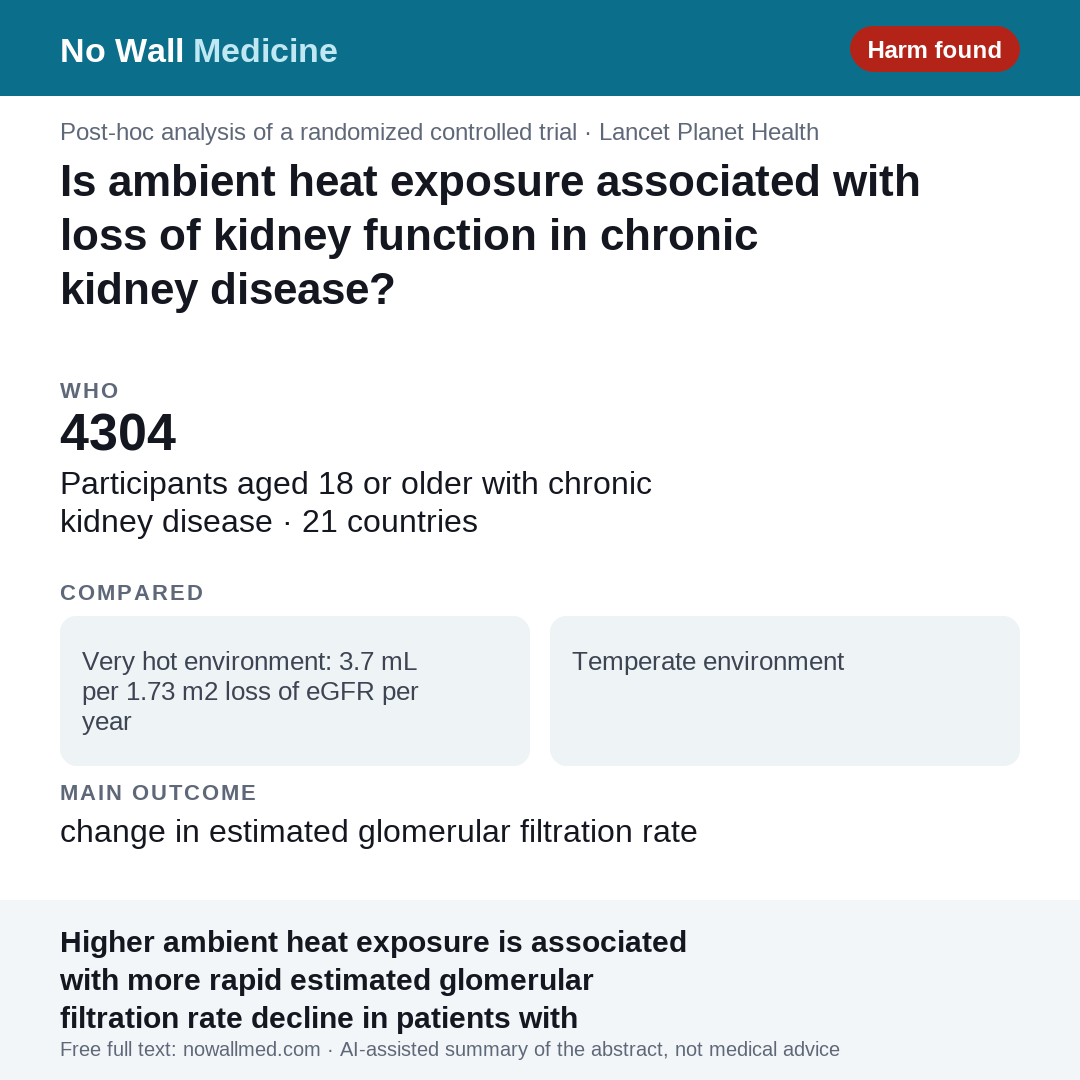
Is ambient heat exposure associated with loss of kidney function in chronic kidney disease?
Who
4304
Participants aged 18 or older with chronic kidney disease · 21 countries
Compared
Very hot environment: 3.7 mL per 1.73 m2 loss of eGFR per year
Temperate environment
Main outcome
change in estimated glomerular filtration rate
Result: 3.7 mL per 1.73 m2 (95% CI 0.1 to 7.0) loss of eGFR per year
Bottom line: Higher ambient heat exposure is associated with more rapid estimated glomerular filtration rate decline in patients with chronic kidney disease.
Lancet Planet Health · 2024-04-06Download image
Clinical question: Is ambient heat exposure associated with loss of kidney function in chronic kidney disease?
Why it matters: It was unclear whether ambient heat exposure is associated with loss of kidney function in patients with established chronic kidney disease.
Key points
- Researchers analyzed 4017 participants from the DAPA-CKD trial across 21 countries with a median follow-up of 28 months.
- A 30-day heat index of more than 30°C was associated with a -0.6% (95% CI -0.9% to -0.3%) change in estimated glomerular filtration rate, a measure of kidney function.
- Patients in very hot versus temperate environments showed an additional 3.7 mL per 1.73 m2 (95% CI 0.1 to 7.0) loss of estimated glomerular filtration rate per year.
Headline and key points written with AI from the paper’s abstract, with every number checked against it. Read the paper before relying on them.
Was this summary helpful?
Abstract
Background
Higher temperatures are associated with higher rates of hospital admissions for nephrolithiasis and acute kidney injury. Occupational heat stress is also a risk factor for kidney dysfunction in resource-poor settings. It is unclear whether ambient heat exposure is associated with loss of kidney function in patients with established chronic kidney disease. We assessed the association between heat index and change in estimated glomerular filtration rate (eGFR) in participants from the DAPA-CKD trial in a post-hoc analysis. Methods
DAPA-CKD was a randomised controlled trial of oral dapagliflozin 10 mg once daily or placebo that enrolled participants aged 18 years or older, with or without type 2 diabetes, with a urinary albumin-to-creatinine ratio of 200-5000 mg/g, and an eGFR of 25-75 mL/min per 1·73 m2. In this post-hoc analysis, we explored the association between time-varying daily centre-level heat index (ERA5 dataset) and individual-level change in eGFR in trial participants using linear mixed effect models and case-time series. The DAPA-CKD trial is registered with ClinicalTrials.gov, NCT03036150. Findings
Climate and eGFR data were available for 4017 (93·3%) of 4304 participants in 21 countries (mean age: 61·9 years; mean eGFR: 43·3 mL per 1·73 m2; median 28 months follow-up). Across centres, a heat index of more than 30°C occurred on a median of 0·6% of days. In adjusted linear mixed effect models, within each 120-day window, each 30 days' heat index of more than 30°C was associated with a -0·6% (95% CI -0·9% to -0·3%) change in eGFR. Similar estimates were obtained using case-time series. Additional analyses over longer time-windows showed associations consistent with haemodynamic or seasonal variability, or both, but overall estimates corresponded to an additional 3·7 mL per 1·73 m2 (95% CI 0·1 to 7·0) loss of eGFR per year in a patient with an eGFR of 45 mL per 1·73 m2 located in a very hot versus a temperate environment. Interpretation
Higher ambient heat exposure is associated with more rapid eGFR decline in those with established chronic kidney disease. Efforts to mitigate heat exposure should be tested as part of strategies to attenuate chronic kidney disease progression. Funding
None.
Abstract reproduced under the article’s CC BY licence.
Subject terms
Cite this article
Zhang Z, Heerspink HJL, Chertow GM, Correa-Rotter R, Gasparrini A, Jongs N. Ambient heat exposure and kidney function in patients with chronic kidney disease: a post-hoc analysis of the DAPA-CKD trial. Lancet Planet Health. 2024. doi:10.1016/S2542-5196(24)00026-3
Spotted a mistake? Suggest a correction