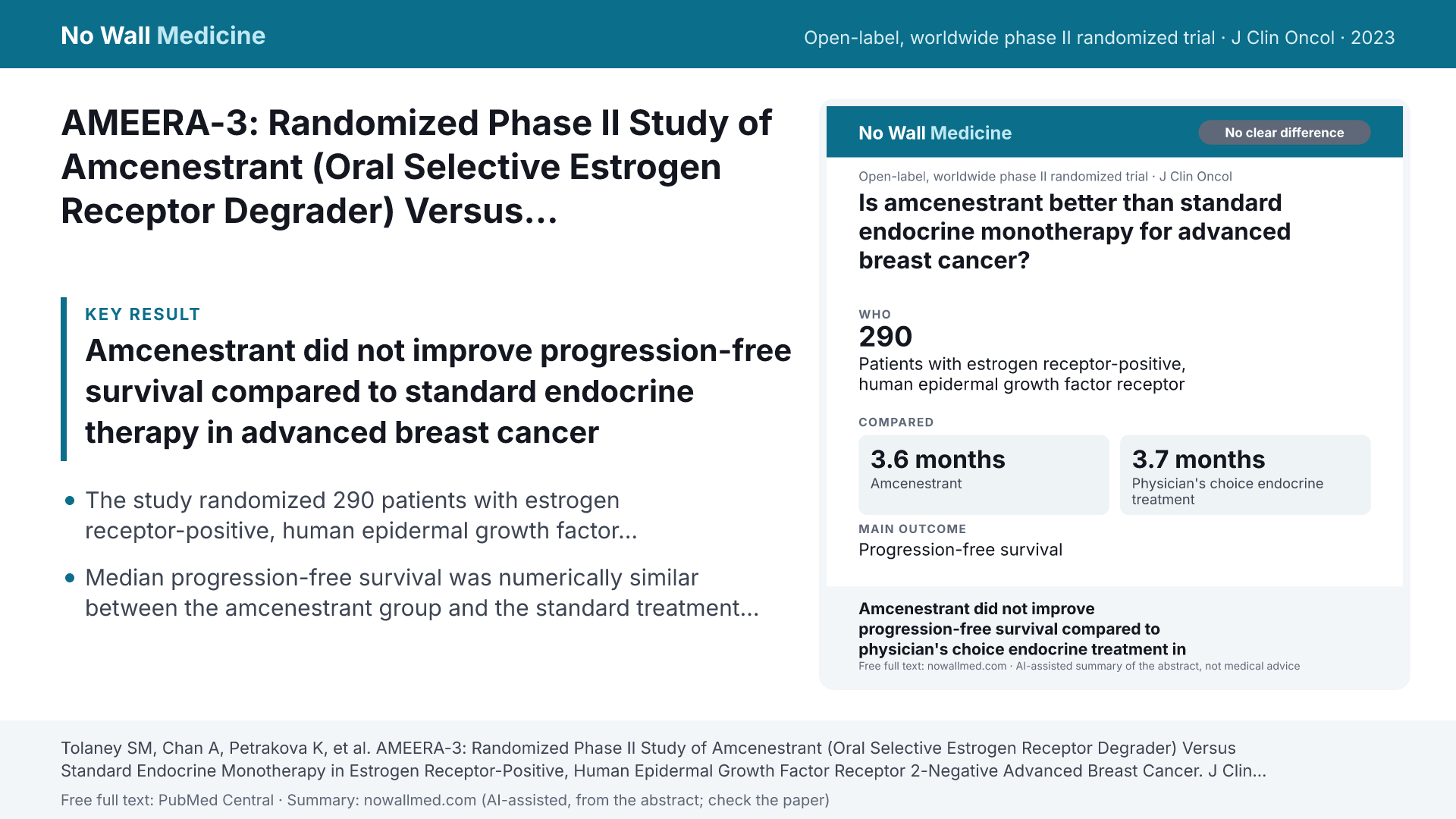
Amcenestrant did not improve progression-free survival compared to standard endocrine therapy in advanced breast cancer
AMEERA-3: Randomized Phase II Study of Amcenestrant (Oral Selective Estrogen Receptor Degrader) Versus Standard Endocrine Monotherapy in Estrogen Receptor-Positive, Human Epidermal Growth Factor Receptor 2-Negative Advanced Breast Cancer
Open-label, worldwide phase II randomized trialNo clear difference
Is amcenestrant better than standard endocrine monotherapy for advanced breast cancer?
Who
290
Patients with estrogen receptor-positive, human epidermal growth factor receptor 2-negative advanced breast cancer · Worldwide
Compared
3.6 monthsAmcenestrant
3.7 monthsPhysician's choice endocrine treatment
Main outcome
Progression-free survival
Result: hazard ratio 1.051 (95% CI 0.789 to 1.4)
Bottom line: Amcenestrant did not improve progression-free survival compared to physician's choice endocrine treatment in advanced breast cancer.
J Clin Oncol · 2023-06-22Download image

Clinical question: Is amcenestrant better than standard endocrine monotherapy for advanced breast cancer?
Why it matters: It was unknown if amcenestrant, an oral selective estrogen receptor degrader, provides better progression-free survival than standard endocrine monotherapy for patients with endocrine-resistant advanced breast cancer.
Key points
- The study randomized 290 patients with estrogen receptor-positive, human epidermal growth factor receptor 2-negative advanced breast cancer to receive either amcenestrant or physician's choice endocrine therapy.
- Median progression-free survival was numerically similar between the amcenestrant group and the standard treatment group at 3.6 months versus 3.7 months.
- Grade 3 or higher adverse events occurred in 21.7% of patients receiving amcenestrant compared to 15.6% in the standard treatment group.
Headline and key points written with AI from the paper’s abstract, with every number checked against it. Read the paper before relying on them.
Was this summary helpful?
Subject terms
Cite this article
Tolaney SM, Chan A, Petrakova K, Delaloge S, Campone M, Iwata H. AMEERA-3: Randomized Phase II Study of Amcenestrant (Oral Selective Estrogen Receptor Degrader) Versus Standard Endocrine Monotherapy in Estrogen Receptor-Positive, Human Epidermal Growth Factor Receptor 2-Negative Advanced Breast Cancer. J Clin Oncol. 2023. doi:10.1200/JCO.22.02746
Spotted a mistake? Suggest a correction