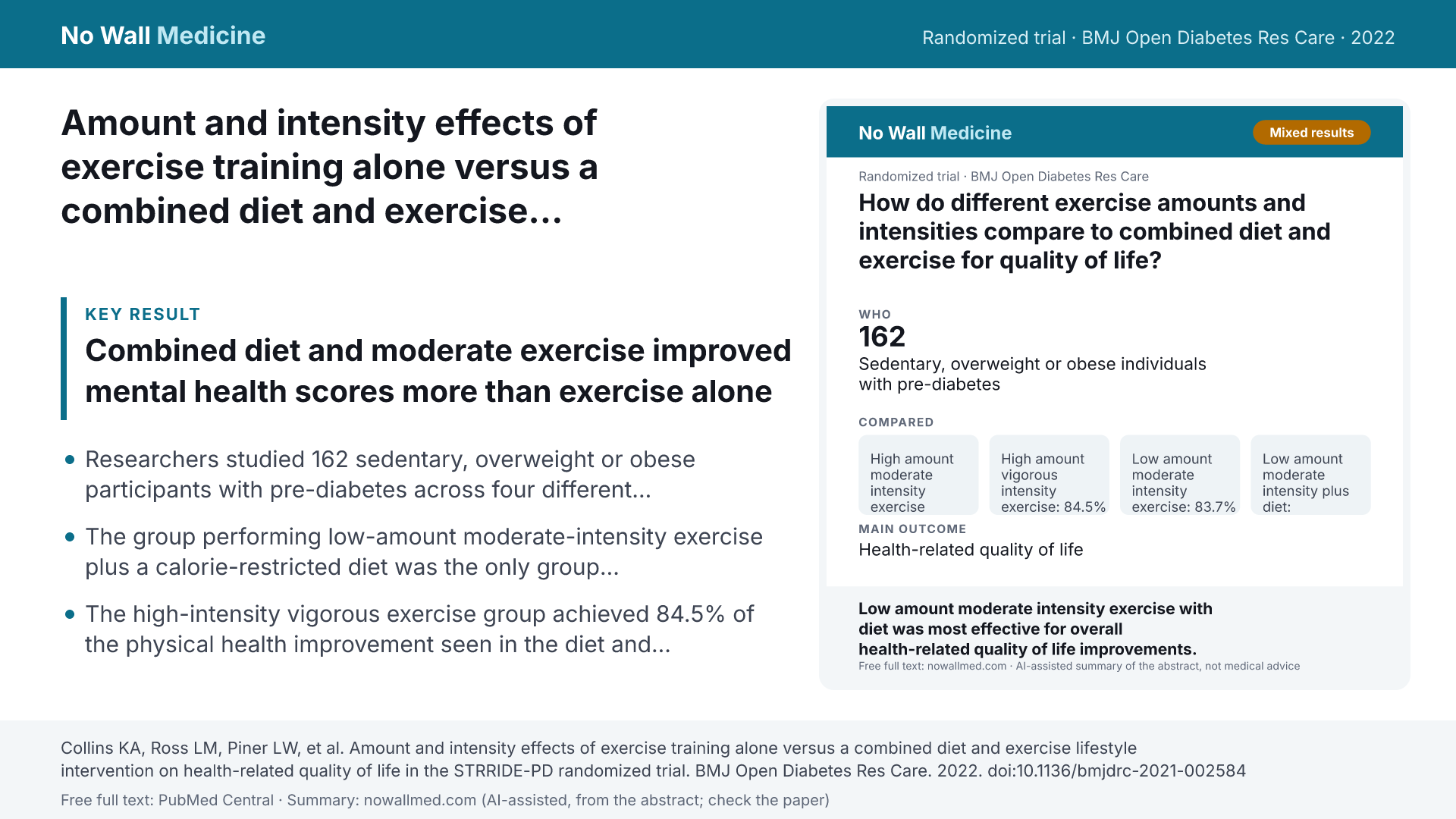
Combined diet and moderate exercise improved mental health scores more than exercise alone
Amount and intensity effects of exercise training alone versus a combined diet and exercise lifestyle intervention on health-related quality of life in the STRRIDE-PD randomized trial
Randomized trialMixed results
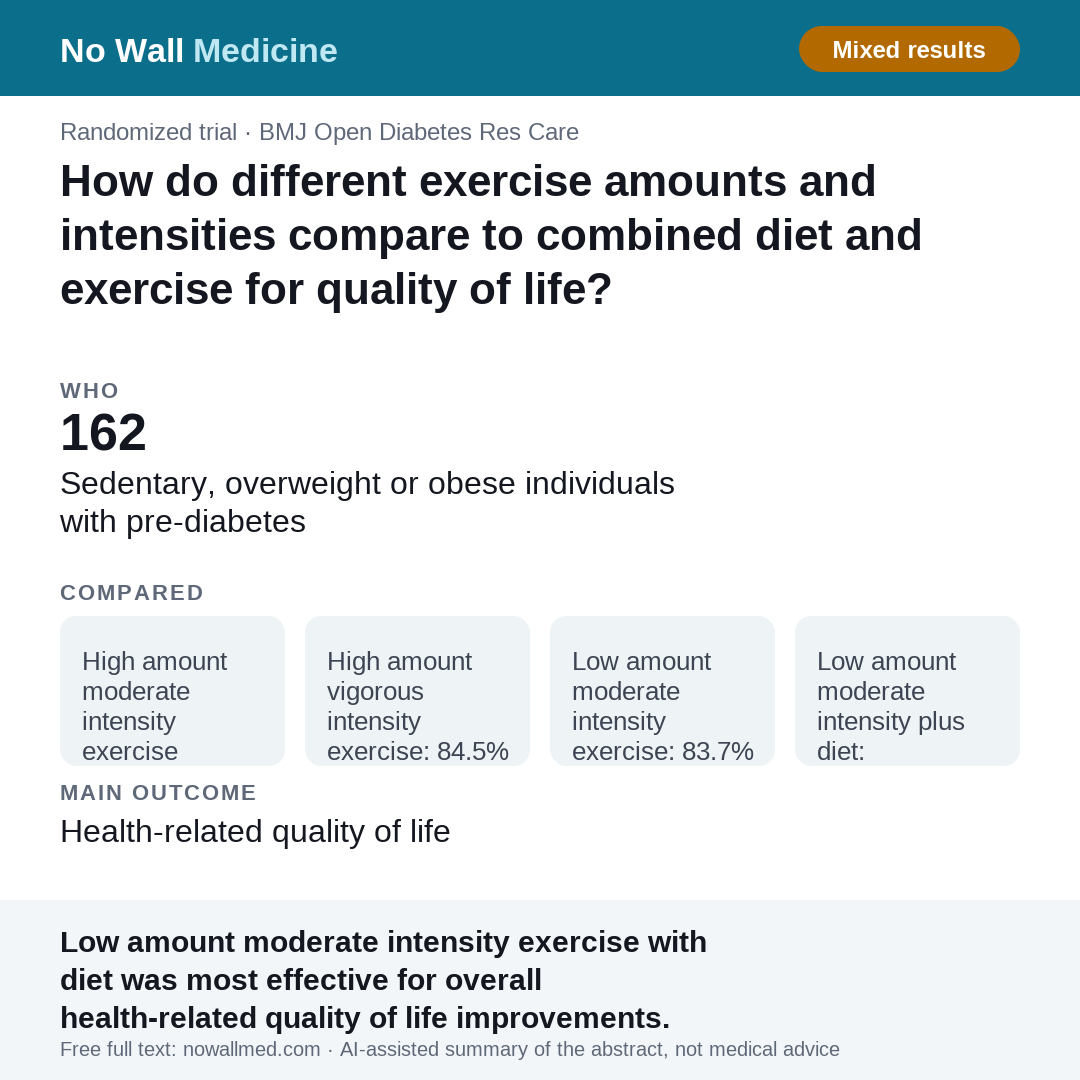
How do different exercise amounts and intensities compare to combined diet and exercise for quality of life?
Who
162
Sedentary, overweight or obese individuals with pre-diabetes
Compared
High amount moderate intensity exercise
High amount vigorous intensity exercise: 84.5% of the low/moderate/diet group effect for physical component
Low amount moderate intensity exercise: 83.7% of the low/moderate/diet group effect for mental component
Low amount moderate intensity plus diet: Significantly improved the mental component score
Main outcome
Health-related quality of life
Bottom line: Low amount moderate intensity exercise with diet was most effective for overall health-related quality of life improvements.
BMJ Open Diabetes Res Care · 2022-01-28Download image
Clinical question: How do different exercise amounts and intensities compare to combined diet and exercise for quality of life?
Key points
- Researchers studied 162 sedentary, overweight or obese participants with pre-diabetes across four different 6-month exercise and diet programs.
- The group performing low-amount moderate-intensity exercise plus a calorie-restricted diet was the only group to significantly improve mental health component scores.
- The high-intensity vigorous exercise group achieved 84.5% of the physical health improvement seen in the diet and moderate exercise group.
Headline and key points written with AI from the paper’s abstract, with every number checked against it. Read the paper before relying on them.
Was this summary helpful?
Abstract
Introduction
To determine the relative contributions of various amounts and intensities of exercise alone to a combined lifestyle intervention on health-related quality of life (HrQoL) measures. Research design and methods
Participants (n=162) were sedentary, overweight/obese, with pre-diabetes, and randomized to one of four 6-month interventions: (1) high amount/moderate intensity exercise-energy expenditure of 16 kcal/kg of body weight/week (KKW) at 50% oxygen consumption (V̇O2) reserve; (2) high/vigorous-16 KKW at 75% V̇O2 reserve; (3) low/moderate-10 KKW at 50% V̇O2 reserve; (4) low/moderate plus diet-10 KKW at 50% V̇O2 reserve plus a calorically restricted diet. The 36-Item Short-Form Survey (SF-36) and Satisfaction with Physical Function and Appearance (SPF/SPA) survey were assessed at baseline and post-intervention. Analyses of covariance determined differences in change scores among groups (p<0.05). Paired t-tests determined significant pre-intervention versus post-intervention scores within groups (p<0.05). Results
Across the intervention, all groups (p<0.05) improved the physical component, SPF, and SPA scores. Only the low/moderate/diet group (p<0.001) significantly improved the mental component score. The high/vigorous group achieved 84.5% of the low/moderate/diet group effect for change in physical component score, and the low/moderate group achieved 83.7% of the low/moderate/diet group effect for change in mental component score. Conclusions
In general, a low amount of moderate intensity exercise combined with diet was the most effective intervention for improving HrQoL. Of the exercise-only interventions, vigorous intensity exercise provided the greatest impact on changes in physical function. On the other hand, low amounts of moderate intensity exercise provided the greatest impact on mental well-being, potentially being a more attainable exercise dose for previously sedentary individuals with pre-diabetes to achieve.
Abstract reproduced under the article’s CC BY NC licence.
Subject terms
Cite this article
Collins KA, Ross LM, Piner LW, et al. Amount and intensity effects of exercise training alone versus a combined diet and exercise lifestyle intervention on health-related quality of life in the STRRIDE-PD randomized trial. BMJ Open Diabetes Res Care. 2022. doi:10.1136/bmjdrc-2021-002584
Spotted a mistake? Suggest a correction