Increased amygdala reactivity was associated with depression relapse after stopping antidepressant medication
Amygdala Reactivity, Antidepressant Discontinuation, and Relapse
Longitudinal, observational studyBenefit found
Does amygdala reactivity change with antidepressant discontinuation and relate to depression relapse?
Who
83
Adult patients with remitted major depressive disorder · University settings in Switzerland and Germany
Compared
Discontinued antidepressants
Waited to discontinue
Main outcome
Amygdala reactivity and major depressive disorder relapse
Result: hazard ratio 1.05 (95% CI 1.01-1.09)
Bottom line: Increased amygdala reactivity after stopping antidepressants is associated with a higher risk of depression relapse.
JAMA Psychiatry · 2024-09-11Download image
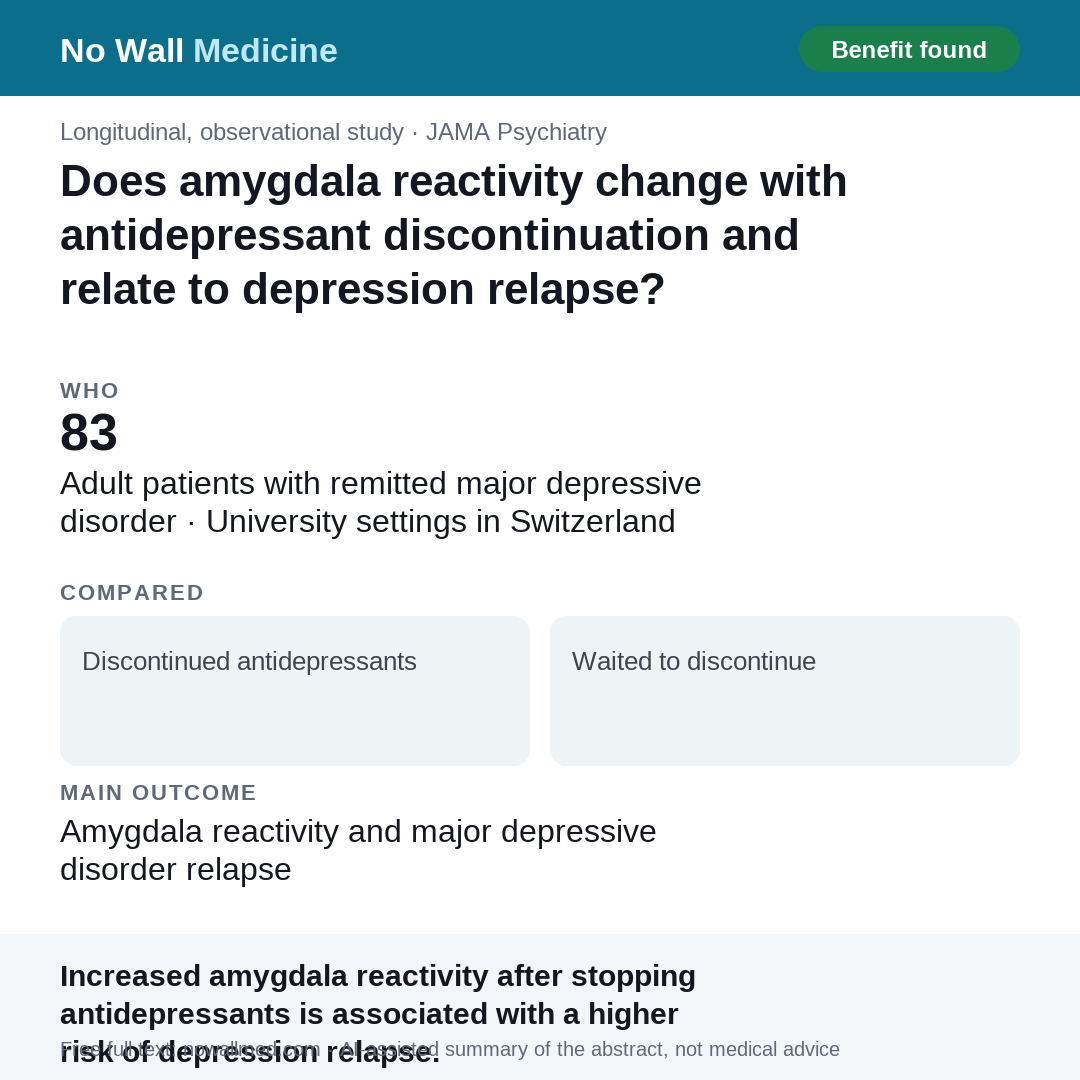
Clinical question: Does amygdala reactivity change with antidepressant discontinuation and relate to depression relapse?
Why it matters: It is unknown if amygdala reactivity to negative information changes when antidepressants are stopped or if these changes relate to the risk of depression relapse.
Key points
- The study followed 83 adult patients with remitted major depressive disorder and 53 healthy controls using functional magnetic resonance imaging to measure brain activity.
- An increase in amygdala reactivity, a brain region involved in processing emotions, after stopping antidepressants was associated with depression relapse.
- Changes in amygdala reactivity were associated with shorter times to relapse and had a predictive accuracy of 67%.
Headline and key points written with AI from the paper’s abstract, with every number checked against it. Read the paper before relying on them.
Was this summary helpful?
Subject terms
Cite this article
Erdmann T, Berwian IM, Stephan KE, Seifritz E, Walter H, Huys QJM. Amygdala Reactivity, Antidepressant Discontinuation, and Relapse. JAMA Psychiatry. 2024. doi:10.1001/jamapsychiatry.2024.2136
Spotted a mistake? Suggest a correction
Top studies every Monday
The week’s key trials and guidelines in your specialties, plus any topics you follow. By email, free.
Get the weekly digest