Donanemab was associated with higher rates of brain imaging abnormalities in Alzheimer disease trials
Amyloid-Related Imaging Abnormalities With Donanemab in Early Symptomatic Alzheimer Disease: Secondary Analysis of the TRAILBLAZER-ALZ and ALZ 2 Randomized Clinical Trials
Randomized clinical trials and open-label addendumHarm found
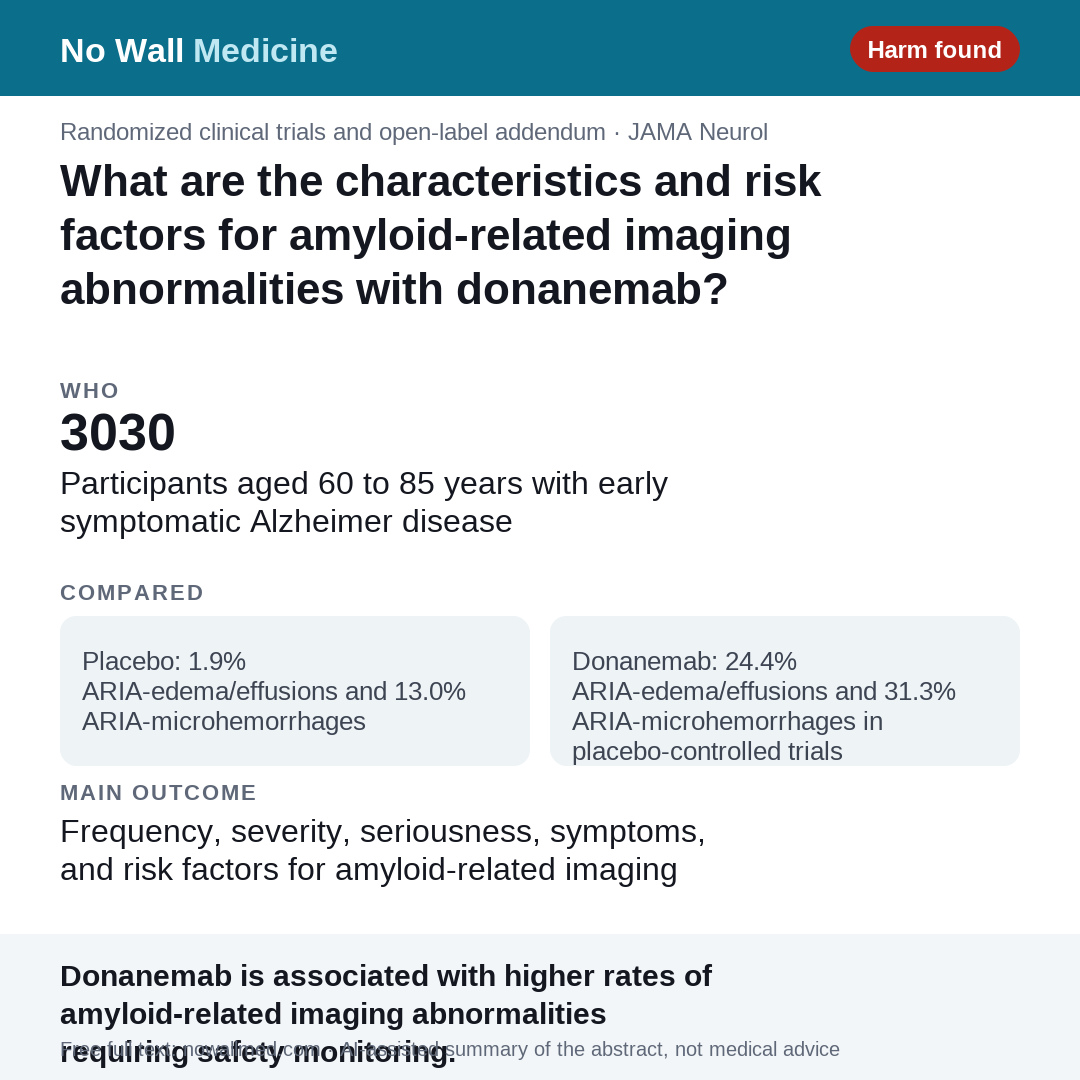
What are the characteristics and risk factors for amyloid-related imaging abnormalities with donanemab?
Who
3030
Participants aged 60 to 85 years with early symptomatic Alzheimer disease
Compared
Placebo: 1.9% ARIA-edema/effusions and 13.0% ARIA-microhemorrhages
Donanemab: 24.4% ARIA-edema/effusions and 31.3% ARIA-microhemorrhages in placebo-controlled trials
Main outcome
Frequency, severity, seriousness, symptoms, and risk factors for amyloid-related imaging abnormalities
Bottom line: Donanemab is associated with higher rates of amyloid-related imaging abnormalities requiring safety monitoring.
JAMA Neurol · 2025-03-10Download image
Clinical question: What are the characteristics and risk factors for amyloid-related imaging abnormalities with donanemab?
Why it matters: The clinical features and individual risk factors for amyloid-related imaging abnormalities, which are side effects of amyloid-targeting immunotherapy, were not fully characterized.
In absolute numbers
Placebo: 1.9% · Donanemab: 24.4% → a difference of 22.5 percentage points, so about 5 people would receive it for 1 more to be harmed (number needed to harm) over the trial’s follow-up.
Worked out by us from the two group results above, not reported by the authors. Check the paper for the exact outcome and timing.
Key points
- Researchers analyzed 3030 participants with early symptomatic Alzheimer disease across randomized trials and an open-label study.
- In placebo-controlled trials, ARIA-edema/effusions occurred in 24.4% of donanemab participants compared to 1.9% in the placebo group.
- ARIA-microhemorrhages and hemosiderin deposition occurred in 31.3% of donanemab participants compared to 13.0% in the placebo group.
Headline and key points written with AI from the paper’s abstract, with every number checked against it. Read the paper before relying on them.
Topics
Cite this article
Zimmer JA, Ardayfio P, Wang H, Khanna R, Evans CD, Lu M. Amyloid-Related Imaging Abnormalities With Donanemab in Early Symptomatic Alzheimer Disease: Secondary Analysis of the TRAILBLAZER-ALZ and ALZ 2 Randomized Clinical Trials. JAMA Neurol. 2025. doi:10.1001/jamaneurol.2025.0065
Spotted a mistake? Suggest a correction
Top studies every Monday
The week’s key trials and guidelines in your specialties, plus any topics you follow. By email, free.
Get the weekly digest