Training focused on minimizing pauses during defibrillator use increased chest compression time in students
An effort to reduce chest compression pauses during automated external defibrillator use among laypeople: A randomized partially blinded controlled trial
Randomized partially blinded controlled trialBenefit found
Can specific training changes reduce chest compression pauses during automated external defibrillator use?
Who
78
University students with no basic life support knowledge
Compared
Control group: median 52.0, interquartile rank 43.0-58.0
Traditional group: median 44.0, interquartile rank 42.0-47.0
Focused no-flow group: median 56.0, interquartile rank 53.5-58.5
Main outcome
Compression fraction
Bottom line: Training focused on anticipating automated external defibrillator prompts increased chest compression fractions among laypeople.
Resusc Plus · 2023-05-08Download image
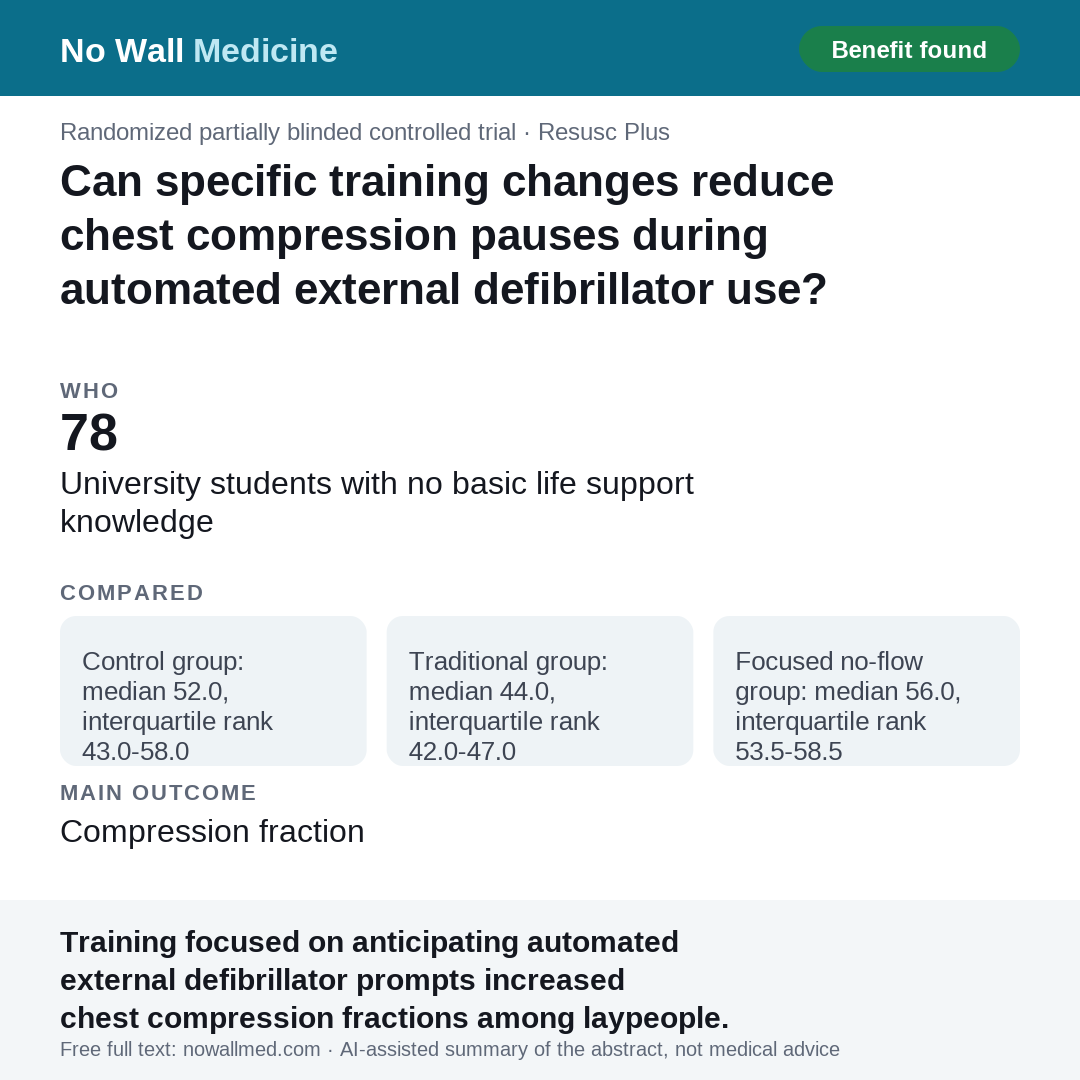
Clinical question: Can specific training changes reduce chest compression pauses during automated external defibrillator use?
Why it matters: It is unknown if specific methodological changes in basic life support training can reduce unnecessary pauses when using an automated external defibrillator.
Key points
- Researchers studied 78 university students divided into a control group, a traditional training group, and a group with training focused on reducing no-flow time.
- The focused no-flow group achieved a median compression fraction of 56.0, compared to 44.0 in the traditional group and 52.0 in the control group.
- The focused no-flow group also reached a higher CPR fraction of 77.6, while the traditional group reached 61.9 and the control group reached 52.0.
Headline and key points written with AI from the paper’s abstract, with every number checked against it. Read the paper before relying on them.
Was this summary helpful?
Cite this article
Abelairas-Gómez C, Carballo-Fazanes A, Martínez-Isasi S, López-García S, Rodríguez-Núñez A. An effort to reduce chest compression pauses during automated external defibrillator use among laypeople: A randomized partially blinded controlled trial. Resusc Plus. 2023. doi:10.1016/j.resplu.2023.100393
Spotted a mistake? Suggest a correction
Top studies every Monday
The week’s key trials and guidelines in your specialties, plus any topics you follow. By email, free.
Get the weekly digest