Choice architecture intervention did not increase tuberculosis preventive treatment prescribing in three southern African countries
An evaluation of a choice architecture-based intervention on prescribing of TB preventive treatment to people living with HIV in southern Africa (the CAT study): a cluster-randomised trial
Cluster-randomised trialNo clear difference
Does choice architecture increase tuberculosis preventive treatment prescribing for people living with HIV?
Who
Clients initiating antiretroviral therapy in Malawi, Mozambique and Zimbabwe · 57 healthcare facilities in Malawi, Mozambique and Zimbabwe
Compared
Choice architecture: 86.9% in Mozambique, 55.5% in Malawi, 55.9% in Zimbabwe
Standard prescribing: 70.9% in Mozambique, 56.5% in Malawi, 56.2% in Zimbabwe
Main outcome
Facility-level percentage of clients initiating antiretroviral therapy who initiated tuberculosis preventive treatment
Bottom line: The choice architecture intervention did not significantly increase tuberculosis preventive treatment prescribing across the studied countries.
BMJ Glob Health · 2025-05-24Download image
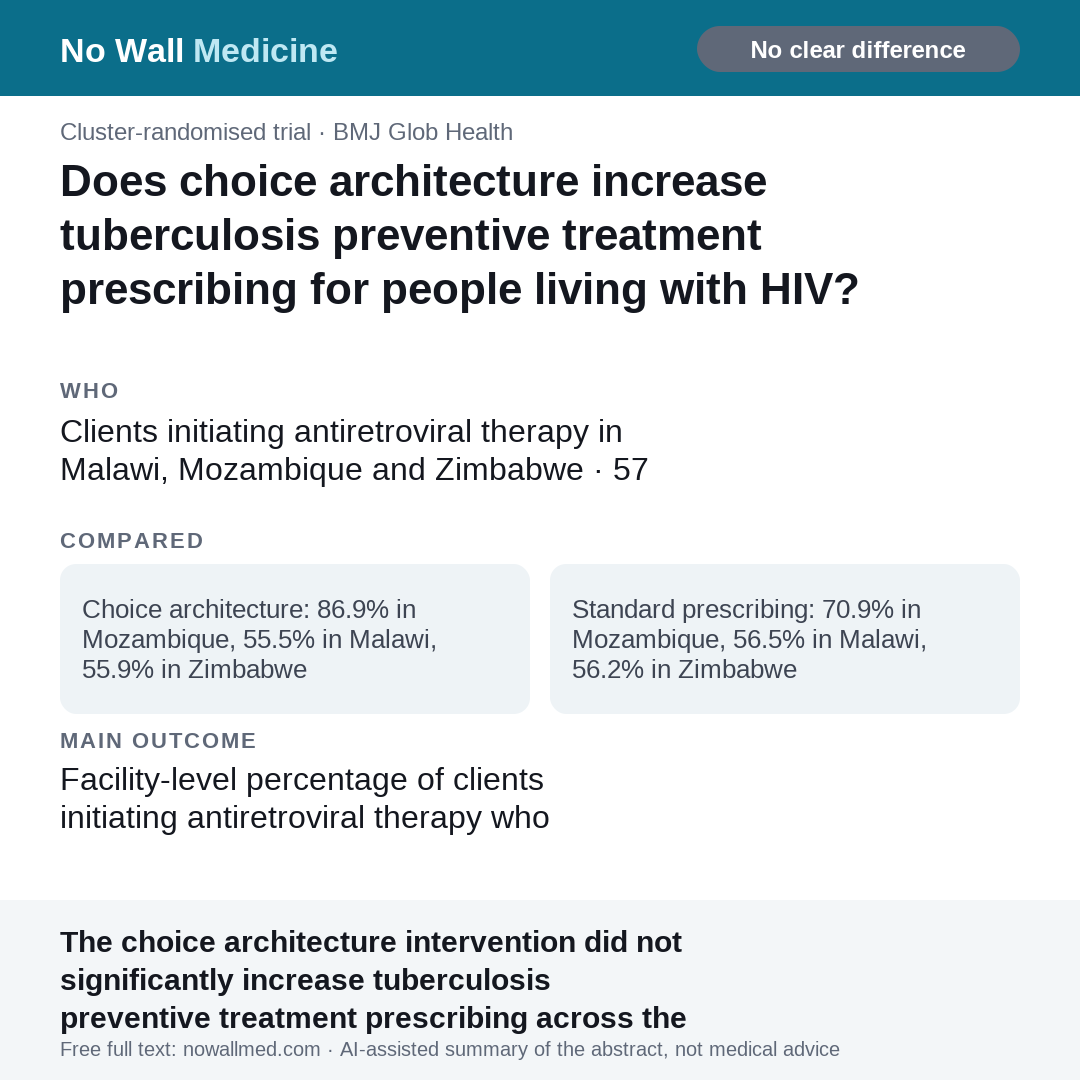
Clinical question: Does choice architecture increase tuberculosis preventive treatment prescribing for people living with HIV?
Why it matters: Tuberculosis preventive treatment is underused among people living with HIV, and researchers wanted to see if making it the default option through choice architecture would increase prescribing rates.
Key points
- Researchers conducted a cluster-randomized trial involving 57 healthcare facilities in Malawi, Mozambique, and Zimbabwe to test a behavioral economics approach to prescribing tuberculosis preventive treatment.
- The intervention did not show a statistically significant difference in prescribing rates compared to standard care in Mozambique (86.9% vs 70.9%), Malawi (55.5% vs 56.5%), or Zimbabwe (55.9% vs 56.2%).
- The study measured the facility-level percentage of clients initiating antiretroviral therapy who also started tuberculosis preventive treatment.
Headline and key points written with AI from the paper’s abstract, with every number checked against it. Read the paper before relying on them.
Abstract
Introduction
While highly effective for reducing the risk of tuberculosis (TB) disease, TB preventive treatment (TPT) is underused among people living with HIV (PWH). We evaluated the effectiveness of a behavioural economics-based choice architecture approach to increase facility-level TPT prescribing to PWH in Malawi, Mozambique and Zimbabwe. Methods
We conducted a cluster-randomised trial within the IMPAACT4TB 3HP rollout, in which 57 healthcare facilities were randomly assigned 1:1 to choice architecture (intervention) or standard TPT prescribing (control). The aim was to link TPT to antiretroviral therapy (ART) prescribing and to make TPT prescribing the default. The intervention was supported by clinician training and a default prescribing module built into the point-of-care HIV electronic medical record in Malawi and stickers placed in clients' clinical stationery in Mozambique and Zimbabwe. Data were collected in aggregate, and the primary outcome was the facility-level percentage of clients initiating ART who initiated TPT. The CAT study was registered with clinicaltrials.gov where it is listed as completed. Results
Implementation occurred from October 2021 to September 2022 in Mozambique (20 facilities), April 2021 to March 2022 in Malawi (19 facilities) and June 2021 to May 2022 in Zimbabwe (18 facilities), for a total of 29 control arm and 28 choice architecture intervention arm facilities, respectively. Comparing control to intervention facilities, mean TPT prescribing to clients initiating ART was 70.9% vs 86.9% in Mozambique (difference: -16.0%; 95% CI: -38.3%, 6.3%; p=0.15), 56.5% vs 55.5% in Malawi (difference: 1.0%; 95% CI: -14.0%, 16.9%; p=0.89) and 56.2% vs 55.9% in Zimbabwe (difference: 0.2%; 95% CI: -25.2%, 25.8%; p=0.98). Conclusion
The choice architecture intervention did not overcome barriers to TPT prescribing. While the intervention may have led to an improvement in TPT prescribing in Mozambique, no differences were observed in the other countries. Further innovation is needed to ensure that all clients initiating ART are either prescribed TPT or started on anti-TB treatment, as appropriate. Trial registration number
NCT04466293.
Abstract reproduced under the article’s CC BY NC licence.
Topics
Cite this article
Shearer K, Nonyane BAS, Mulder C, Kaonga E, Nyirenda R, Mbendera K. An evaluation of a choice architecture-based intervention on prescribing of TB preventive treatment to people living with HIV in southern Africa (the CAT study): a cluster-randomised trial. BMJ Glob Health. 2025. doi:10.1136/bmjgh-2024-016921
Spotted a mistake? Suggest a correction
Top studies every Monday
The week’s key trials and guidelines in your specialties, plus any topics you follow. By email, free.
Get the weekly digest