Social prescribing link workers showed no significant impact on quality of life or mental health
An exploratory randomised trial investigating feasibility, potential impact and cost effectiveness of link workers for people living with multimorbidity attending general practices in deprived urban communities
Pragmatic exploratory randomized trialNo clear difference
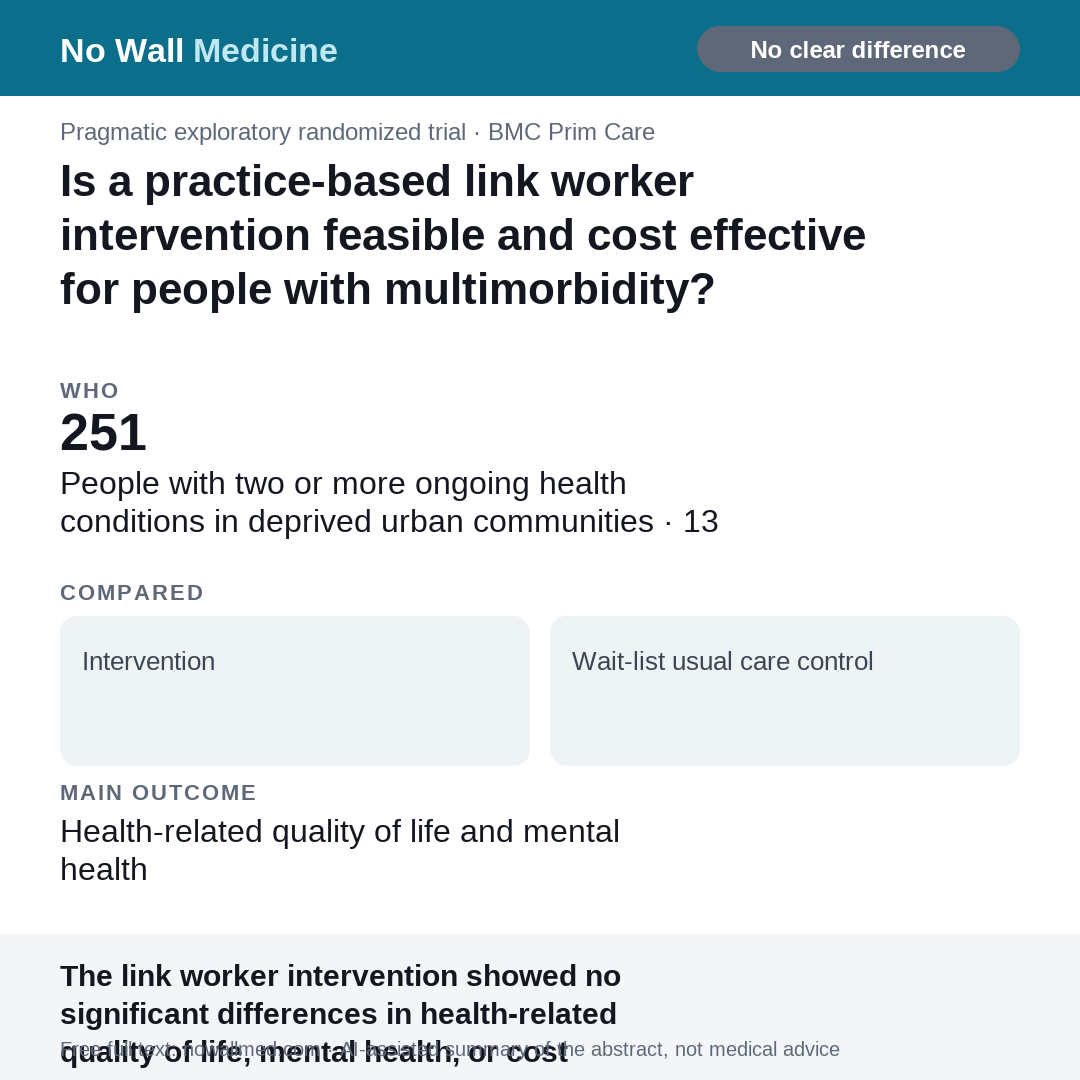
Is a practice-based link worker intervention feasible and cost effective for people with multimorbidity?
Who
251
People with two or more ongoing health conditions in deprived urban communities · 13 general practices
Compared
Intervention
Wait-list usual care control
Main outcome
Health-related quality of life and mental health
Result: MD 0.01, 95% CI -0.07 to 0.09
Bottom line: The link worker intervention showed no significant differences in health-related quality of life, mental health, or cost effectiveness.
Limitation: The trial under-recruited participants mainly due to COVID-19 restrictions.
BMC Prim Care · 2024-06-28Download image
Clinical question: Is a practice-based link worker intervention feasible and cost effective for people with multimorbidity?
Why it matters: It is unknown if social prescribing link workers, who connect people to community supports, are feasible, effective, or cost-efficient for people with multiple ongoing health conditions.
Key points
- Researchers conducted a randomized trial with 251 patients having two or more health conditions across 13 general practices in deprived urban areas.
- The intervention group of 123 patients and control group of 117 patients showed no significant differences in health-related quality of life or mental health scores.
- The study found no cost effectiveness advantages for the link worker intervention from a health service perspective.
Limitation the authors note: The trial under-recruited participants mainly due to COVID-19 restrictions.
Headline and key points written with AI from the paper’s abstract, with every number checked against it. Read the paper before relying on them.
Was this summary helpful?
Subject terms
Cite this article
Kiely B, Hobbins A, Boland F, Clyne B, Galvin E, Byers V. An exploratory randomised trial investigating feasibility, potential impact and cost effectiveness of link workers for people living with multimorbidity attending general practices in deprived urban communities. BMC Prim Care. 2024. doi:10.1186/s12875-024-02482-6
Spotted a mistake? Suggest a correction
Top studies every Monday
The week’s key trials and guidelines in your specialties, plus any topics you follow. By email, free.
Get the weekly digest