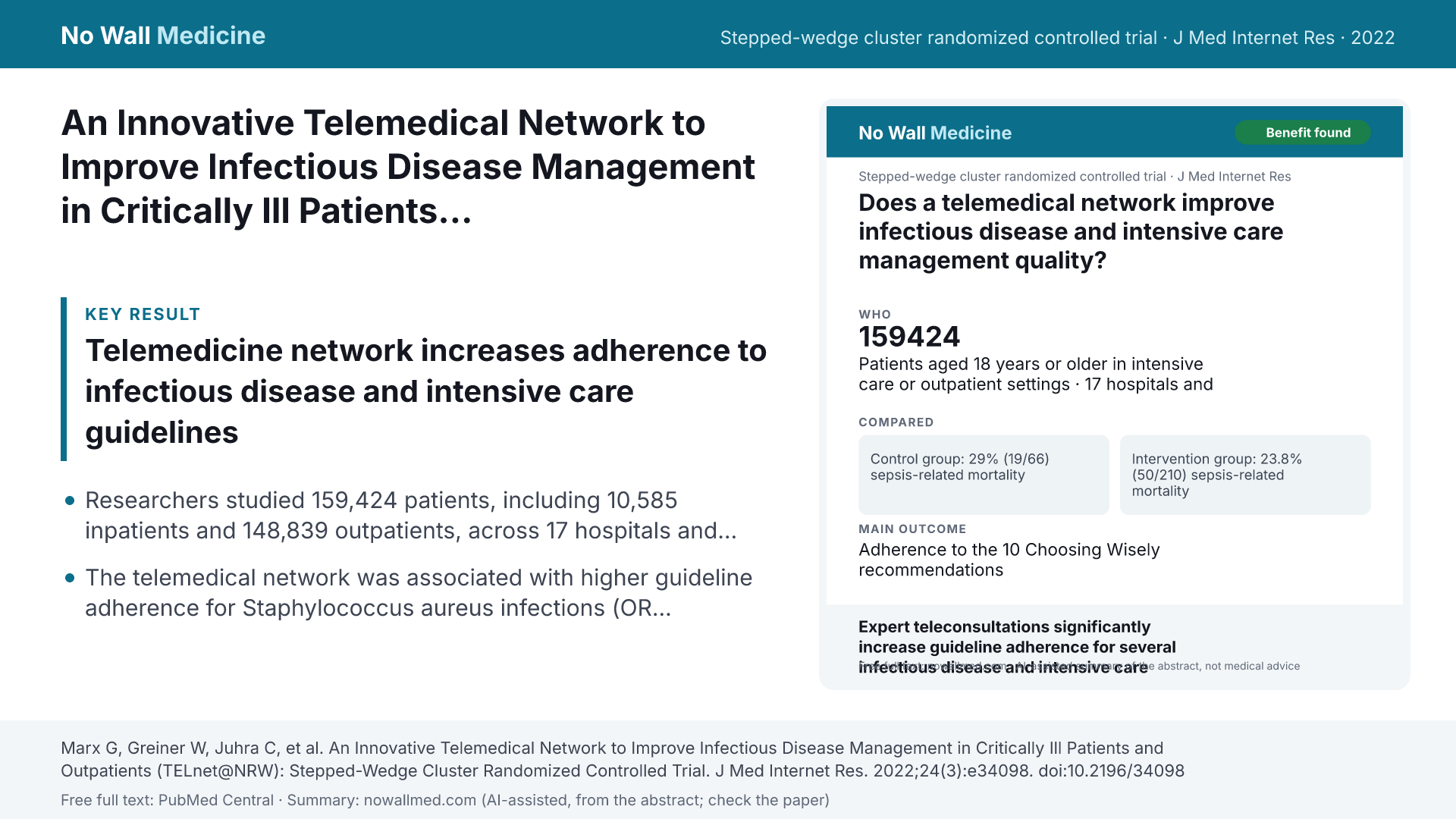
Telemedicine network increases adherence to infectious disease and intensive care guidelines
An Innovative Telemedical Network to Improve Infectious Disease Management in Critically Ill Patients and Outpatients (TELnet@NRW): Stepped-Wedge Cluster Randomized Controlled Trial
Stepped-wedge cluster randomized controlled trialBenefit found
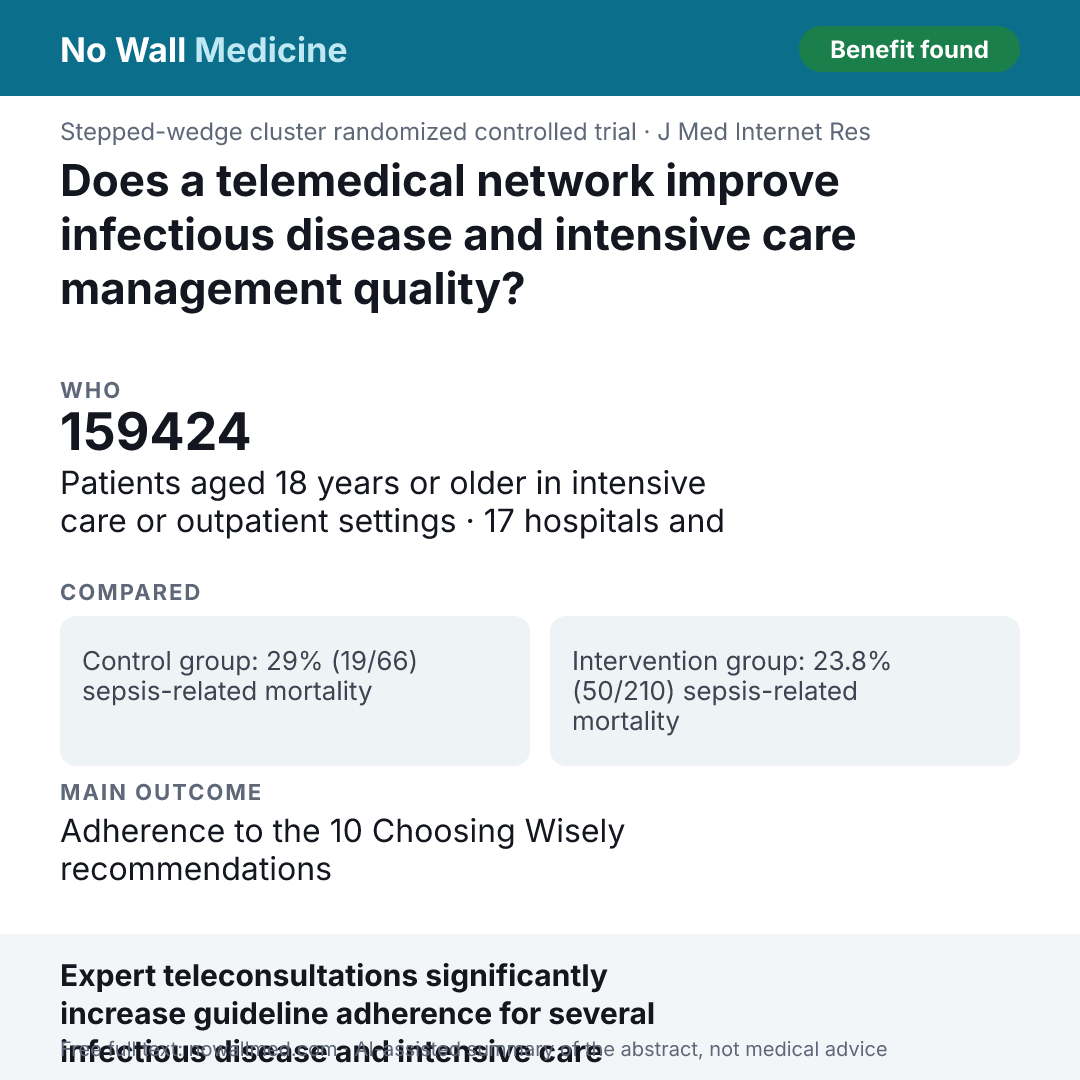
Does a telemedical network improve infectious disease and intensive care management quality?
Who
159424
Patients aged 18 years or older in intensive care or outpatient settings · 17 hospitals and 103 outpatient physicians in Germany
Compared
Control group: 29% (19/66) sepsis-related mortality
Intervention group: 23.8% (50/210) sepsis-related mortality
Main outcome
Adherence to the 10 Choosing Wisely recommendations
Bottom line: Expert teleconsultations significantly increase guideline adherence for several infectious disease and intensive care management recommendations.
Limitation: Selection effects from on-site triage and limited control for secular effects.
J Med Internet Res · 2022-03-02 · Save PNG
Clinical question: Does a telemedical network improve infectious disease and intensive care management quality?
Why it matters: Medical expertise in infectious diseases and intensive care is often geographically limited to university institutions and lacks sufficient interconnection between inpatient and outpatient care.
In absolute numbers
Control group: 29% · Intervention group: 23.8% → a difference of 5.2 percentage points, so about 20 people would need the treatment for 1 more to benefit (number needed to treat) over the trial’s follow-up.
Worked out by us from the two group results above, not reported by the authors. Check the paper for the exact outcome and timing.
Key points
- Researchers studied 159,424 patients, including 10,585 inpatients and 148,839 outpatients, across 17 hospitals and 103 outpatient physicians in Germany.
- The telemedical network was associated with higher guideline adherence for Staphylococcus aureus infections (OR 4.00), sepsis management (OR 6.82), and post-surgery antibiotic prophylaxis (OR 9.37).
- Outpatient physicians using teleconsultations showed higher guideline adherence for upper respiratory tract infections (OR 1.34) and asymptomatic bacteriuria (OR 9.31).
Limitation the authors note: The authors noted selection effects due to on-site triage and limited possibilities to control for secular effects.
Headline and key points written with AI from the paper’s abstract, with every number checked against it. Read the paper before relying on them.
Was this summary helpful?
Subject terms
Headline, design, result, key points, caveat and citation as plain text.
Cite this article
Marx G, Greiner W, Juhra C, et al. An Innovative Telemedical Network to Improve Infectious Disease Management in Critically Ill Patients and Outpatients (TELnet@NRW): Stepped-Wedge Cluster Randomized Controlled Trial. J Med Internet Res. 2022;24(3):e34098. doi:10.2196/34098
Spotted a mistake? Suggest a correction