Lifestyle intervention improved quality of life and fatigue in men receiving androgen deprivation therapy
An integrated lifestyle intervention for mitigation of adverse effects associated with androgen deprivation therapy for prostate cancer (STAMINA): a multicentre, randomised trial
Multicentre, randomised trialBenefit found
Does the STAMINA lifestyle intervention improve quality of life and fatigue in men on androgen deprivation therapy?
Who
700
Men on androgen deprivation therapy for prostate cancer · 15 UK National Health Service trusts in England
Compared
STAMINA lifestyle intervention: adjusted mean difference 4·5 (97·232% CI 1·7-7·2) for FACT-P
Optimised Usual Care
Main outcome
cancer-specific quality of life and fatigue
Result: adjusted mean difference 4·5 (97·232% CI 1·7-7·2) for FACT-P; 1·9 (0·4-3·4) for FACIT-F
Bottom line: The STAMINA lifestyle intervention improved cancer-specific quality of life and fatigue in men receiving androgen deprivation therapy.
Funded by: National Institute for Health Research
Lancet Oncol · 2026-09-04Download image
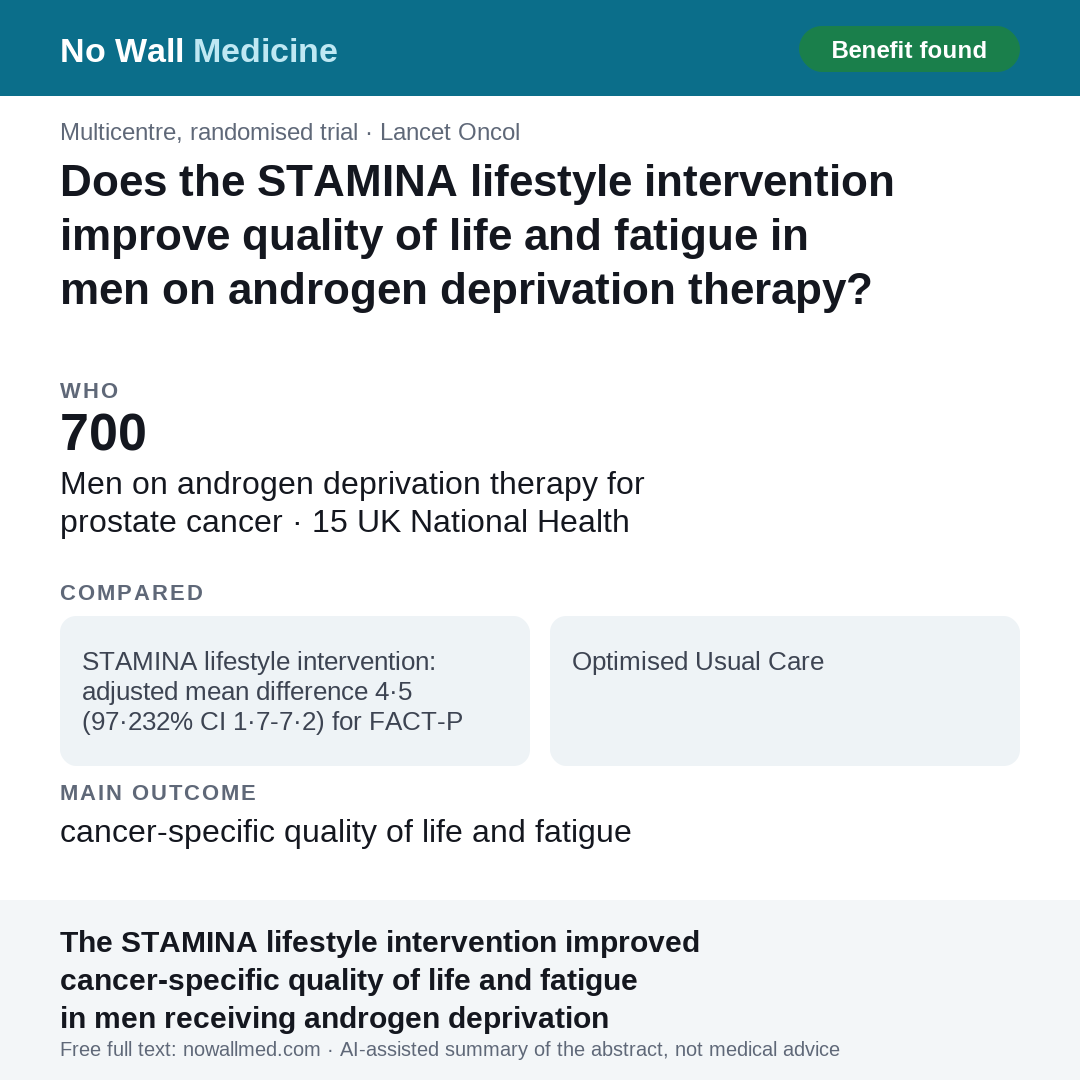
Clinical question: Does the STAMINA lifestyle intervention improve quality of life and fatigue in men on androgen deprivation therapy?
Why it matters: Androgen deprivation therapy for prostate cancer causes substantial adverse effects, but supervised exercise is rarely integrated into standard care.
Key points
- Researchers studied 700 men receiving androgen deprivation therapy for prostate cancer, comparing a lifestyle intervention to optimized usual care.
- The lifestyle intervention group showed higher scores for cancer-specific quality of life and fatigue compared to the usual care group.
- Three intervention-related serious adverse events occurred in the lifestyle group, including transient loss of consciousness, leg pain or weakness, and back pain.
Headline and key points written with AI from the paper’s abstract, with every number checked against it. Read the paper before relying on them.
Abstract
Background
Androgen deprivation therapy (ADT) for prostate cancer causes substantial adverse effects. Despite consistent national and international guideline recommendations, supervised exercise is rarely integrated into care. We aimed to determine whether the STAMINA lifestyle intervention, embedded into cancer care, would improve cancer-specific quality of life and fatigue versus behaviourally Optimised Usual Care in men with prostate cancer in England. Methods
STAMINA was a multicentre, randomised trial done across 15 UK National Health Service (NHS) trusts in England. Men on ADT for prostate cancer were eligible. Participants were randomly assigned (5:4) via computer-generated minimisation, stratified by age, ADT duration, chemotherapy or androgen receptor pathway inhibitor therapy, and radiotherapy, to the STAMINA lifestyle intervention or to Optimised Usual Care. Participants were aware of treatment allocation. The STAMINA lifestyle intervention comprised supervised aerobic and resistance exercise for 12 months, dietary advice, behavioural support, and complimentary gym membership. Optimised Usual Care comprised clinician training, educational materials, behavioural prompts, and safety-to-exercise checks. Primary outcomes were the Functional Assessment of Cancer Therapy-prostate (FACT-P) and the Functional Assessment of Chronic Illness Therapy-fatigue (FACIT-F) subscale at 12 months, analysed by intention to treat (according to randomised treatment). This trial is registered with ISRCTN (ISRCTN46385239), and recruitment is complete. Findings
Between Jan 20, 2022, and June 12, 2023, 700 men were randomly assigned to STAMINA lifestyle intervention (n=389) or Optimised Usual Care (n=311). Median age was 71·6 years (IQR 66·3-76·0), and 680 (97%) of 700 participants were White. Primary outcome data were available for 345 (89%) of 389 participants in the STAMINA lifestyle intervention group and 251 (81%) of 311 in the Optimised Usual Care group. The STAMINA lifestyle intervention was superior to Optimised Usual Care in terms of FACT-P score (adjusted mean difference 4·5, 97·232% CI 1·7-7·2; p=0·0004) and FACIT-F score (1·9, 0·4-3·4; p=0·0068). Three intervention-related serious adverse events occurred in the STAMINA lifestyle intervention group (transient loss of consciousness, leg pain or weakness, and back pain); all participants recovered. No treatment-related deaths occurred. Interpretation
The STAMINA lifestyle intervention meets best practice guidelines, can be implemented in NHS trusts in England, and offers clinicians a clear basis for identification and prescription of a supervised exercise and dietary advice intervention to mitigate negative effects associated with ADT. Funding
National Institute for Health Research.
Abstract reproduced under the article’s CC BY licence.
Topics
Cite this article
Bourke L, Rosario DJ, Reale S, Ibeggazene S, Innes A, Scope A. An integrated lifestyle intervention for mitigation of adverse effects associated with androgen deprivation therapy for prostate cancer (STAMINA): a multicentre, randomised trial. Lancet Oncol. 2026. doi:10.1016/S1470-2045(26)00304-9
Spotted a mistake? Suggest a correction