An international multi-institution real-world study of the optimal surveillance frequency for stage II/III gastric cancer: the more, the better?
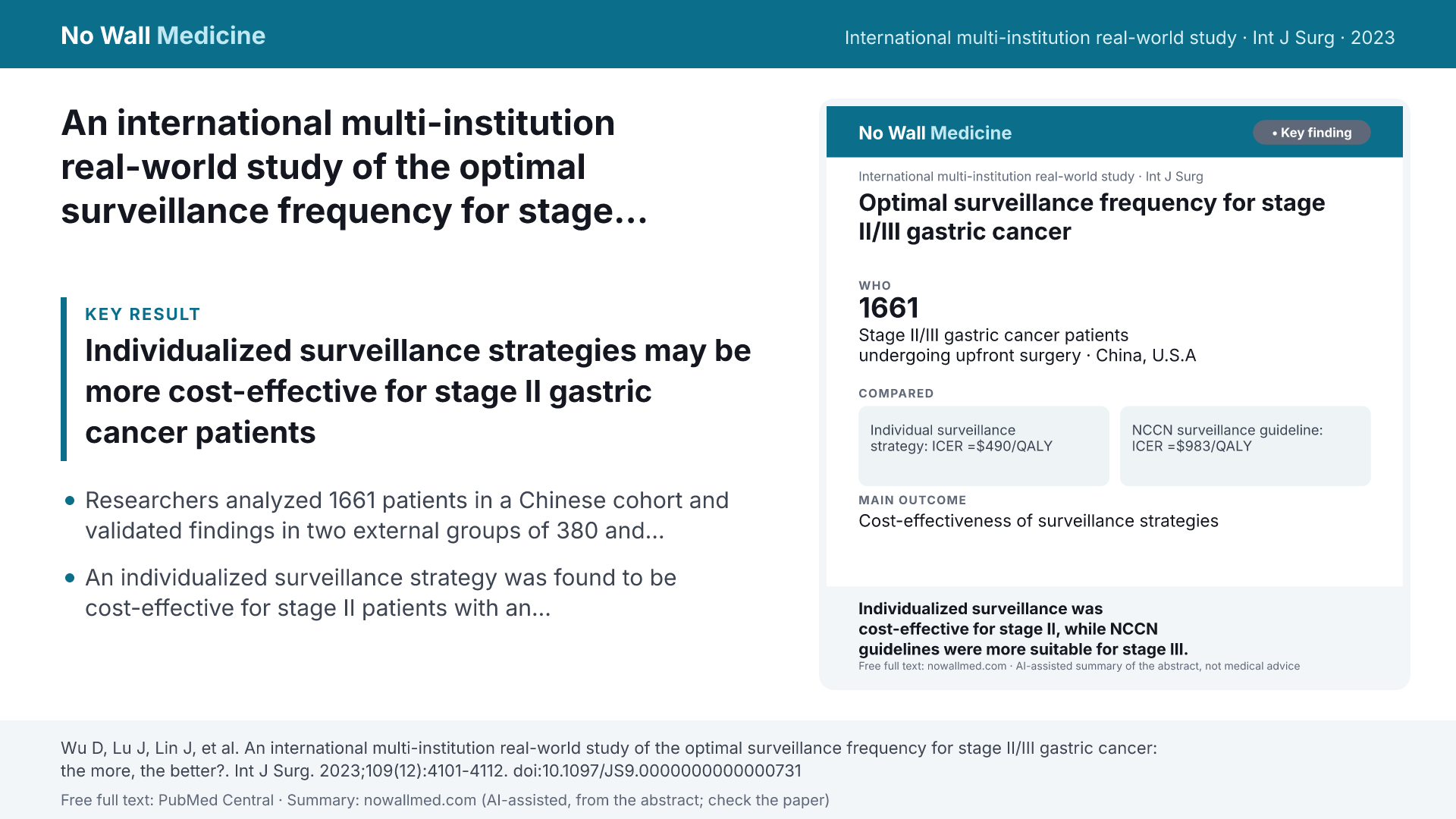
Key result: Individualized surveillance strategies may be more cost-effective for stage II gastric cancer patients
Key points
- Researchers analyzed 1661 patients in a Chinese cohort and validated findings in two external groups of 380 and 270 patients with stage II or III gastric cancer.
- An individualized surveillance strategy was found to be cost-effective for stage II patients with an incremental cost-effectiveness ratio of $490 per quality-adjusted life year.
- The most intensive National Comprehensive Cancer Network surveillance guideline was more cost-effective for stage III patients with an incremental cost-effectiveness ratio of $983 per quality-adjusted life year.
Why it matters: The optimal frequency for monitoring patients after surgery for stage II and III gastric cancer is currently unknown due to a lack of evidence.
Limitation the authors note: The authors state that the results are limited by the retrospective study design.
Discussion prompts
- Would these patients look like yours? Who was left out?
- Is the main outcome one that matters to patients?
- Is the difference large enough to change what you do?
Cite: Wu D, Lu J, Lin J, et al. An international multi-institution real-world study of the optimal surveillance frequency for stage II/III gastric cancer: the more, the better?. Int J Surg. 2023;109(12):4101-4112. doi:10.1097/JS9.0000000000000731
Free full text: PubMed Central · Summary and visual abstract: nowallmed.com/a/an-international-multi-institution-real-world-study-of-the-optimal-8sf81x/ (AI-assisted from the abstract; check the paper before relying on it).