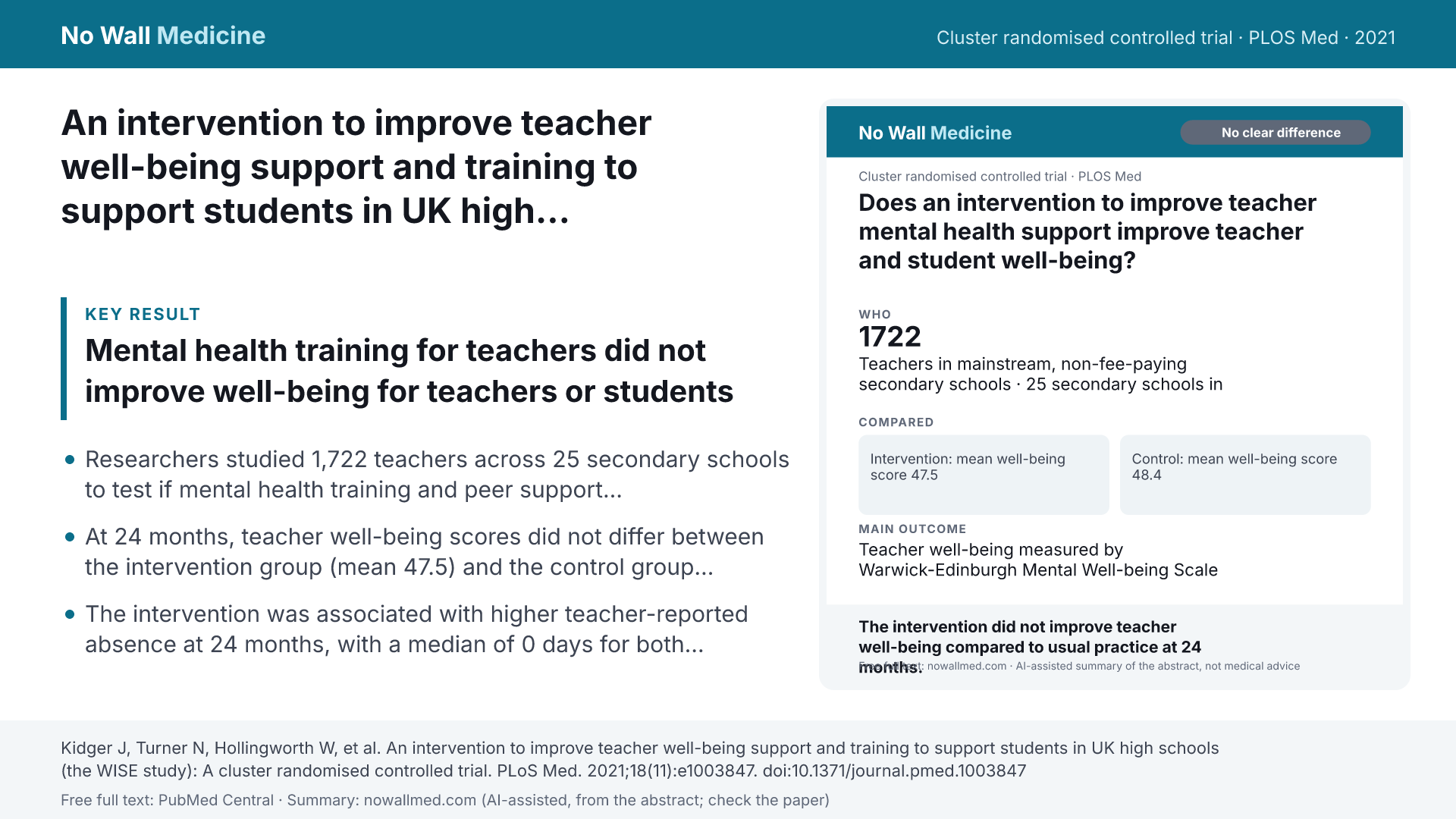
An intervention to improve teacher well-being support and training to support students in UK high schools (the WISE study): A cluster randomised controlled trial
Key result: Mental health training for teachers did not improve well-being for teachers or students
Key points
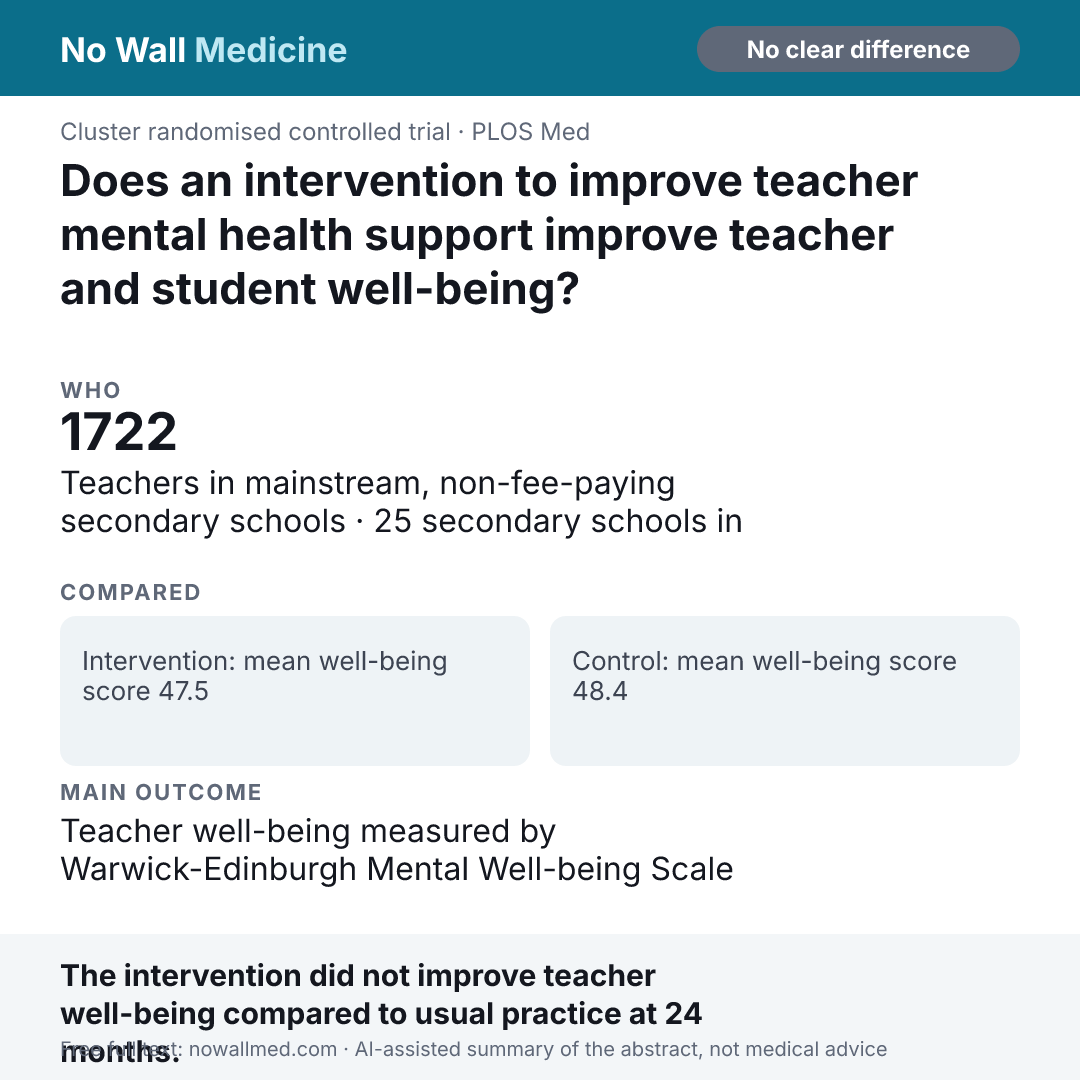
- Researchers studied 1,722 teachers across 25 secondary schools to test if mental health training and peer support improved well-being.
- At 24 months, teacher well-being scores did not differ between the intervention group (mean 47.5) and the control group (mean 48.4).
- The intervention was associated with higher teacher-reported absence at 24 months, with a median of 0 days for both groups and a ratio of geometric means of 1.04.
Limitation the authors note: The study's main limitations were a lack of blinding of research participants and the self-report nature of the outcome measures.
Discussion prompts
- Would these patients look like yours? Who was left out?
- Is the main outcome one that matters to patients?
- Is the difference large enough to change what you do?
Cite: Kidger J, Turner N, Hollingworth W, et al. An intervention to improve teacher well-being support and training to support students in UK high schools (the WISE study): A cluster randomised controlled trial. PLoS Med. 2021;18(11):e1003847. doi:10.1371/journal.pmed.1003847
Free full text: PubMed Central · Summary and visual abstract: nowallmed.com/a/an-intervention-to-improve-teacher-well-being-support-and-training-to-1imbd6h/ (AI-assisted from the abstract; check the paper before relying on it).