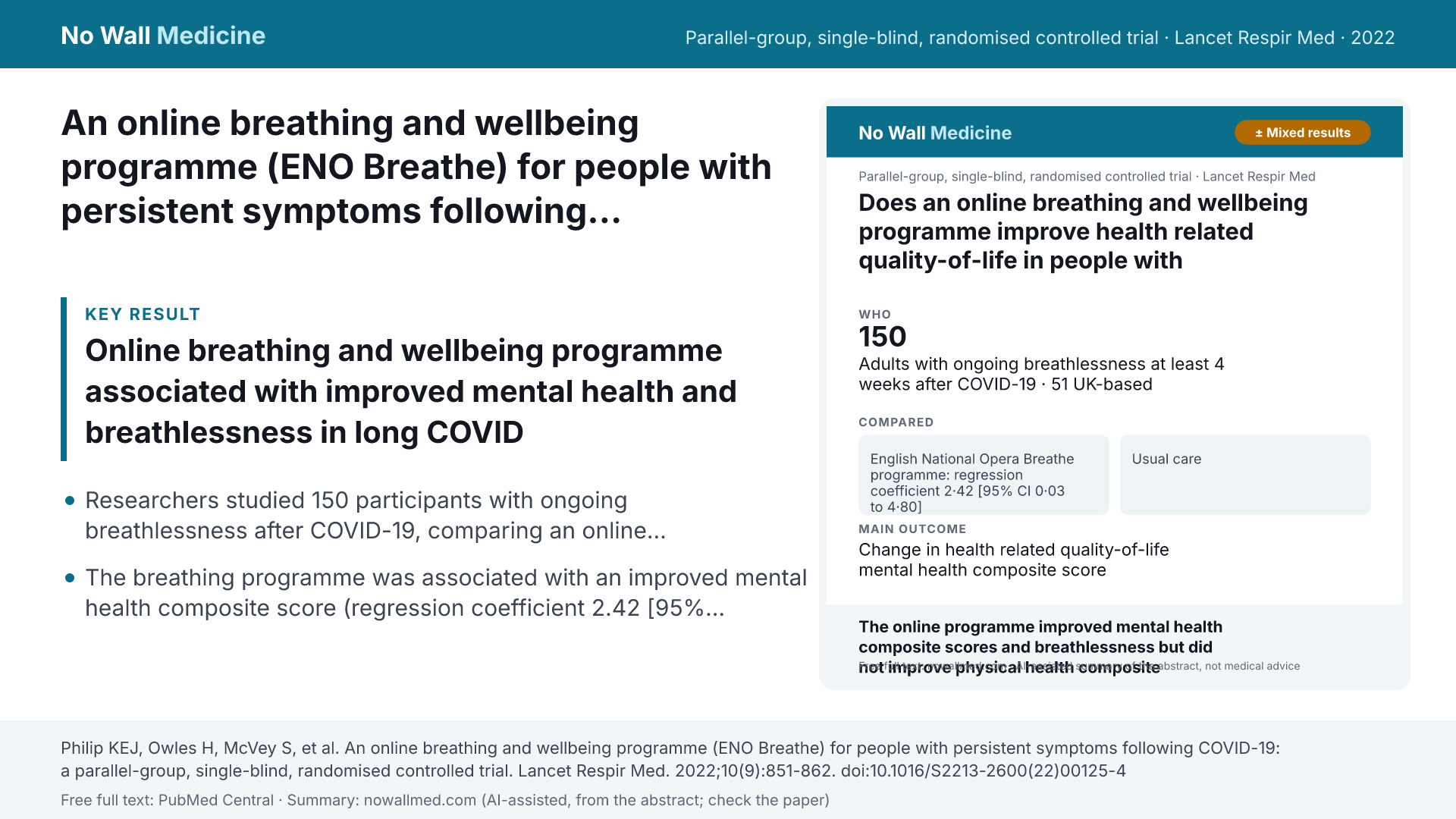
Online breathing and wellbeing programme associated with improved mental health and breathlessness in long COVID
An online breathing and wellbeing programme (ENO Breathe) for people with persistent symptoms following COVID-19: a parallel-group, single-blind, randomised controlled trial
Parallel-group, single-blind, randomised controlled trialMixed results
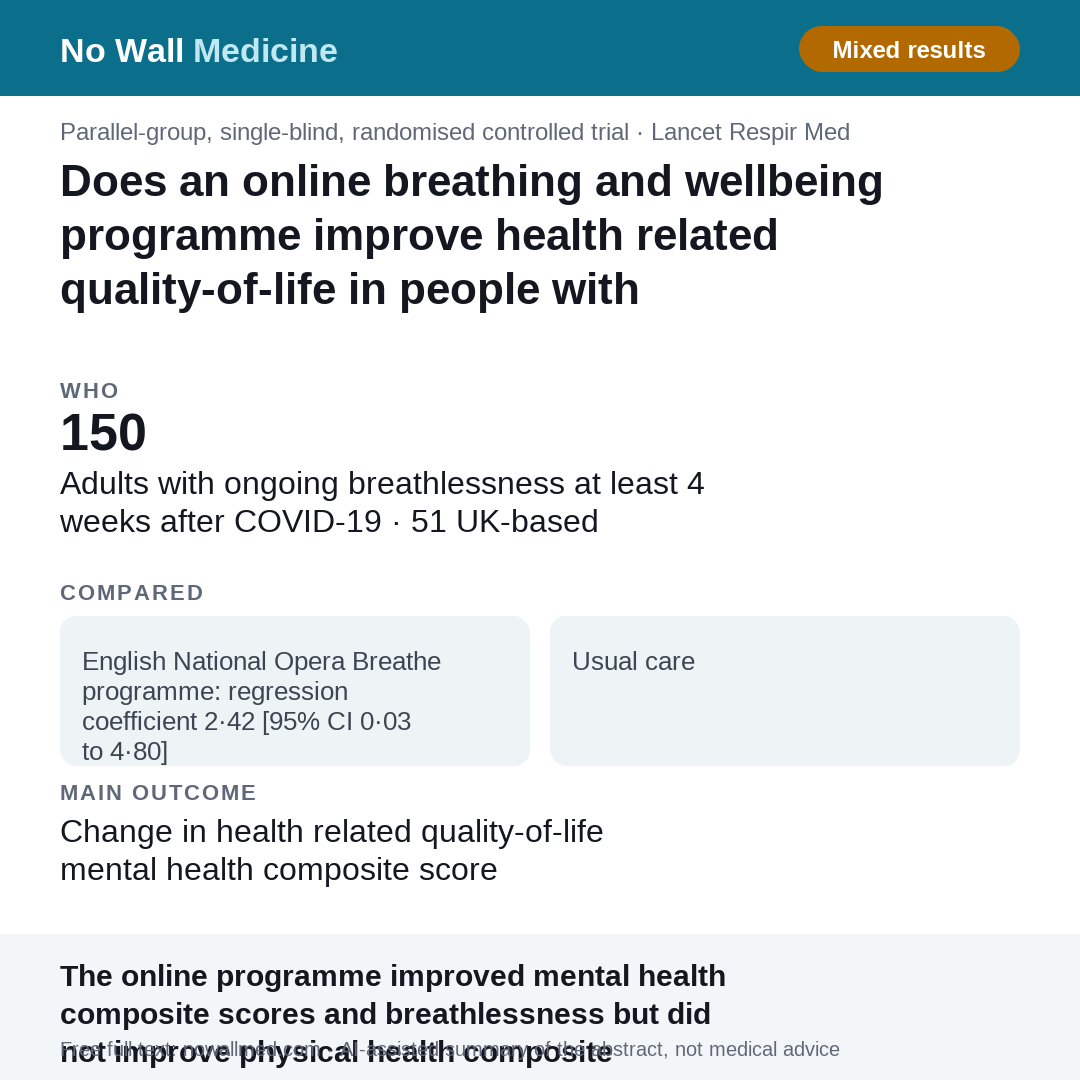
Does an online breathing and wellbeing programme improve health related quality-of-life in people with persistent COVID-19 breathlessness?
Who
150
Adults with ongoing breathlessness at least 4 weeks after COVID-19 · 51 UK-based collaborating long COVID clinics
Compared
English National Opera Breathe programme: regression coefficient 2·42 [95% CI 0·03 to 4·80]
Usual care
Main outcome
Change in health related quality-of-life mental health composite score
Result: regression coefficient 2·42 (95% CI 0·03 to 4·80)
Bottom line: The online programme improved mental health composite scores and breathlessness but did not improve physical health composite scores.
Funded by: Imperial College London
Lancet Respir Med · 2022-04-27Download image
Clinical question: Does an online breathing and wellbeing programme improve health related quality-of-life in people with persistent COVID-19 breathlessness?
Why it matters: There are few evidence-based interventions for long COVID, and it is unknown if holistic approaches like online breathing and wellbeing programmes improve quality of life.
Key points
- Researchers studied 150 participants with ongoing breathlessness after COVID-19, comparing an online breathing and wellbeing programme to usual care.
- The breathing programme was associated with an improved mental health composite score (regression coefficient 2.42 [95% CI 0.03 to 4.80]; p=0.047) and improved breathlessness during running (-10.48 [-17.23 to -3.73]; p=0.0026).
- The programme was not associated with a significant difference in physical health composite scores (0.60 [-1.33 to 2.52]; p=0.54).
Headline and key points written with AI from the paper’s abstract, with every number checked against it. Read the paper before relying on them.
Was this summary helpful?
Abstract
Background
There are few evidence-based interventions for long COVID; however, holistic approaches supporting recovery are advocated. We assessed whether an online breathing and wellbeing programme improves health related quality-of-life (HRQoL) in people with persisting breathlessness following COVID-19. Methods
We conducted a parallel-group, single-blind, randomised controlled trial in patients who had been referred from one of 51 UK-based collaborating long COVID clinics. Eligible participants were aged 18 years or older; were recovering from COVID-19 with ongoing breathlessness, with or without anxiety, at least 4 weeks after symptom onset; had internet access with an appropriate device; and were deemed clinically suitable for participation by one of the collaborating COVID-19 clinics. Following clinical assessment, potential participants were given a unique online portal code. Participants were randomly assigned (1:1) to either immediate participation in the English National Opera (ENO) Breathe programme or to usual care. Randomisation was done by the research team using computer-generated block randomisation lists, with block size 10. The researcher responsible for randomisation was masked to responses. Participants in the ENO Breathe group participated in a 6-week online breathing and wellbeing programme, developed for people with long COVID experiencing breathlessness, focusing on breathing retraining using singing techniques. Those in the deferred group received usual care until they exited the trial. The primary outcome, assessed in the intention-to-treat population, was change in HRQoL, assessed using the RAND 36-item short form survey instrument mental health composite (MHC) and physical health composite (PHC) scores. Secondary outcome measures were the chronic obstructive pulmonary disease assessment test score, visual analogue scales (VAS) for breathlessness, and scores on the dyspnoea-12, the generalised anxiety disorder 7-item scale, and the short form-6D. A thematic analysis exploring participant experience was also conducted using qualitative data from focus groups, survey responses, and email correspondence. This trial is registered with ClinicalTrials.gov, NCT04830033. Findings
Between April 22 and May 25, 2021, 158 participants were recruited and randomly assigned. Of these, eight (5%) individuals were excluded and 150 participants were allocated to a treatment group (74 in the ENO Breathe group and 76 in the usual care group). Compared with usual care, ENO Breathe was associated with an improvement in MHC score (regression coefficient 2·42 [95% CI 0·03 to 4·80]; p=0·047), but not PHC score (0·60 [-1·33 to 2·52]; p=0·54). VAS for breathlessness (running) favoured ENO Breathe participation (-10·48 [-17·23 to -3·73]; p=0·0026). No other statistically significant between-group differences in secondary outcomes were observed. One minor self-limiting adverse event was reported by a participant in the ENO Breathe group who felt dizzy using a computer for extended periods. Thematic analysis of ENO Breathe participant experience identified three key themes: (1) improvements in symptoms; (2) feeling that the programme was complementary to standard care; and (3) the particular suitability of singing and music to address their needs. Interpretation
Our findings suggest that an online breathing and wellbeing programme can improve the mental component of HRQoL and elements of breathlessness in people with persisting symptoms after COVID-19. Mind-body and music-based approaches, including practical, enjoyable, symptom-management techniques might have a role supporting recovery. Funding
Imperial College London.
Abstract reproduced under the article’s CC BY licence.
Subject terms
Cite this article
Philip KEJ, Owles H, McVey S, et al. An online breathing and wellbeing programme (ENO Breathe) for people with persistent symptoms following COVID-19: a parallel-group, single-blind, randomised controlled trial. Lancet Respir Med. 2022. doi:10.1016/S2213-2600(22)00125-4
Spotted a mistake? Suggest a correction