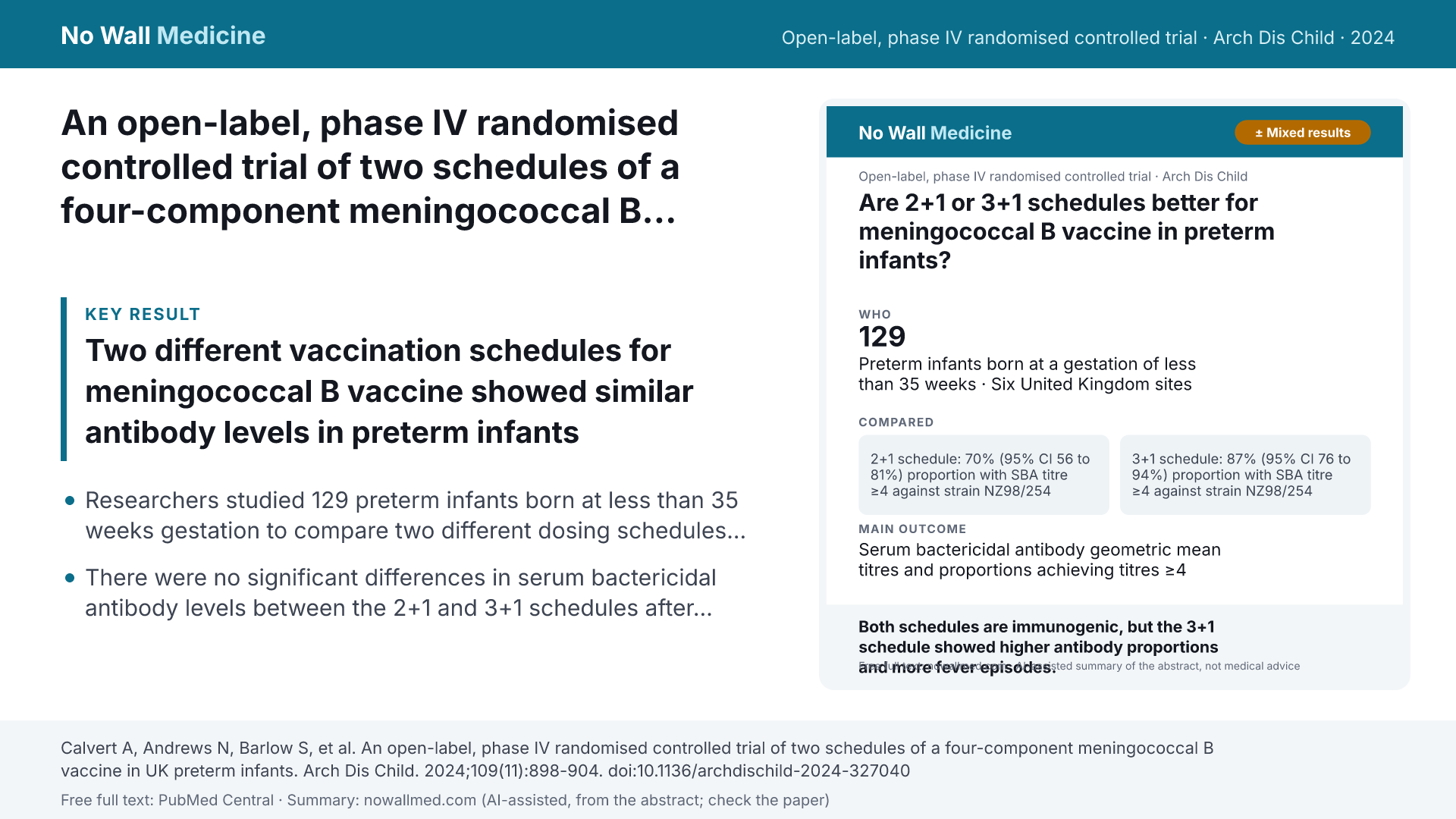
Two different vaccination schedules for meningococcal B vaccine showed similar antibody levels in preterm infants
An open-label, phase IV randomised controlled trial of two schedules of a four-component meningococcal B vaccine in UK preterm infants
Open-label, phase IV randomised controlled trialMixed results
Are 2+1 or 3+1 schedules better for meningococcal B vaccine in preterm infants?
Who
129
Preterm infants born at a gestation of less than 35 weeks · Six United Kingdom sites
Compared
2+1 schedule: 70% (95% CI 56 to 81%) proportion with SBA titre ≥4 against strain NZ98/254
3+1 schedule: 87% (95% CI 76 to 94%) proportion with SBA titre ≥4 against strain NZ98/254
Main outcome
Serum bactericidal antibody geometric mean titres and proportions achieving titres ≥4
Result: p=0.03 for proportion with SBA titre ≥4 against strain NZ98/254
Bottom line: Both schedules are immunogenic, but the 3+1 schedule showed higher antibody proportions and more fever episodes.
Arch Dis Child · 2024-10-18Download image
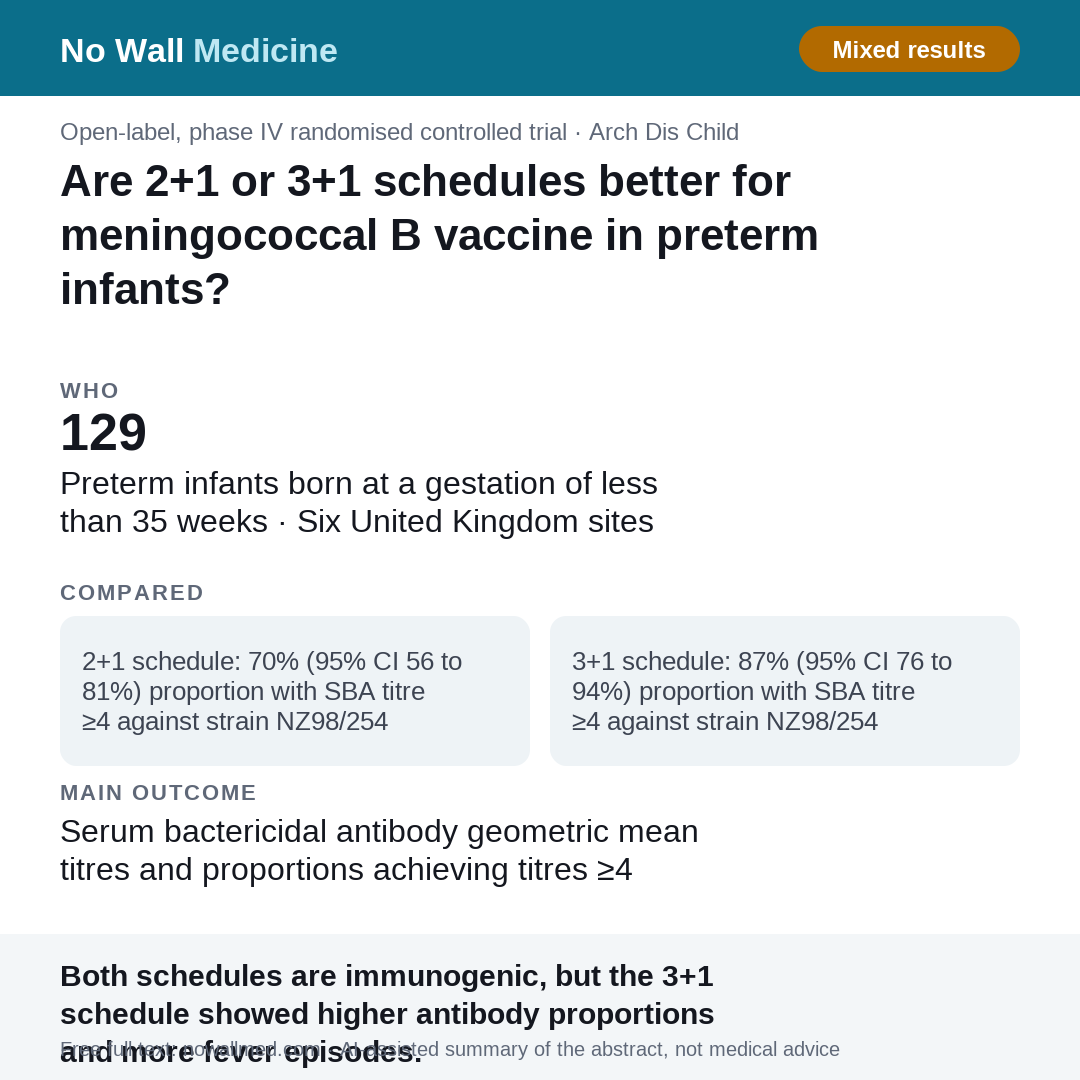
Clinical question: Are 2+1 or 3+1 schedules better for meningococcal B vaccine in preterm infants?
Why it matters: It is unknown whether a 2+1 or a 3+1 dosing schedule for the four-component meningococcal B vaccine is more effective for preterm infants.
Key points
- Researchers studied 129 preterm infants born at less than 35 weeks gestation to compare two different dosing schedules for the Bexsero vaccine.
- There were no significant differences in serum bactericidal antibody levels between the 2+1 and 3+1 schedules after primary or booster doses.
- Infants in the 3+1 schedule group had a higher proportion of infants with antibody titres ≥4 against strain NZ98/254 at 1 month (87% vs 70%) and more fever episodes >38.0°C (14% vs 2%).
Headline and key points written with AI from the paper’s abstract, with every number checked against it. Read the paper before relying on them.
Was this summary helpful?
Abstract
Objective
To compare immunological responses of preterm infants to a four-component meningococcal B vaccine (4CMenB; Bexsero) following a 2+1 vs a 3+1 schedule, and to describe reactogenicity of routine vaccines. Design
An open-label, phase IV randomised study conducted across six UK sites. Setting
Neonatal units, postnatal wards, community recruitment following discharge. Participants
129 preterm infants born at a gestation of <35 weeks (64 in group 1 (2+1), 65 in group 2 (3+1)) were included in the analysis. Analysis was completed for postprimary samples from 125 participants (59 in group 1, 66 in group 2) and for postbooster samples from 118 participants (59 in both groups). Interventions
Infants randomised to 4CMenB according to a 2+1 or a 3+1 schedule, alongside routine vaccines. Main outcome measures
Serum bactericidal antibody (SBA) assays performed at 5, 12 and 13 months of age: geometric mean titres (GMTs) and proportions of infants achieving titres ≥4 compared between groups. Results
There were no significant differences in SBA GMTs between infants receiving a 2+1 compared with a 3+1 schedule following primary or booster vaccination, but a significantly higher proportion of infants had an SBA titre ≥4 against strain NZ98/254 (porin A) at 1 month after primary vaccination using a 3+1 compared with a 2+1 schedule (3+1: 87% (95% CI 76 to 94%), 2+1: 70% (95% CI 56 to 81%), p=0.03).At 12 weeks of age those in the 3+1 group, who received a dose of 4CMenB, had significantly more episodes of fever >38.0°C than those in the 2+1 group who did not (group 2+1: 2% (n=1); 3+1: 14% (n=9); p=0.02). Conclusions
Both schedules were immunogenic in preterm infants, although a lower response against strain NZ98/254 was seen in the 2+1 schedule; ongoing disease surveillance is important in understanding the clinical significance of this difference. Trial registration number
NCT03125616.
Abstract reproduced under the article’s CC BY NC licence.
Subject terms
Cite this article
Calvert A, Andrews N, Barlow S, et al. An open-label, phase IV randomised controlled trial of two schedules of a four-component meningococcal B vaccine in UK preterm infants. Arch Dis Child. 2024. doi:10.1136/archdischild-2024-327040
Spotted a mistake? Suggest a correction