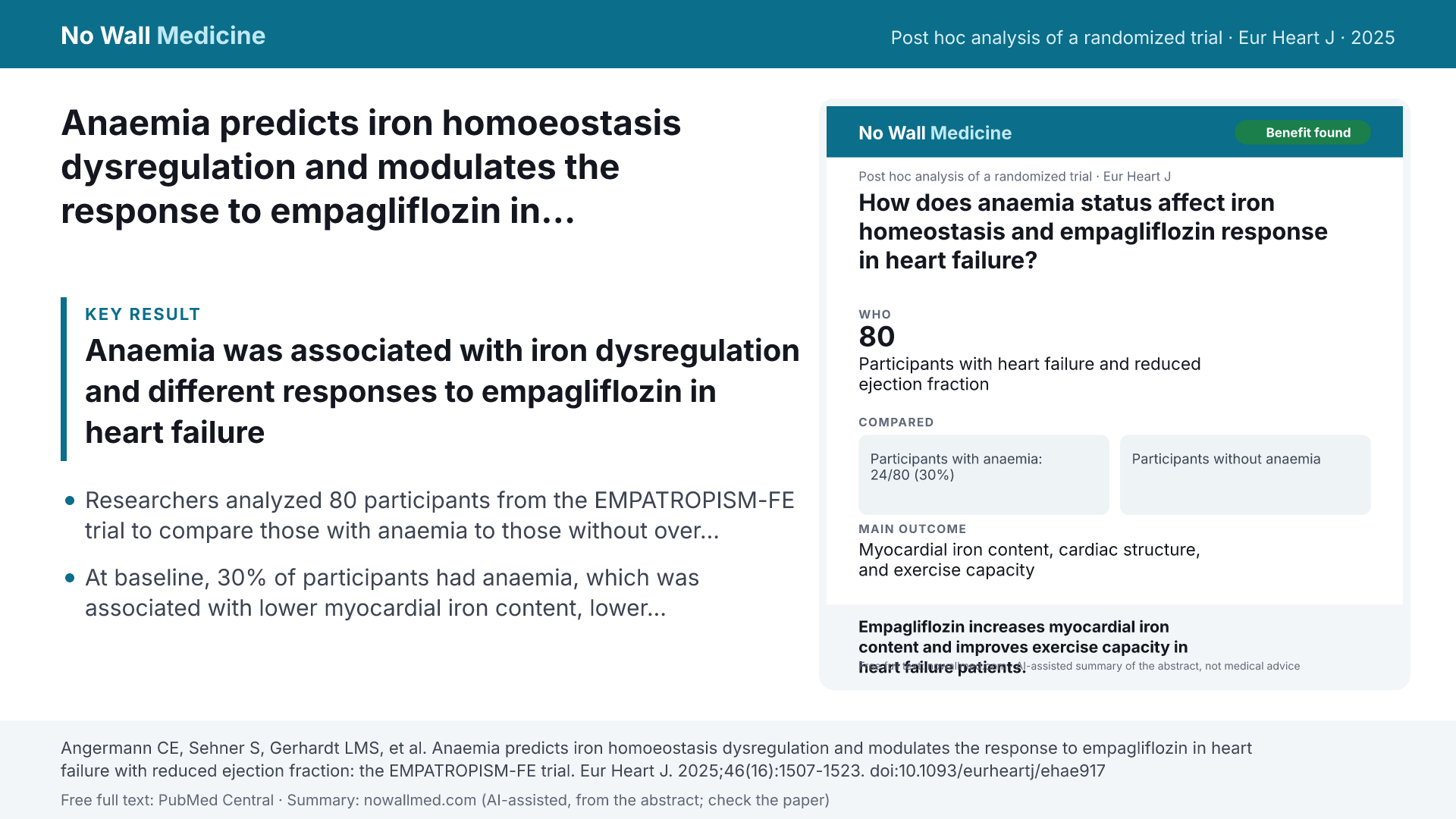
Anaemia was associated with iron dysregulation and different responses to empagliflozin in heart failure
Anaemia predicts iron homoeostasis dysregulation and modulates the response to empagliflozin in heart failure with reduced ejection fraction: the EMPATROPISM-FE trial
Post hoc analysis of a randomized trialBenefit found
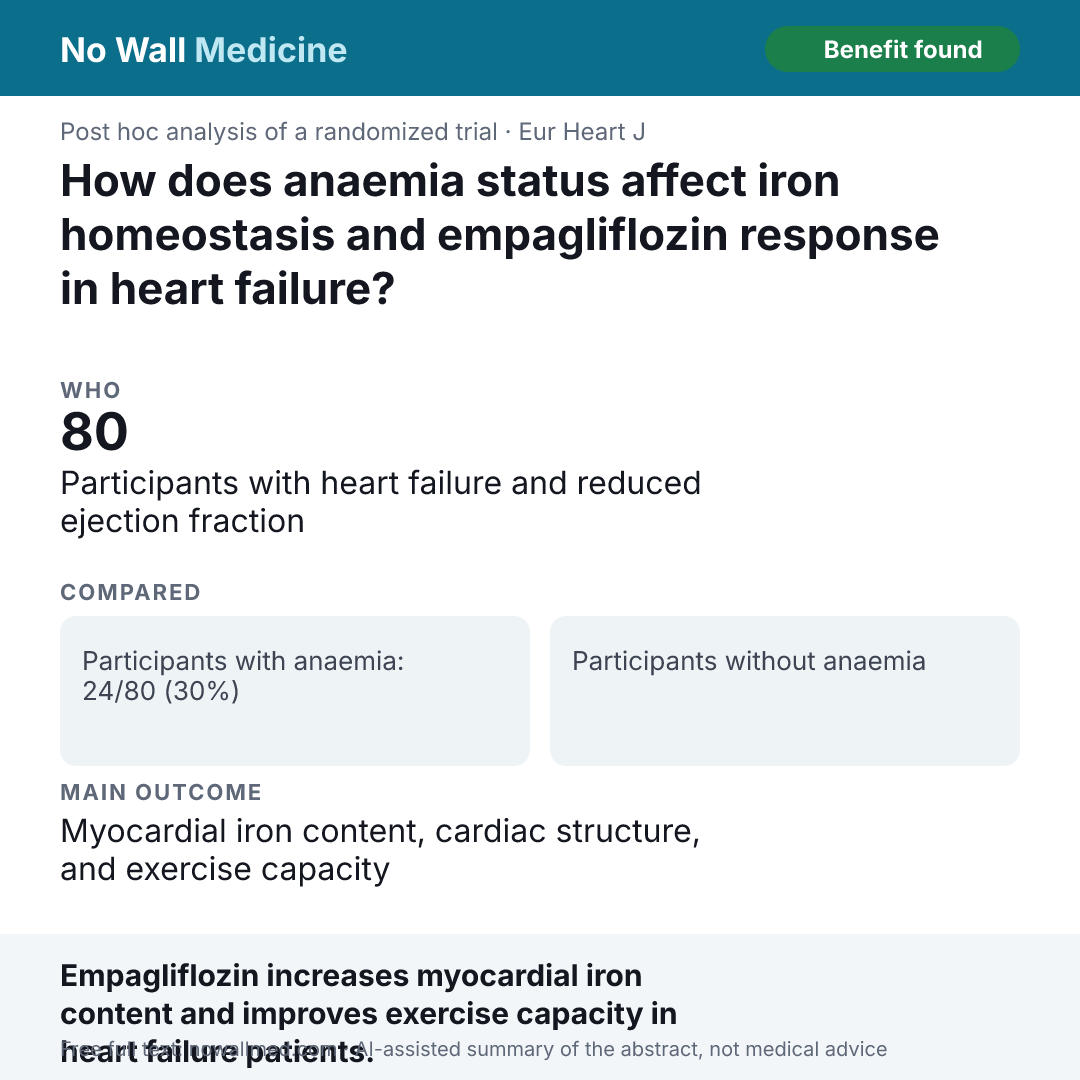
How does anaemia status affect iron homeostasis and empagliflozin response in heart failure?
Who
80
Participants with heart failure and reduced ejection fraction
Compared
Participants with anaemia: 24/80 (30%)
Participants without anaemia
Main outcome
Myocardial iron content, cardiac structure, and exercise capacity
Bottom line: Empagliflozin increases myocardial iron content and improves exercise capacity in heart failure patients.
Eur Heart J · 2025-02-05 · Save PNG
Same trial (NCT03485222)
Papers we list that report this registered trial, oldest first. Read a secondary analysis alongside the main results.
- Secondary analysis Benefit found
Empagliflozin associated with reduced heart fat and stiffness in nondiabetic heart failure patients JACC Heart Fail 2021-07 - Secondary analysis Benefit found
This paper Eur Heart J 2025-02
Clinical question: How does anaemia status affect iron homeostasis and empagliflozin response in heart failure?
Why it matters: The mechanisms by which sodium-glucose cotransporter 2 inhibitors impact iron metabolism in patients with heart failure are not completely understood.
Key points
- Researchers analyzed 80 participants from the EMPATROPISM-FE trial to compare those with anaemia to those without over 6 months of empagliflozin or placebo treatment.
- At baseline, 30% of participants had anaemia, which was associated with lower myocardial iron content, lower peak oxygen consumption, lower hepcidin, and higher erythropoietin and norepinephrine.
- Empagliflozin was associated with increased myocardial iron content, improved exercise capacity, and greater left ventricular reverse remodelling in individuals with anaemia.
Headline and key points written with AI from the paper’s abstract, with every number checked against it. Read the paper before relying on them.
Was this summary helpful?
Subject terms
Headline, design, result, key points, caveat and citation as plain text.
Cite this article
Angermann CE, Sehner S, Gerhardt LMS, et al. Anaemia predicts iron homoeostasis dysregulation and modulates the response to empagliflozin in heart failure with reduced ejection fraction: the EMPATROPISM-FE trial. Eur Heart J. 2025;46(16):1507-1523. doi:10.1093/eurheartj/ehae917
Spotted a mistake? Suggest a correction