Analysis of a Machine Learning-Based Risk Stratification Scheme for Chronic Limb-Threatening Ischemia
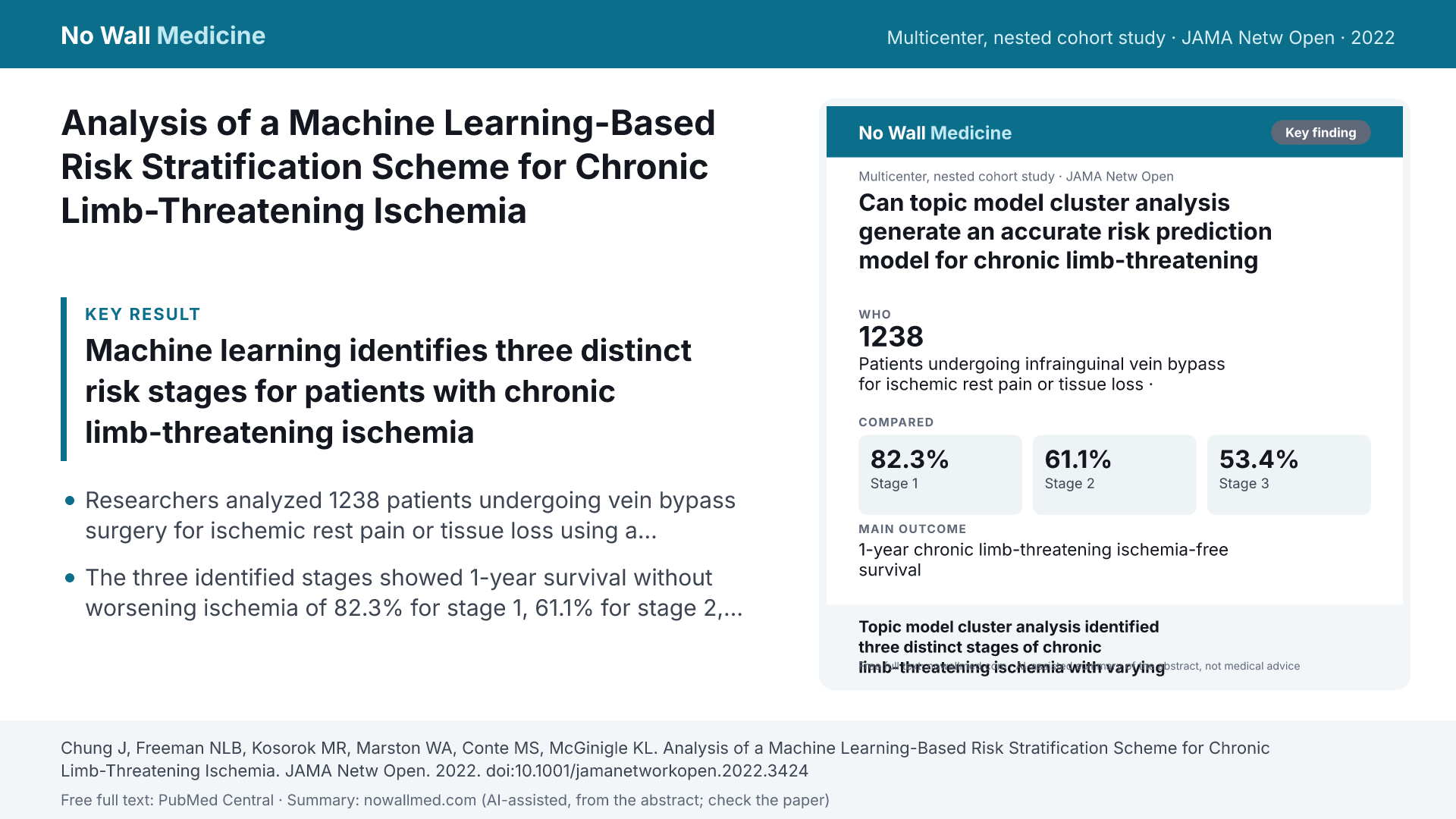
Key result: Machine learning identifies three distinct risk stages for patients with chronic limb-threatening ischemia
Multicenter, nested cohort studyKey finding
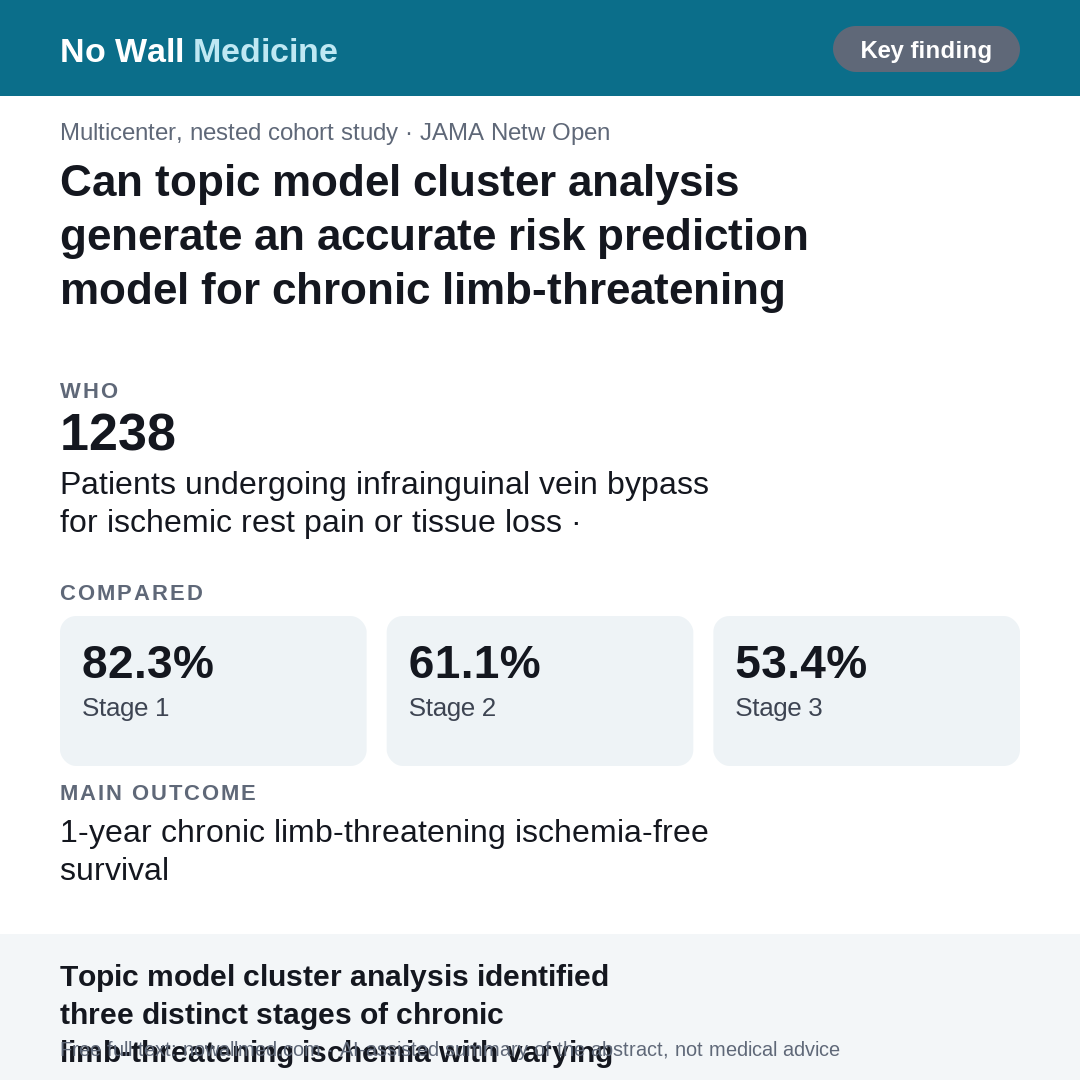
Can topic model cluster analysis generate an accurate risk prediction model for chronic limb-threatening ischemia?
Who
1238
Patients undergoing infrainguinal vein bypass for ischemic rest pain or tissue loss · Multicenter
Compared
82.3%Stage 1 (107 of 130 patients)
61.1%Stage 2 (353 of 578 patients)
53.4%Stage 3 (283 of 530 patients)
Main outcome
1-year chronic limb-threatening ischemia-free survival
Bottom line: Topic model cluster analysis identified three distinct stages of chronic limb-threatening ischemia with varying survival and amputation rates.
JAMA Netw Open · 2022-03-01Download image
Key points
- Researchers analyzed 1238 patients undergoing vein bypass surgery for ischemic rest pain or tissue loss using a machine learning cluster analysis.
- The three identified stages showed 1-year survival without worsening ischemia of 82.3% for stage 1, 61.1% for stage 2, and 53.4% for stage 3.
- Major limb amputation rates were 4.2% in stage 1, 10.8% in stage 2, and 18.4% in stage 3.
Why it matters: Existing risk stratification schemes for chronic limb-threatening ischemia have limited efficacy and more accurate, reproducible models are needed.
Discussion prompts
- Would these patients look like yours? Who was left out?
- Is the main outcome one that matters to patients?
- Is the difference large enough to change what you do?
Cite: Chung J, Freeman NLB, Kosorok MR, Marston WA, Conte MS, McGinigle KL. Analysis of a Machine Learning-Based Risk Stratification Scheme for Chronic Limb-Threatening Ischemia. JAMA Netw Open. 2022. doi:10.1001/jamanetworkopen.2022.3424
Free full text: PubMed Central · Summary and visual abstract: nowallmed.com/a/analysis-of-a-machine-learning-based-risk-stratification-scheme-for-yojlgv/ (AI-assisted from the abstract; check the paper before relying on it).