Analysis of HBsAg Immunocomplexes and cccDNA Activity During and Persisting After NAP-Based Therapy
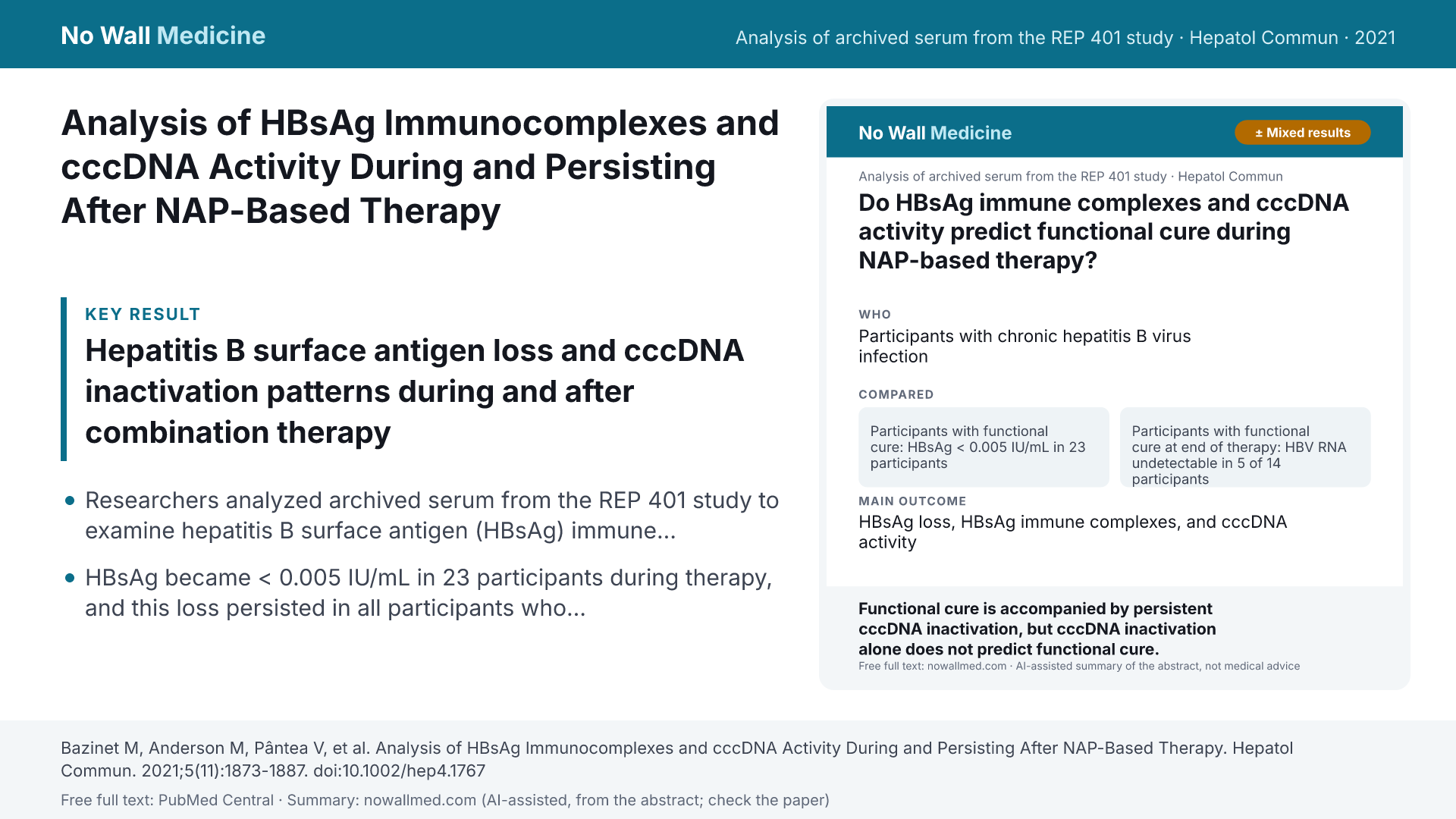
Key result: Hepatitis B surface antigen loss and cccDNA inactivation patterns during and after combination therapy
Analysis of archived serum from the REP 401 studyMixed results
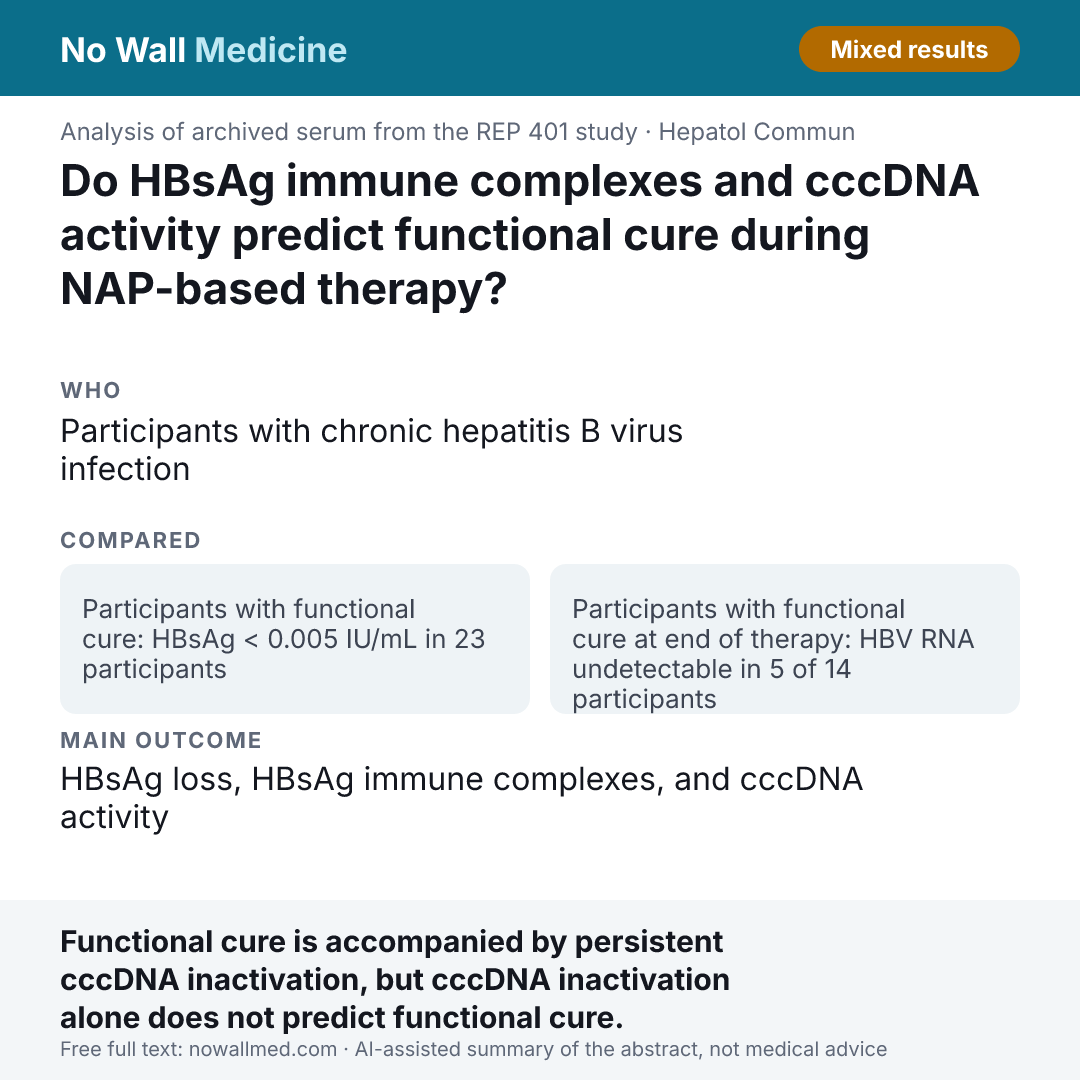
Do HBsAg immune complexes and cccDNA activity predict functional cure during NAP-based therapy?
Who
Participants with chronic hepatitis B virus infection
Compared
Participants with functional cure: HBsAg < 0.005 IU/mL in 23 participants
Participants with functional cure at end of therapy: HBV RNA undetectable in 5 of 14 participants
Main outcome
HBsAg loss, HBsAg immune complexes, and cccDNA activity
Bottom line: Functional cure is accompanied by persistent cccDNA inactivation, but cccDNA inactivation alone does not predict functional cure.
Hepatol Commun · 2021-07-10 · Save PNG
Key points
- Researchers analyzed archived serum from the REP 401 study to examine hepatitis B surface antigen (HBsAg) immune complexes and covalently closed circular DNA (cccDNA) activity.
- HBsAg became < 0.005 IU/mL in 23 participants during therapy, and this loss persisted in all participants who achieved functional cure.
- At the end of therapy, hepatitis B virus RNA was undetectable in only 5 of 14 participants with functional cure, but became undetectable after therapy removal in all participants with functional cure.
Discussion prompts
- Would these patients look like yours? Who was left out?
- Is the main outcome one that matters to patients?
- Is the difference large enough to change what you do?
Cite: Bazinet M, Anderson M, Pântea V, et al. Analysis of HBsAg Immunocomplexes and cccDNA Activity During and Persisting After NAP-Based Therapy. Hepatol Commun. 2021;5(11):1873-1887. doi:10.1002/hep4.1767
Free full text: PubMed Central · Summary and visual abstract: nowallmed.com/a/analysis-of-hbsag-immunocomplexes-and-cccdna-activity-during-and-unxqke/ (AI-assisted from the abstract; check the paper before relying on it).