Postdischarge interventions show varying links to recovery and relapse in children with acute malnutrition
Analysis of Postdischarge Interventions for Children Treated for Moderate or Severe Wasting, Growth Faltering or Failure, or Edema: A Systematic Review
Systematic review of randomized and quasi-experimental studiesMixed results
Do postdischarge interventions improve outcomes for children treated for acute malnutrition?
Who
5965
Children aged 0 to 59 months treated for acute malnutrition · 7 countries
Compared
Unconditional cash transfers: reduced relapse
Integrated package: improved sustained recovery
Main outcome
Outcomes within 6 months after discharge
Bottom line: Evidence is limited, but cash and integrated interventions show promise for improving postdischarge outcomes in children.
Limitation: Risk of bias was moderate or high for half the studies.
JAMA Netw Open · 2023-05-01Download image
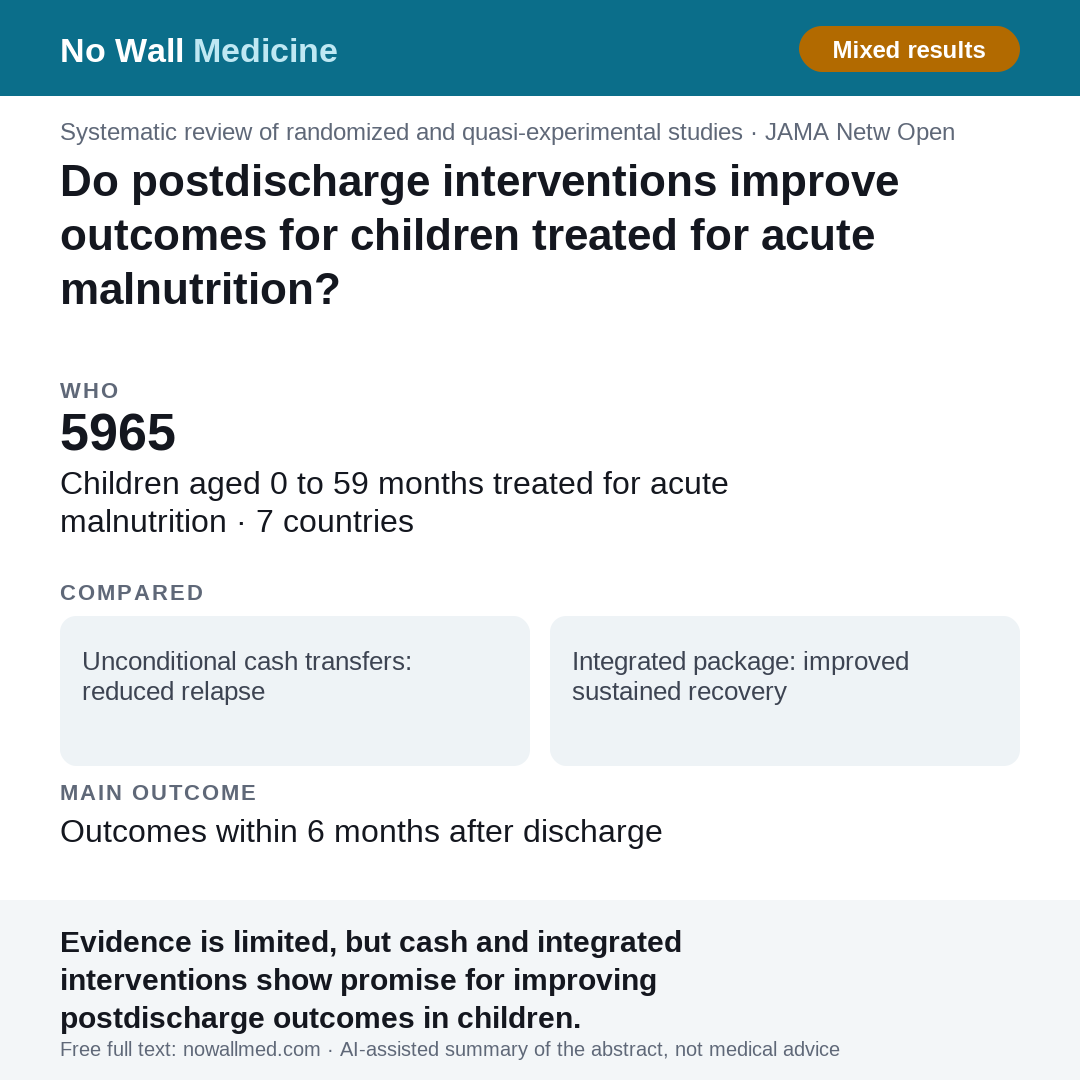
Clinical question: Do postdischarge interventions improve outcomes for children treated for acute malnutrition?
Why it matters: Global guidelines currently provide no recommendations to sustain recovery for children following discharge from nutritional treatment for acute malnutrition.
Key points
- Researchers reviewed 8 studies involving 5965 children aged 0 to 59 months to evaluate interventions delivered after nutritional treatment discharge.
- Unconditional cash transfers were associated with reduced relapse, while an integrated package of biomedical, food, and malaria prevention was associated with improved sustained recovery.
- Zinc supplementation, food supplementation, psychosocial stimulation, and cash transfers were associated with improvements in postdischarge anthropometry, which refers to body measurements.
Limitation the authors note: The risk of bias was moderate or high for half of the included studies.
Headline and key points written with AI from the paper’s abstract, with every number checked against it. Read the paper before relying on them.
Was this summary helpful?
Subject terms
Cite this article
Bliznashka L, Rattigan SM, Sudfeld CR, Isanaka S. Analysis of Postdischarge Interventions for Children Treated for Moderate or Severe Wasting, Growth Faltering or Failure, or Edema: A Systematic Review. JAMA Netw Open. 2023. doi:10.1001/jamanetworkopen.2023.15077
Spotted a mistake? Suggest a correction
Top studies every Monday
The week’s key trials and guidelines in your specialties, plus any topics you follow. By email, free.
Get the weekly digest