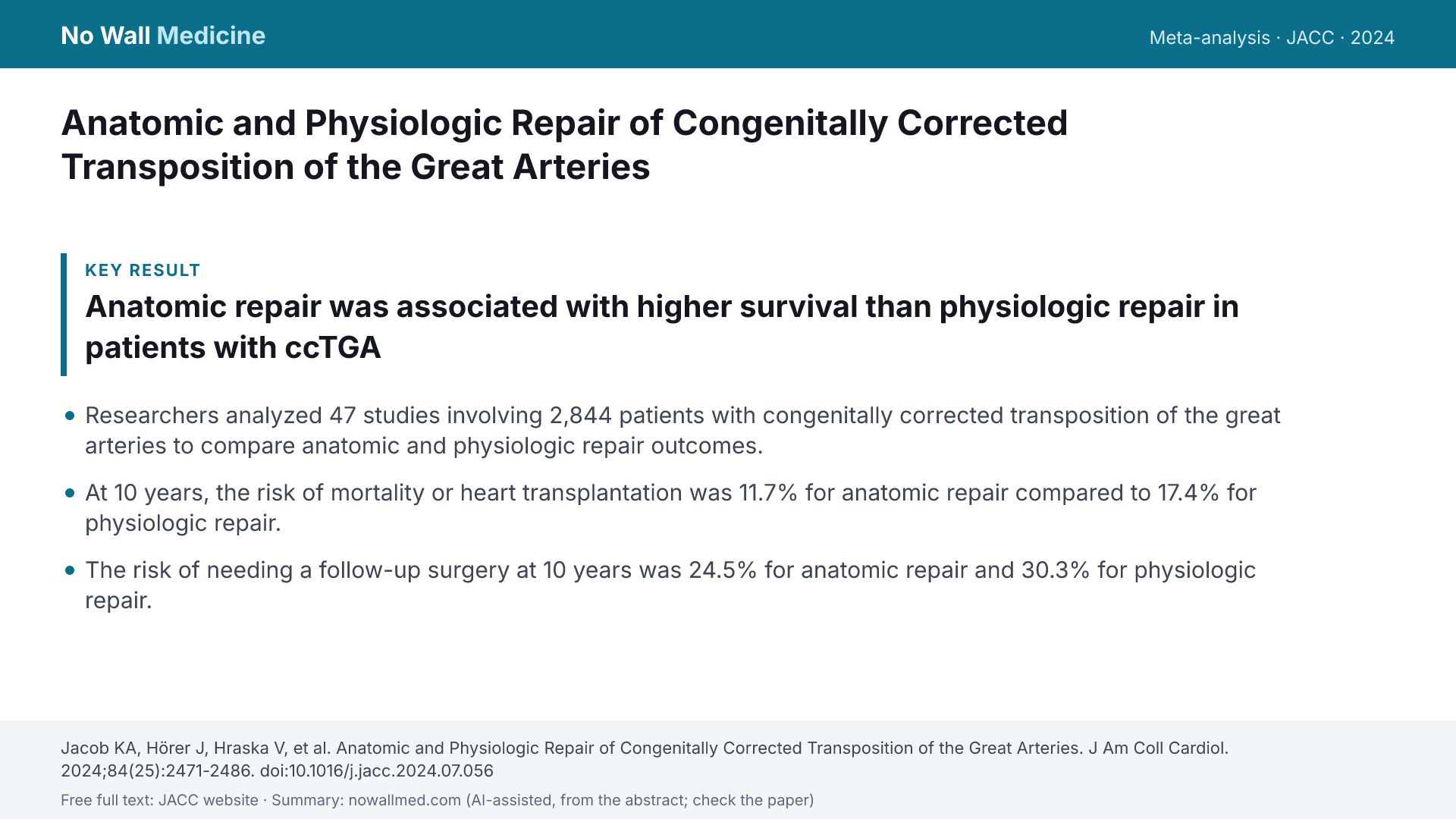
Anatomic repair was associated with higher survival than physiologic repair in patients with ccTGA
Anatomic and Physiologic Repair of Congenitally Corrected Transposition of the Great Arteries
Key points
- Researchers analyzed 47 studies involving 2,844 patients with congenitally corrected transposition of the great arteries to compare anatomic and physiologic repair outcomes.
- At 10 years, the risk of mortality or heart transplantation was 11.7% for anatomic repair compared to 17.4% for physiologic repair.
- The risk of needing a follow-up surgery at 10 years was 24.5% for anatomic repair and 30.3% for physiologic repair.
Headline and key points written with AI from the paper’s abstract, with every number checked against it. Read the paper before relying on them.
Was this summary helpful?
Subject terms
Headline, design, result, key points, caveat and citation as plain text.
Cite this article
Jacob KA, Hörer J, Hraska V, et al. Anatomic and Physiologic Repair of Congenitally Corrected Transposition of the Great Arteries. JACC. 2024. doi:10.1016/j.jacc.2024.07.056
Spotted a mistake? Suggest a correction