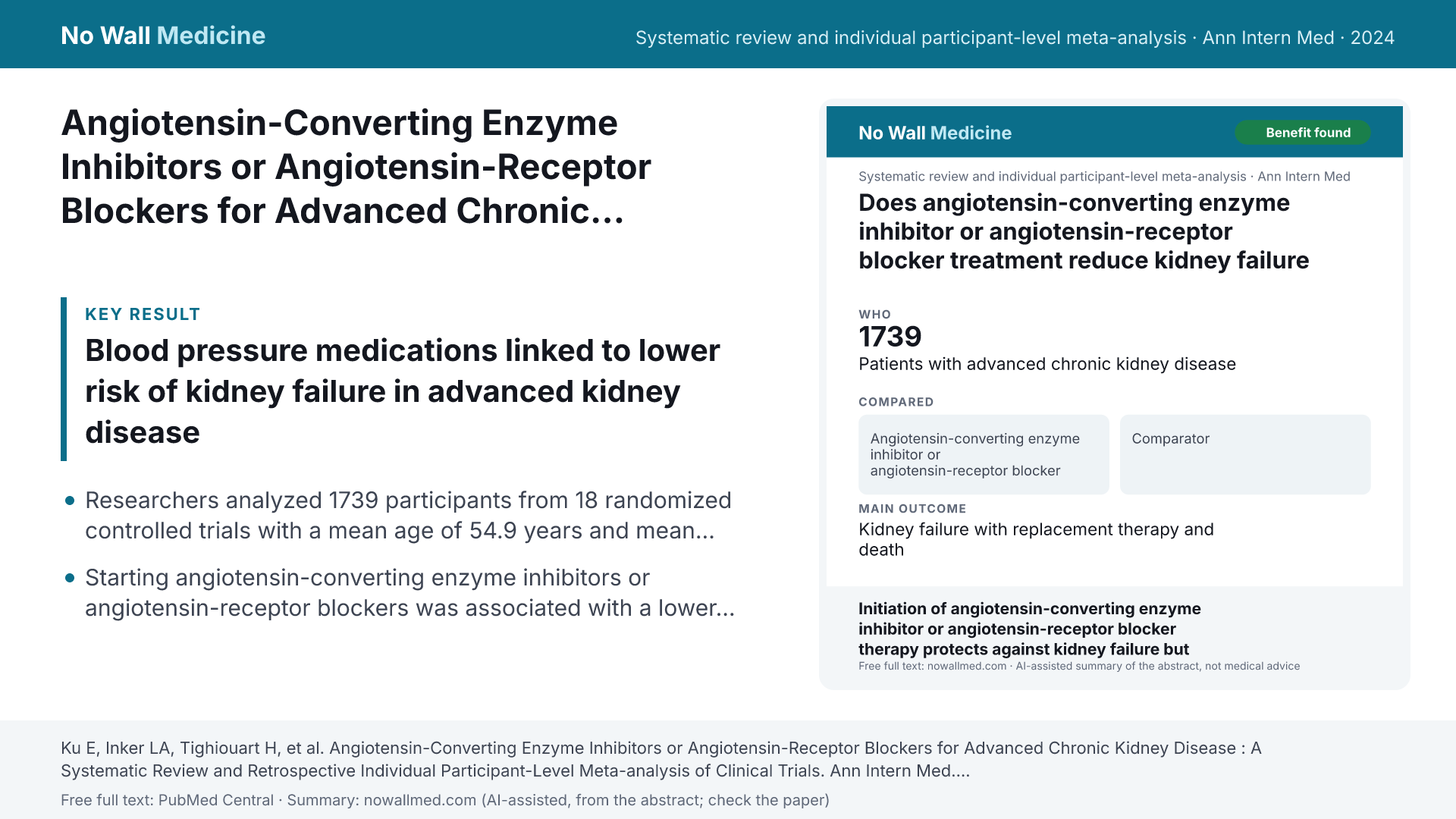
Blood pressure medications linked to lower risk of kidney failure in advanced kidney disease
Angiotensin-Converting Enzyme Inhibitors or Angiotensin-Receptor Blockers for Advanced Chronic Kidney Disease : A Systematic Review and Retrospective Individual Participant-Level Meta-analysis of Clinical Trials
Systematic review and individual participant-level meta-analysisBenefit found
Does angiotensin-converting enzyme inhibitor or angiotensin-receptor blocker treatment reduce kidney failure or death?
Who
1739
Patients with advanced chronic kidney disease
Compared
Angiotensin-converting enzyme inhibitor or angiotensin-receptor blocker
Comparator
Main outcome
Kidney failure with replacement therapy and death
Result: adjusted hazard ratio 0.66 (95% CI 0.55 to 0.79) for kidney failure
Bottom line: Initiation of angiotensin-converting enzyme inhibitor or angiotensin-receptor blocker therapy protects against kidney failure but not death in advanced chronic kidney disease.
Limitation: Individual participant-level data for hyperkalemia or acute kidney injury were not available.
Funded by: National Institutes of Health
Ann Intern Med · 2024-07-02 · Save PNG
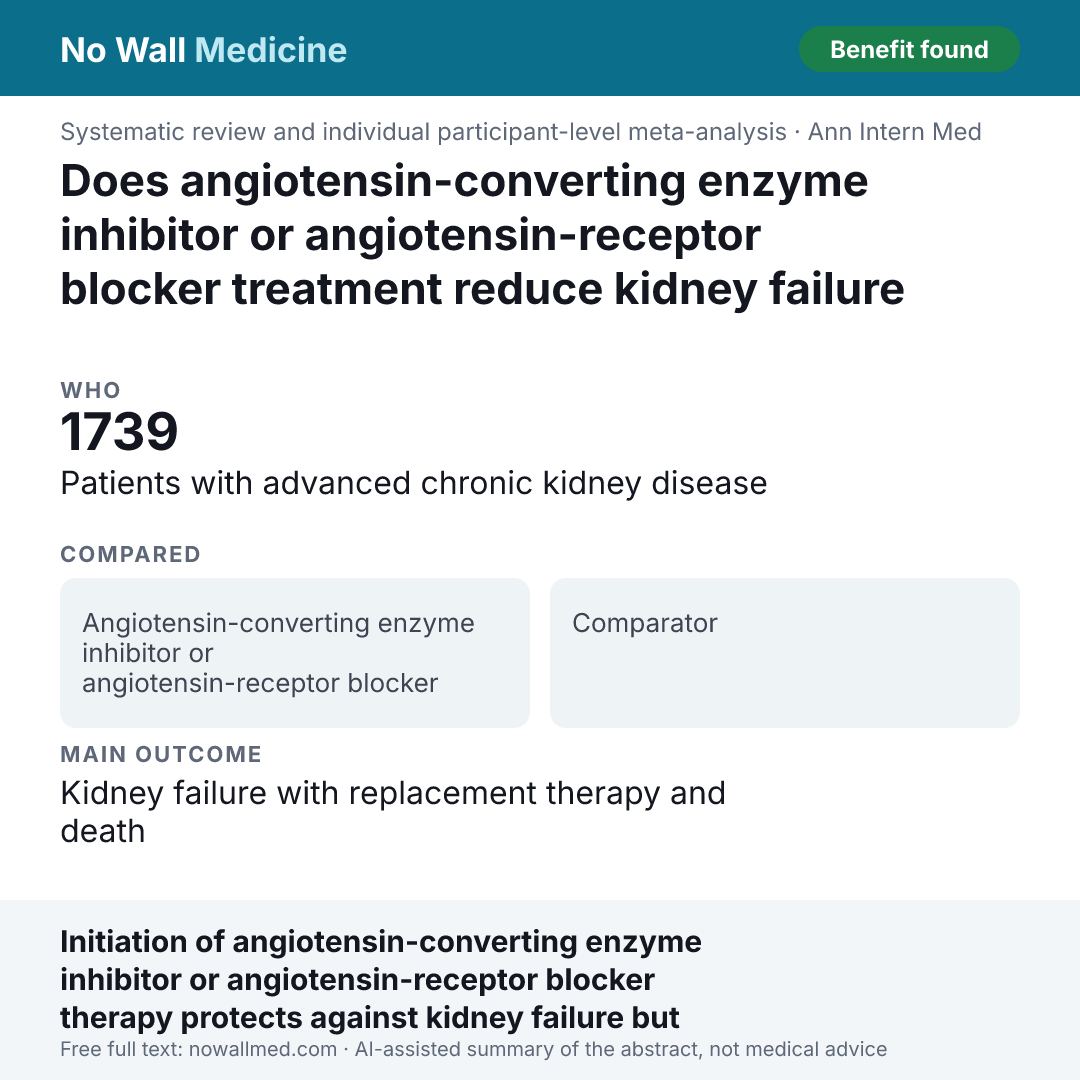
Clinical question: Does angiotensin-converting enzyme inhibitor or angiotensin-receptor blocker treatment reduce kidney failure or death?
Key points
- Researchers analyzed 1739 participants from 18 randomized controlled trials with a mean age of 54.9 years and mean kidney function of 22.2 mL/min/1.73 m2.
- Starting angiotensin-converting enzyme inhibitors or angiotensin-receptor blockers was associated with a lower risk of kidney failure requiring replacement therapy (adjusted hazard ratio, 0.66 [95% CI, 0.55 to 0.79]).
- The treatment was not associated with a difference in death before kidney failure (hazard ratio, 0.86 [CI, 0.58 to 1.28]).
Limitation the authors note: Individual participant-level data for hyperkalemia or acute kidney injury were not available.
Headline and key points written with AI from the paper’s abstract, with every number checked against it. Read the paper before relying on them.
Was this summary helpful?
Subject terms
Headline, design, result, key points, caveat and citation as plain text.
Cite this article
Ku E, Inker LA, Tighiouart H, et al. Angiotensin-Converting Enzyme Inhibitors or Angiotensin-Receptor Blockers for Advanced Chronic Kidney Disease : A Systematic Review and Retrospective Individual Participant-Level Meta-analysis of Clinical Trials. Ann Intern Med. 2024;177(7):953-963. doi:10.7326/M23-3236
Spotted a mistake? Suggest a correction