Review of 409 animal models shows laser-induced mice are most common for studying eye disease
Animal Models of Choroidal Neovascularization: A Systematic Review
Systematic reviewUnclear result
What are the characteristics of contemporary mammalian animal models of choroidal neovascularization?
Who
409
Mammalian animal models of choroidal neovascularization
Compared
76%Mice
Rats and non-human primates
Main outcome
Characteristics of contemporary animal models of choroidal neovascularization
Bottom line: The laser-induced mouse model is predominant, but inadequate reporting and animal selection may challenge clinical translation.
Invest Ophthalmol Vis Sci · 2022-08-09Download image
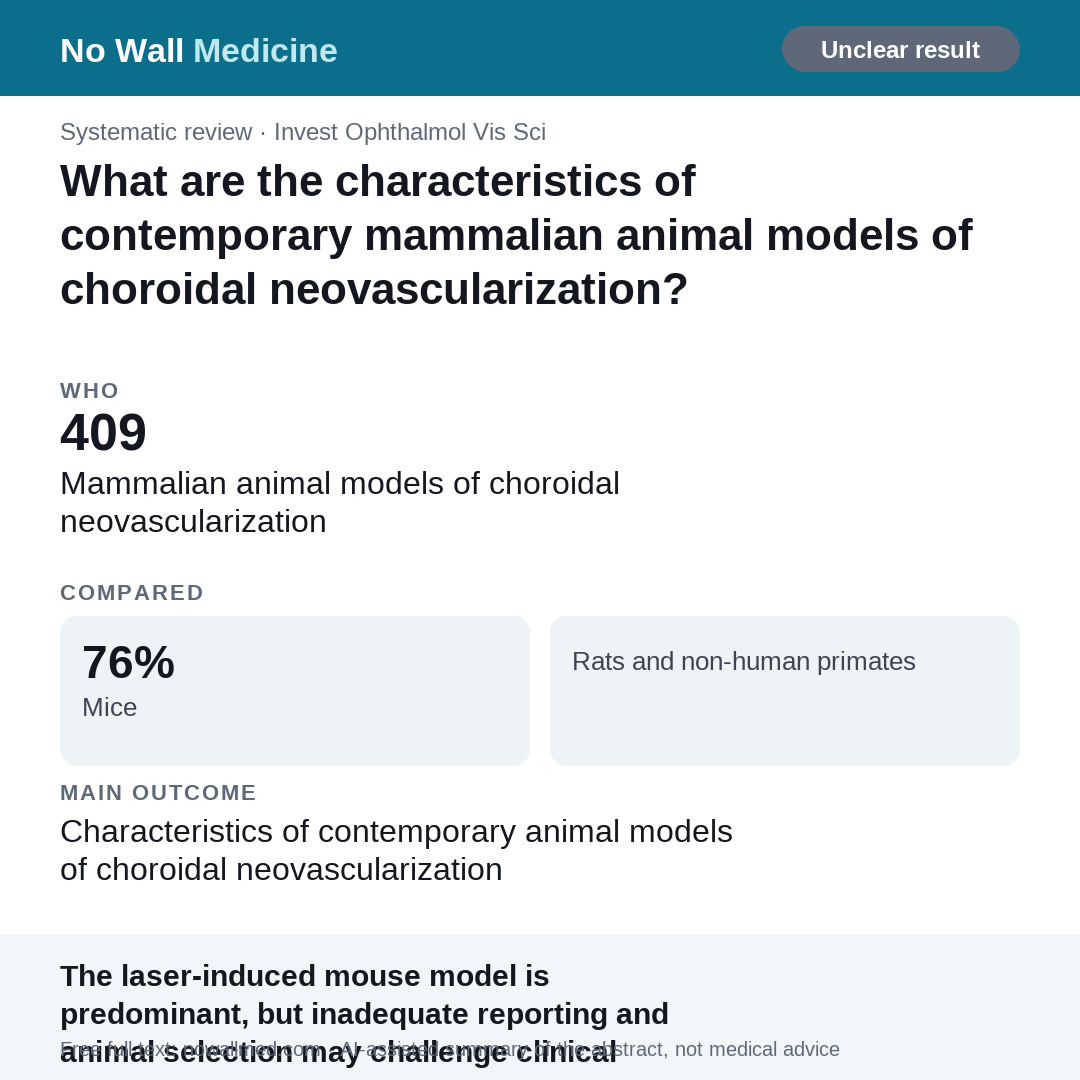
Clinical question: What are the characteristics of contemporary mammalian animal models of choroidal neovascularization?
Why it matters: It is unclear how well current animal models of choroidal neovascularization translate to human clinical settings due to variations in reporting and animal characteristics.
Key points
- Researchers reviewed 380 articles covering 409 independent mammalian animal models used to study choroidal neovascularization, which is the growth of abnormal blood vessels under the retina.
- Mice were the most used animal at 76%, and while 89% used laser induction, only 44% reported standard laser parameters sufficiently.
- The review found that 28% of studies did not report a sample size for quantitative evaluation and 32% of studies did not report the sex of the animals.
Headline and key points written with AI from the paper’s abstract, with every number checked against it. Read the paper before relying on them.
Was this summary helpful?
Subject terms
Cite this article
Fabian-Jessing BK, Jakobsen TS, Jensen EG, Alsing S, Hansen S, Aagaard L. Animal Models of Choroidal Neovascularization: A Systematic Review. Invest Ophthalmol Vis Sci. 2022. doi:10.1167/iovs.63.9.11
Spotted a mistake? Suggest a correction
Top studies every Monday
The week’s key trials and guidelines in your specialties, plus any topics you follow. By email, free.
Get the weekly digest