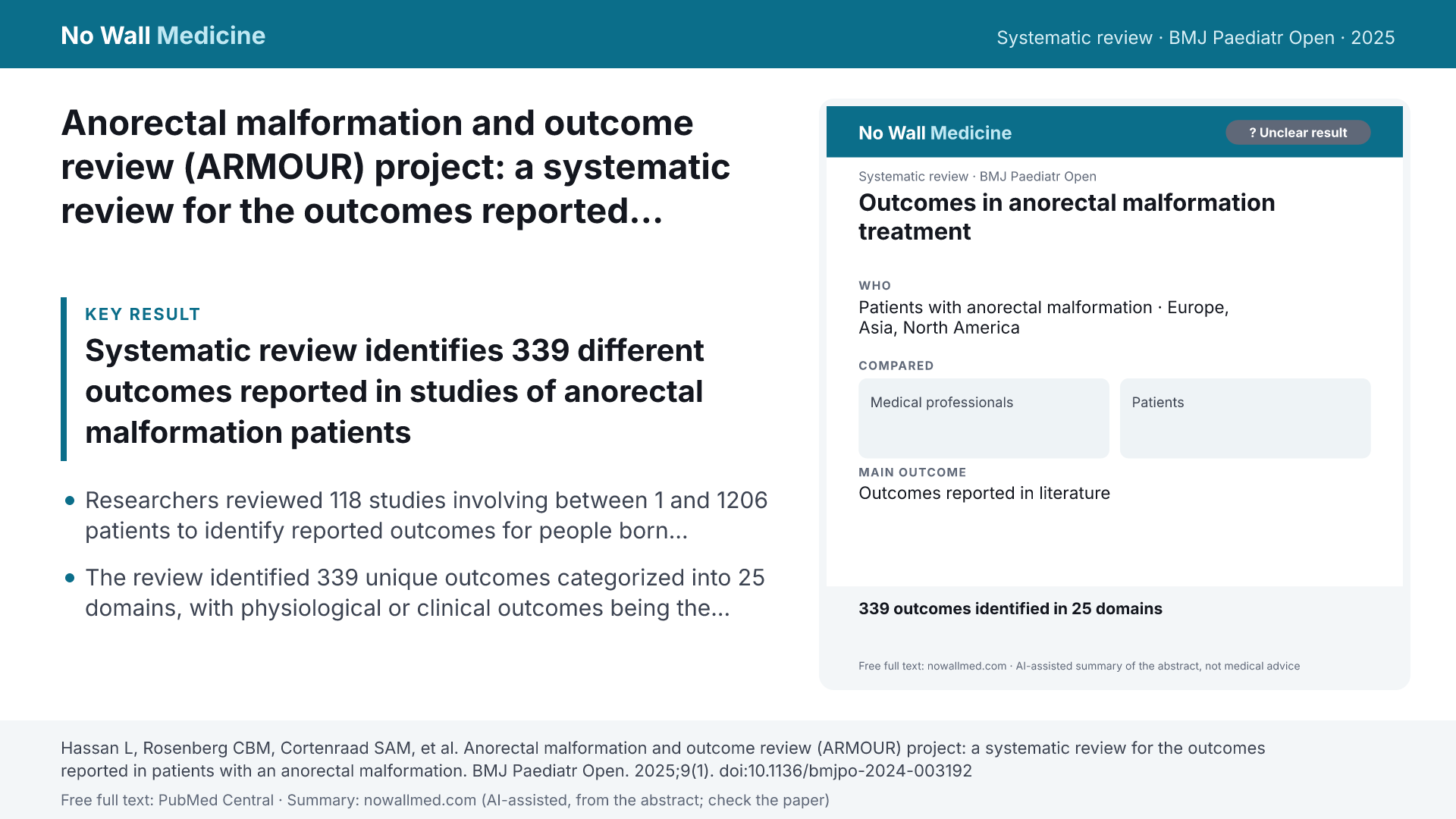
Systematic review identifies 339 different outcomes reported in studies of anorectal malformation patients
Anorectal malformation and outcome review (ARMOUR) project: a systematic review for the outcomes reported in patients with an anorectal malformation
Systematic reviewUnclear result
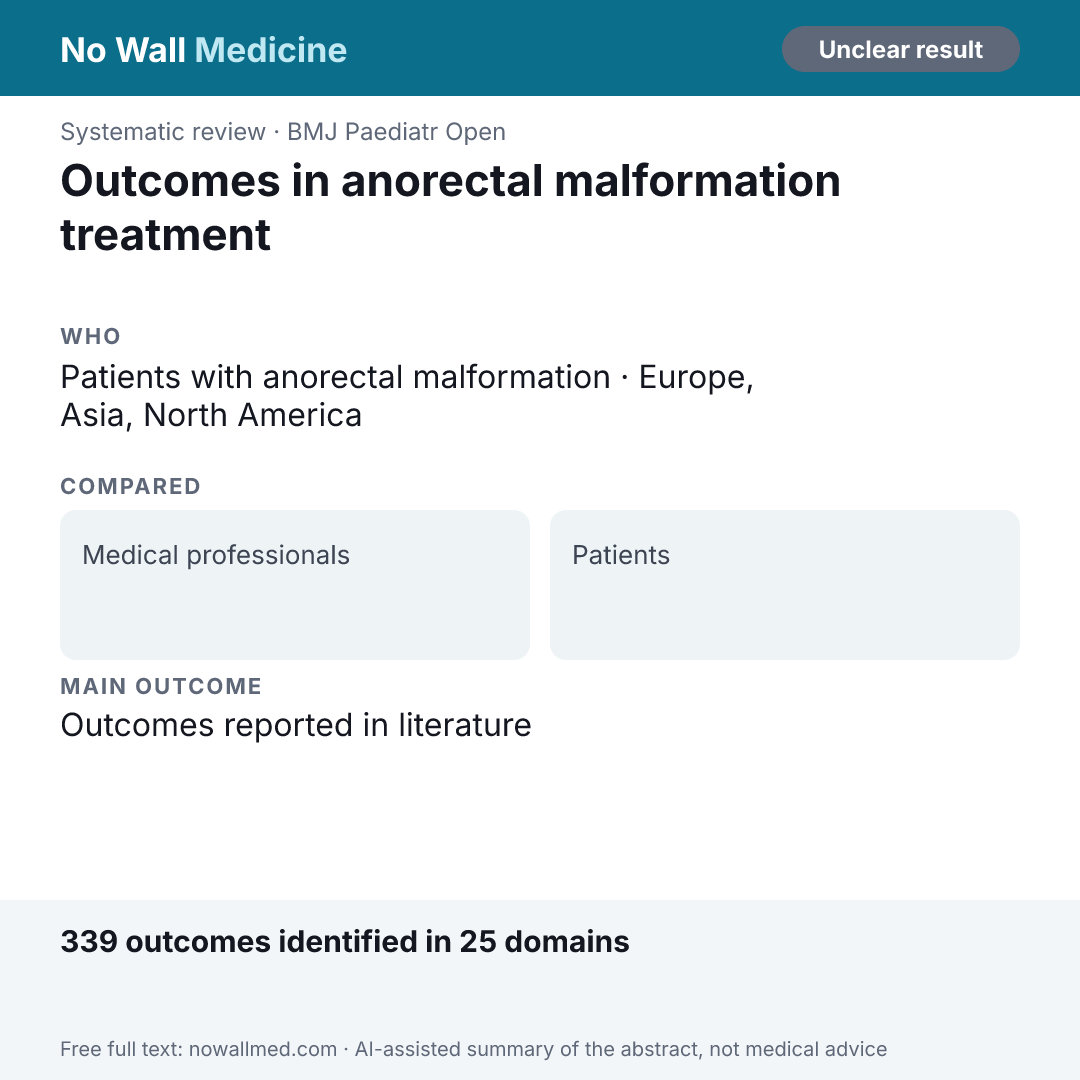
Outcomes in anorectal malformation treatment
Who
Patients with anorectal malformation · Europe, Asia, North America
Compared
Medical professionals
Patients
Main outcome
Outcomes reported in literature
Bottom line: 339 outcomes identified in 25 domains
BMJ Paediatr Open · 2025-07-15 · Save PNG
Key points
- Researchers reviewed 118 studies involving between 1 and 1206 patients to identify reported outcomes for people born with anorectal malformations.
- The review identified 339 unique outcomes categorized into 25 domains, with physiological or clinical outcomes being the most frequently mentioned.
- Long-term outcomes were the most common type reported at 71%, while only 10% of outcomes were reported directly by patients.
Limitation the authors note: Many studies lacked clear descriptions of surgical techniques, age categories, or detailed validation of their measurement methods.
Headline and key points written with AI from the paper’s abstract, with every number checked against it. Read the paper before relying on them.
Was this summary helpful?
Abstract
Background
Being born with an anorectal malformation (ARM) often leads to lifelong issues with faecal and urinary function, as well as challenges in sexual, emotional and psychosocial development. Even when anatomical correction is achieved, full functional recovery is not guaranteed. Despite several international consensus meetings with leading medical professionals in the ARM field, there is still no agreement on the essential outcome domains that should be measured for ARM treatment and follow-up. Therefore, the goal of this systematic review is to identify all the outcomes reported in literature. Methods
This systematic review adhered to Preferred Reporting Items for Systematic Reviews and Meta-Analyses guidelines, aiming to identify all short- and long-term outcomes in ARM studies. A literature search was conducted in PubMed and Embase for studies from 1 January 2009 to 1 May 2023, using terms related to 'anorectal malformation'. The Cochrane Library was also searched, but no relevant reviews were found. Eligibility criteria included studies mentioning ARM outcomes in the title or abstract. Exclusions were non-mention of ARM outcomes, lack of full text, and non-English or non-Dutch language. Data extraction by two reviewers captured author details, study design, patient characteristics, ARM types and outcomes, categorised by occurrence time and reporter. Outcomes were consolidated from 339 unique outcomes into 25 domains according to the Core Outcome Measures in Effectiveness Trial () taxonomy and categorised into five core areas: 'mortality/survival', 'physiological/clinical', 'life impact', 'resource use' and 'adverse events'. Results
Out of 348 eligible studies, 118 met the inclusion criteria. These were mostly conducted in Europe (47%), Asia (34%) and North America (11%), with designs including retrospective (36%), cross-sectional (23%) and case reports/series (18%). Patient numbers ranged from 1 to 1206, with many studies lacking clear descriptions of surgical techniques (29%) and age categories (21%). A total of 339 outcomes were identified, categorised into 25 domains per the COMET taxonomy. Mentioned most frequently were 'physiological/clinical' outcomes (772 mentions), with 'gastrointestinal outcomes' being predominant. Long-term outcomes were most common (71%), followed by both short and long term (16%), and short term (13%). Outcomes were mainly reported by medical professionals (59%), with only 10% being patient-reported outcomes. Various measurement tools were used, including validated and self-made instruments, with the international classification (Krickenbeck) being the most used rating scale for postoperative results. Many studies lacked detailed descriptions and validation of their measurement methods.The identified outcomes in this review will be used as an input to eventually develop a Core Outcome Set.
Abstract reproduced under the article’s CC BY NC licence.
Subject terms
Headline, design, result, key points, caveat and citation as plain text.
Cite this article
Hassan L, Rosenberg CBM, Cortenraad SAM, et al. Anorectal malformation and outcome review (ARMOUR) project: a systematic review for the outcomes reported in patients with an anorectal malformation. BMJ Paediatr Open. 2025;9(1). doi:10.1136/bmjpo-2024-003192
Spotted a mistake? Suggest a correction