Dexamethasone administration for preterm birth was cost-saving in five low-resource countries
Antenatal dexamethasone for improving preterm newborn outcomes in low-resource countries: a cost-effectiveness analysis of the WHO ACTION-I trial
Cost-effectiveness analysis of a randomized, placebo-controlled trialBenefit found
Is antenatal dexamethasone cost-effective for preterm birth in low-resource countries?
Who
2828
Pregnant women at risk of early preterm birth · 29 hospitals in Bangladesh, India, Kenya, Nigeria, and Pakistan
Compared
Dexamethasone: 38 neonatal deaths averted per 1000 woman-baby units
No intervention
Main outcome
Cost per neonatal death or disability-adjusted life-years averted
Result: cost-saving in all five countries
Bottom line: Antenatal dexamethasone is cost-effective and often cost-saving for early preterm birth in low-resource country hospitals.
Funded by: Bill & Melinda Gates Foundation and WHO
Lancet Glob Health · 2022-09-17Download image
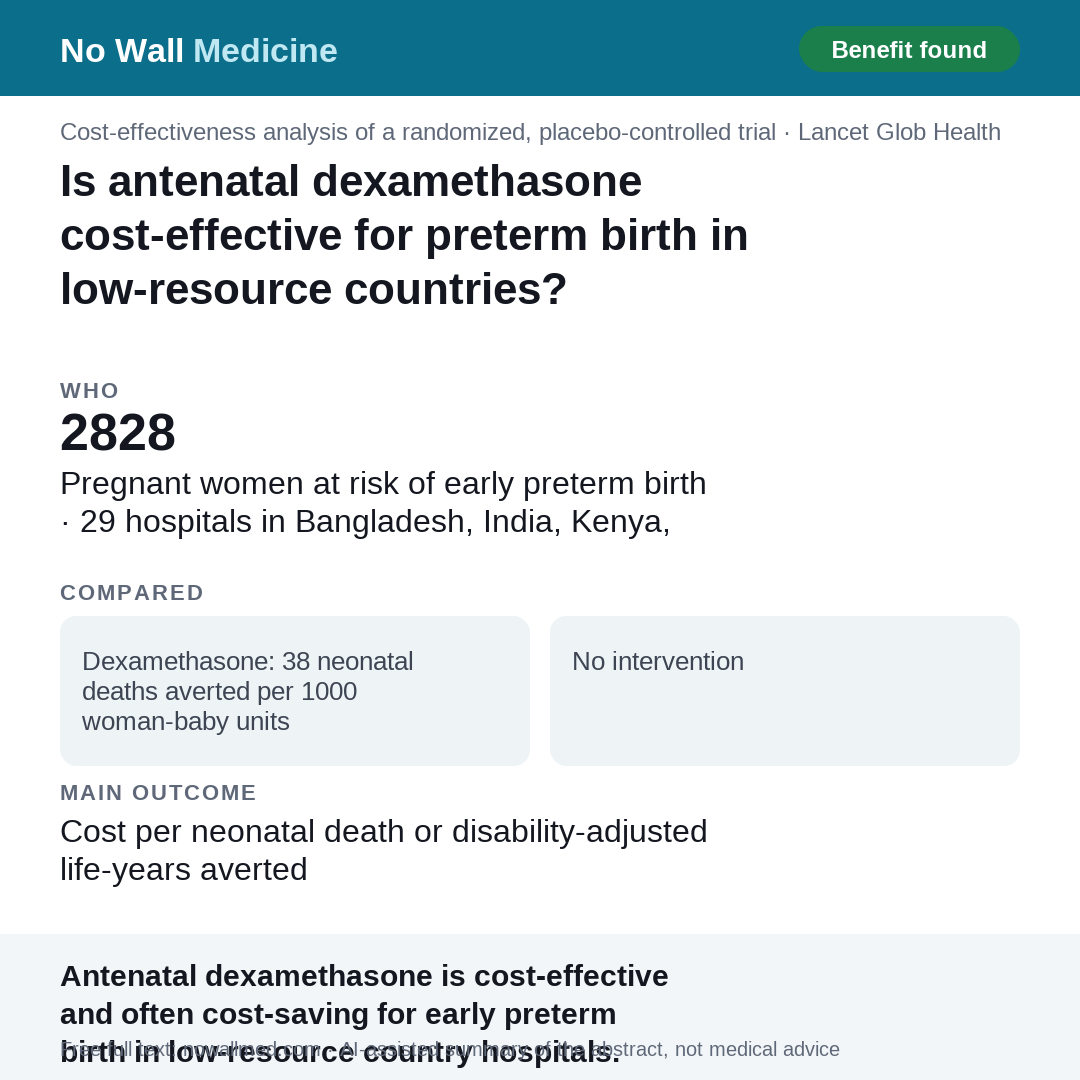
Clinical question: Is antenatal dexamethasone cost-effective for preterm birth in low-resource countries?
Why it matters: The cost-effectiveness of using dexamethasone, a steroid, for managing preterm birth in low-resource settings was not established.
Key points
- Researchers analyzed data from 2828 women and 3051 babies from a randomized trial across 29 hospitals in Bangladesh, India, Kenya, Nigeria, and Pakistan.
- Dexamethasone administration averted 38 neonatal deaths and 1132 disability-adjusted life-years per 1000 woman-baby units compared to no intervention.
- The treatment was cost-saving in all five countries, with savings ranging from US$1778 in Nigeria to US$53 681 in Kenya per 1000 woman-baby units.
Headline and key points written with AI from the paper’s abstract, with every number checked against it. Read the paper before relying on them.
Was this summary helpful?
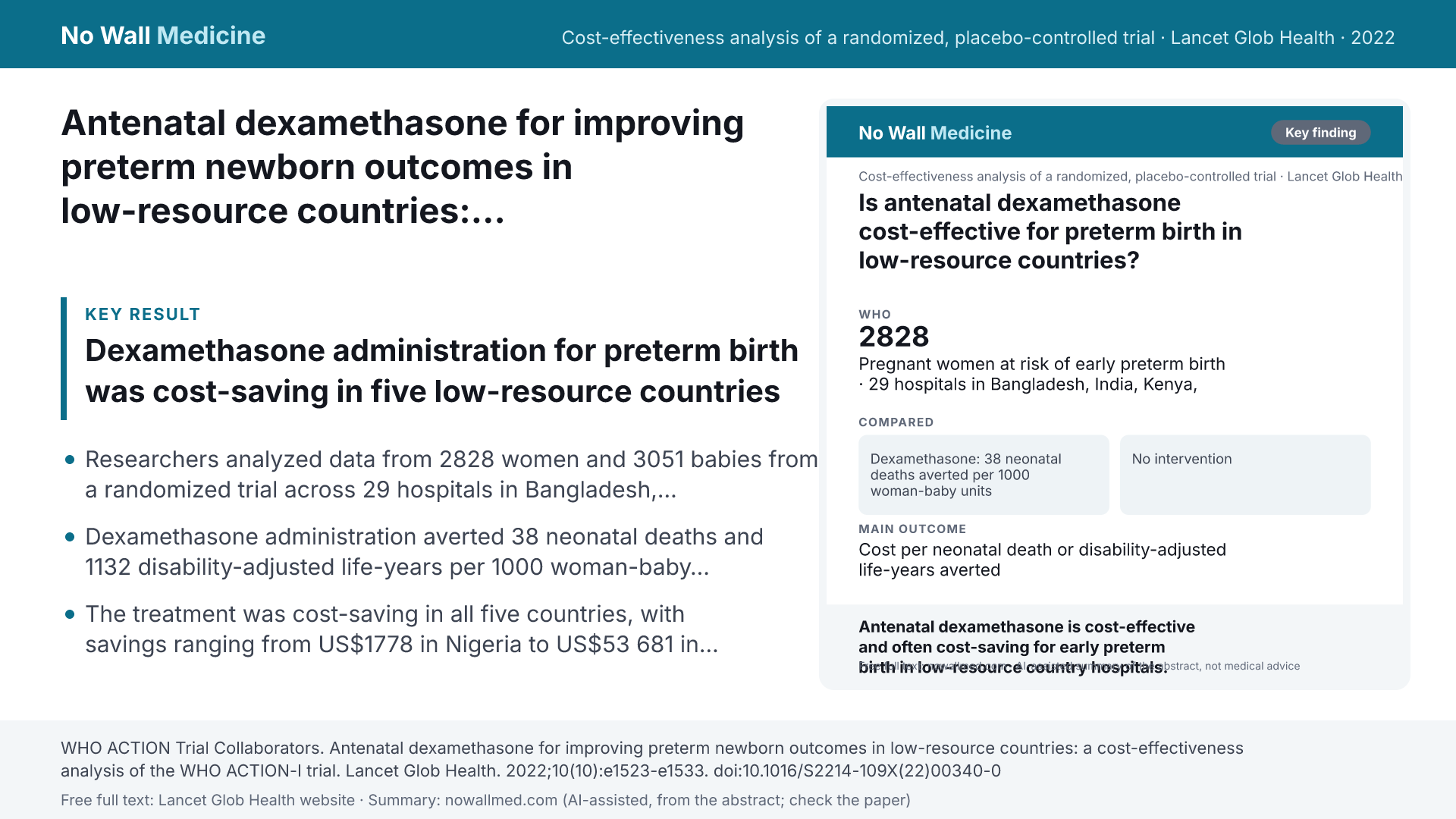
Abstract
Background
After considerable debate, there is now unequivocal evidence that use of antenatal corticosteroids improves outcomes in preterm neonates when used in women at risk of early preterm birth in reasonably equipped hospitals in low-resource countries. We aimed to evaluate the cost-effectiveness of dexamethasone administration in the management of preterm birth in a cohort of pregnant women from five low-resource countries. Methods
We performed a cost-effectiveness analysis using data from 2828 women (and 3051 babies) who participated in the WHO ACTION-I trial, a multicentre, randomised, placebo-controlled trial that assessed the safety and efficacy of dexamethasone in pregnant women at risk of early preterm birth in 29 hospitals across Bangladesh, India, Kenya, Nigeria, and Pakistan. We used a decision tree model to assess the cost-effectiveness of dexamethasone treatment compared with no intervention from a health-care sector perspective. Outcome data were taken from the primary results of the trial and primary data on cost were collected in 28 hospitals. The primary cost-effectiveness outcome was cost per neonatal death or the cost per disability-adjusted life-years (DALYs) averted, or costs saved per 1000 woman-baby units if the intervention was found to be cost-saving. Findings
Administration of dexamethasone averted 38 neonatal deaths per 1000 woman-baby units and 1132 DALYs per 1000 woman-baby units. Compared with no intervention, use of antenatal corticosteroids was cost-saving in all five countries, ranging from a saving of US$1778 per 1000 woman-baby units (95% uncertainty interval [UI] -13 878 to 9483) in Nigeria, to $20 531 per 1000 woman-baby units (-46 387 to 4897) in Pakistan, to $36 870 per 1000 woman-baby units (-61 569 to -15 672) in Bangladesh, to $38 303 per 1000 woman-baby units (-64 183 to -10 753) in India, and to $53 681 per 1000 woman-baby units (-113 822 to 2394) in Kenya. Findings remained consistent following sensitivity analyses. In all five countries, dexamethasone was more effective and cost less compared with no treatment. Interpretation
Antenatal dexamethasone for early preterm birth was cost-saving when used in hospitals in low-resource countries. Decision makers in low-resource settings can be confident that use of antenatal dexamethasone for early preterm birth is cost-effective, and often cost-saving when used in reasonably equipped hospitals in low-resource countries. Funding
Bill & Melinda Gates Foundation and WHO.
Abstract reproduced under the article’s CC BY licence.
Subject terms
Cite this article
WHO ACTION Trial Collaborators. Antenatal dexamethasone for improving preterm newborn outcomes in low-resource countries: a cost-effectiveness analysis of the WHO ACTION-I trial. Lancet Glob Health. 2022. doi:10.1016/S2214-109X(22)00340-0
Spotted a mistake? Suggest a correction
Top studies every Monday
The week’s key trials and guidelines in your specialties, plus any topics you follow. By email, free.
Get the weekly digest