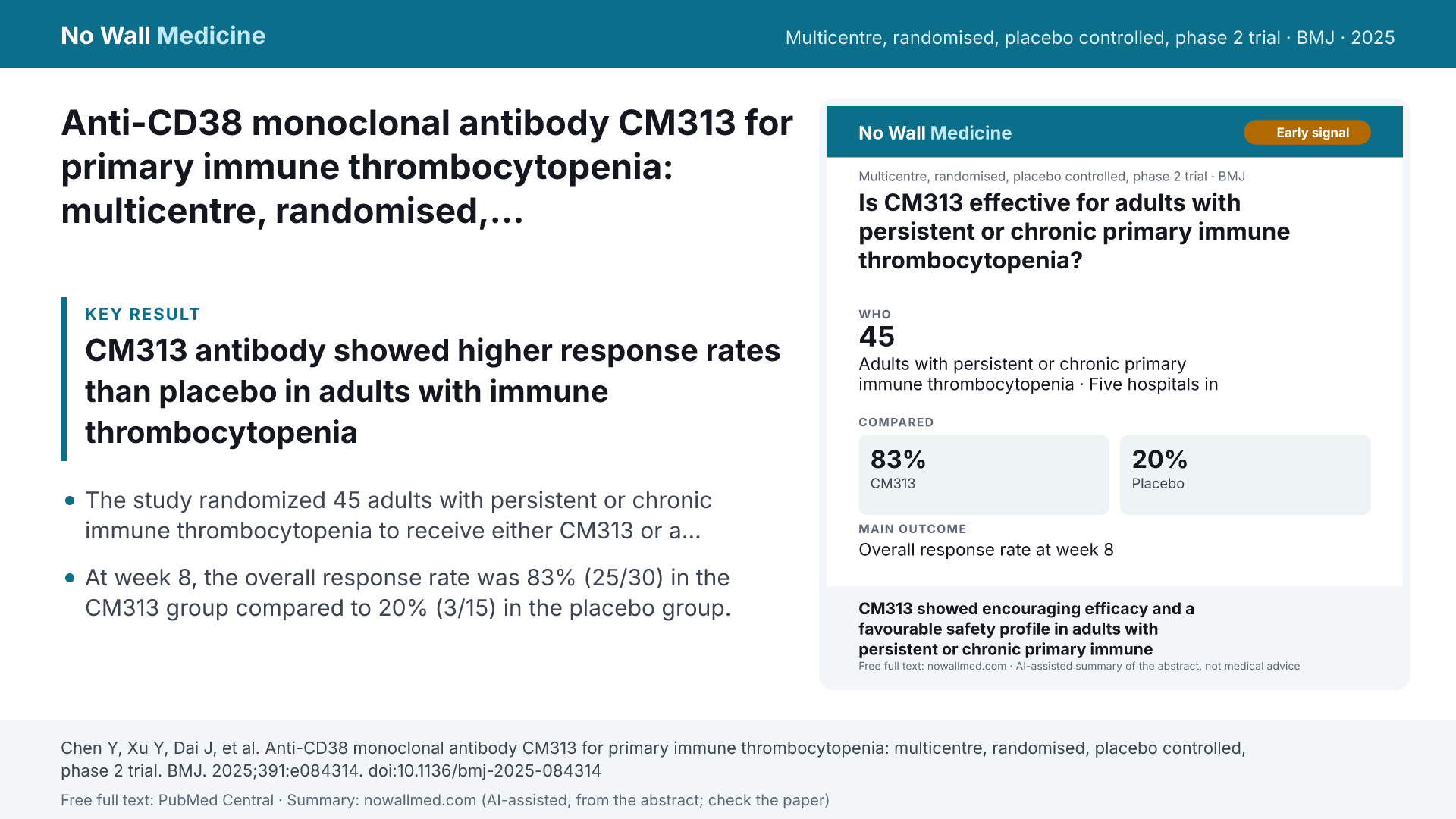
CM313 antibody showed higher response rates than placebo in adults with immune thrombocytopenia
Anti-CD38 monoclonal antibody CM313 for primary immune thrombocytopenia: multicentre, randomised, placebo controlled, phase 2 trial
Multicentre, randomised, placebo controlled, phase 2 trialEarly signal
Is CM313 effective for adults with persistent or chronic primary immune thrombocytopenia?
Who
45
Adults with persistent or chronic primary immune thrombocytopenia · Five hospitals in China
Compared
83%CM313 (25/30)
20%Placebo (3/15)
Main outcome
Overall response rate at week 8
Result: difference 63.3% (95% confidence interval 33.7% to 81.3%)
Bottom line: CM313 showed encouraging efficacy and a favourable safety profile in adults with persistent or chronic primary immune thrombocytopenia.
BMJ · 2025-10-21 · Save PNG
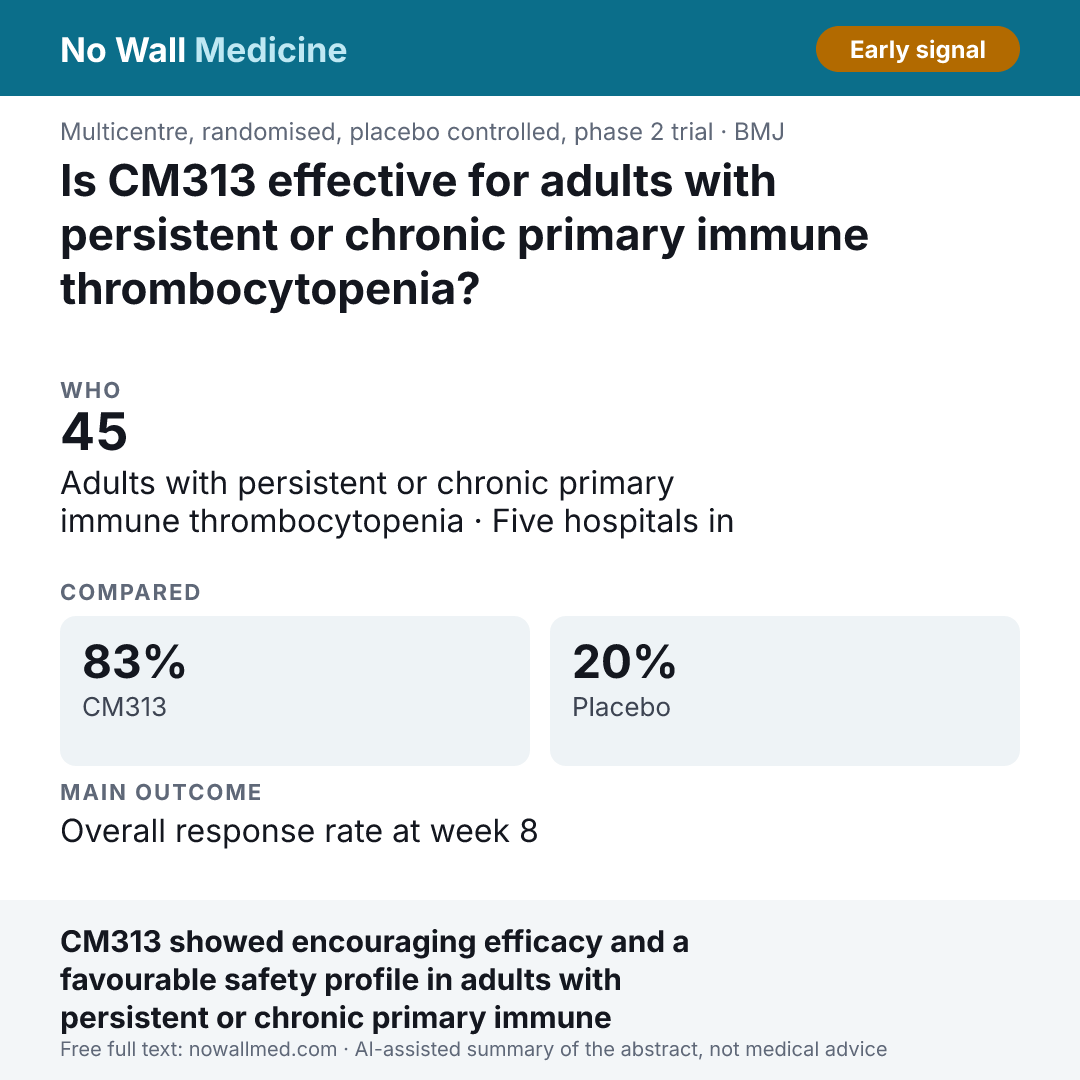
Clinical question: Is CM313 effective for adults with persistent or chronic primary immune thrombocytopenia?
Why it matters: Patients with persistent or chronic immune thrombocytopenia who failed glucocorticoid treatment require new treatment options for managing platelet counts.
Key points
- The study randomized 45 adults with persistent or chronic immune thrombocytopenia to receive either CM313 or a placebo weekly for eight weeks.
- At week 8, the overall response rate was 83% (25/30) in the CM313 group compared to 20% (3/15) in the placebo group.
- Treatment emergent adverse events occurred in 87% (26/30) of the CM313 group and 80% (12/15) of the placebo group.
Headline and key points written with AI from the paper’s abstract, with every number checked against it. Read the paper before relying on them.
Was this summary helpful?
Abstract
Objective
To assess the efficacy and safety of CM313, an anti-CD38 monoclonal antibody, in adults with persistent or chronic primary immune thrombocytopenia. Design
Multicentre, randomised, placebo controlled, phase 2 trial. Setting
Five hospitals in China, 16 January to 11 June 2024. Participants
45 patients aged ≥18 years with persistent or chronic immune thrombocytopenia who failed to respond to, or relapsed after, glucocorticoid treatment but had previously responded to standard first line treatment. Interventions
Patients were randomised to receive intravenous CM313 (16 mg/kg) or placebo weekly for eight weeks. Main outcome measures
The primary outcome was overall response rate (at least two consecutive platelet counts ≥30×109/L, a minimum doubling from baseline, and no bleeding) at week 8. A secondary outcome was time to the first two consecutive platelet counts ≥50×109/L. Results
Of 56 patients screened, 45 were randomised to receive CM313 (n=30) or placebo (n=15). At week 8, the overall response rate was higher in the CM313 group (83%; 25/30) compared with placebo group (20%; 3/15): difference 63.3% (95% confidence interval 33.7% to 81.3%; P<0.001). The median time to a platelet count of ≥50×109/L was one week in the CM313 group but was not reached in the placebo group (P<0.001). The median cumulative response duration for platelet counts ≥50×109/L was 18 weeks in the CM313 group versus three weeks in the placebo group (P=0.004). Treatment emergent adverse events occurred in 87% (26/30) of patients in the CM313 group and 80% (12/15) in the placebo group, with infusion related reactions and petechiae being the most common. Conclusion
CM313 showed a favourable safety profile and encouraging efficacy in adults with persistent or chronic primary immune thrombocytopenia, characterised by rapid increase in platelet count, sustained platelet responses, and manageable adverse events. Trial registration
ClinicalTrials.gov NCT06199089.
Abstract reproduced under the article’s CC BY NC licence.
Subject terms
Headline, design, result, key points, caveat and citation as plain text.
Cite this article
Chen Y, Xu Y, Dai J, et al. Anti-CD38 monoclonal antibody CM313 for primary immune thrombocytopenia: multicentre, randomised, placebo controlled, phase 2 trial. BMJ. 2025;391:e084314. doi:10.1136/bmj-2025-084314
Spotted a mistake? Suggest a correction