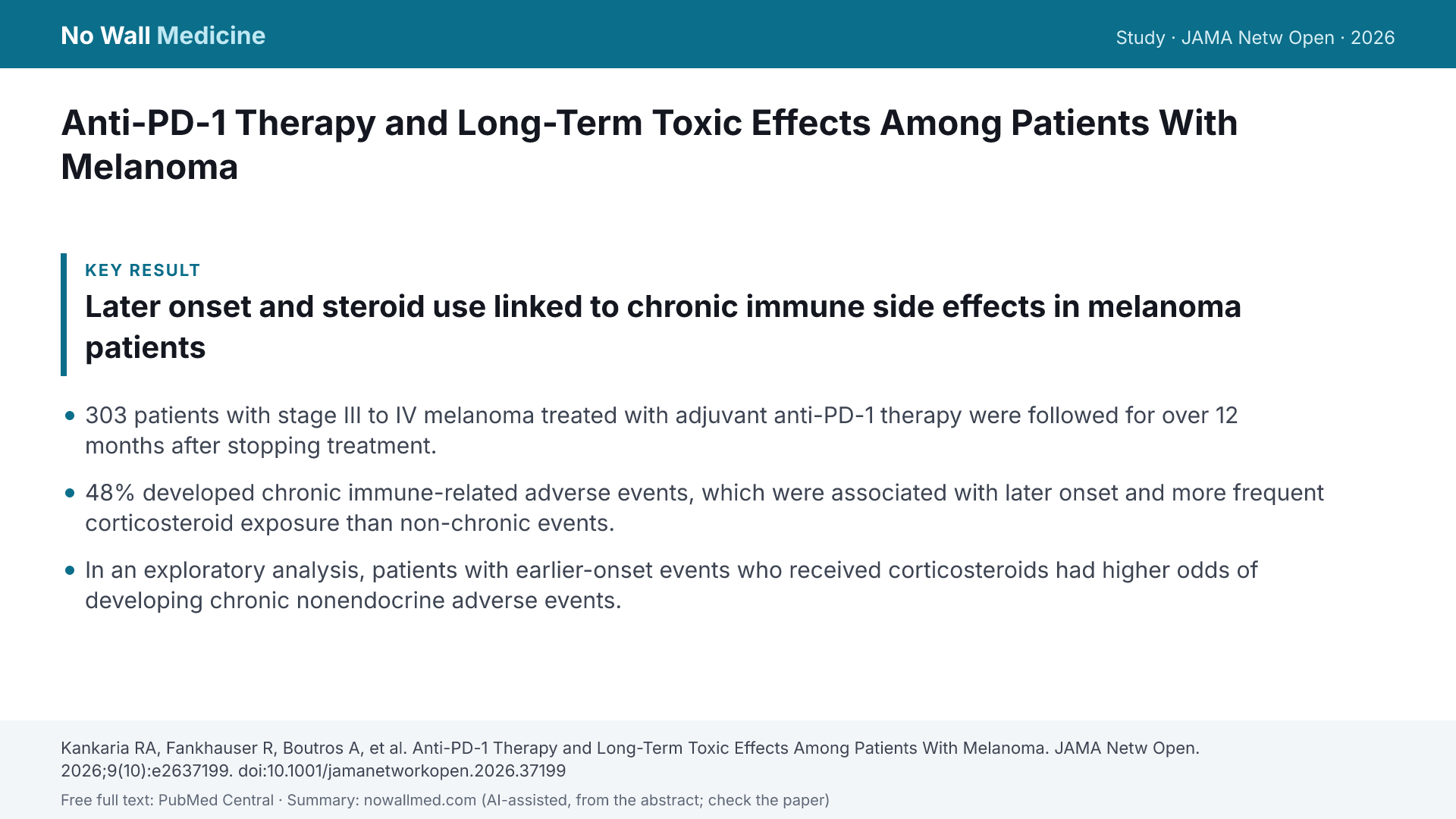
Later onset and steroid use linked to chronic immune side effects in melanoma patients
Anti-PD-1 Therapy and Long-Term Toxic Effects Among Patients With Melanoma
Why it matters: Risk factors distinguishing chronic from acute immune-related adverse events in patients treated with adjuvant anti-PD-1 therapy were previously lacking.
Key points
- 303 patients with stage III to IV melanoma treated with adjuvant anti-PD-1 therapy were followed for over 12 months after stopping treatment.
- 48% developed chronic immune-related adverse events, which were associated with later onset and more frequent corticosteroid exposure than non-chronic events.
- In an exploratory analysis, patients with earlier-onset events who received corticosteroids had higher odds of developing chronic nonendocrine adverse events.
Limitation the authors note: The study was a retrospective cohort design, and the risk factor analysis was exploratory.
Study type: Observational study: it can show a link, but not prove that one thing causes another.
Headline and key points written with AI from the paper’s abstract, with every number checked against it. Read the paper before relying on them.
Was this summary helpful?
Subject terms
Headline, design, result, key points, caveat and citation as plain text.
Cite this article
Kankaria RA, Fankhauser R, Boutros A, et al. Anti-PD-1 Therapy and Long-Term Toxic Effects Among Patients With Melanoma. JAMA Netw Open. 2026;9(10):e2637199. doi:10.1001/jamanetworkopen.2026.37199
Spotted a mistake? Suggest a correction