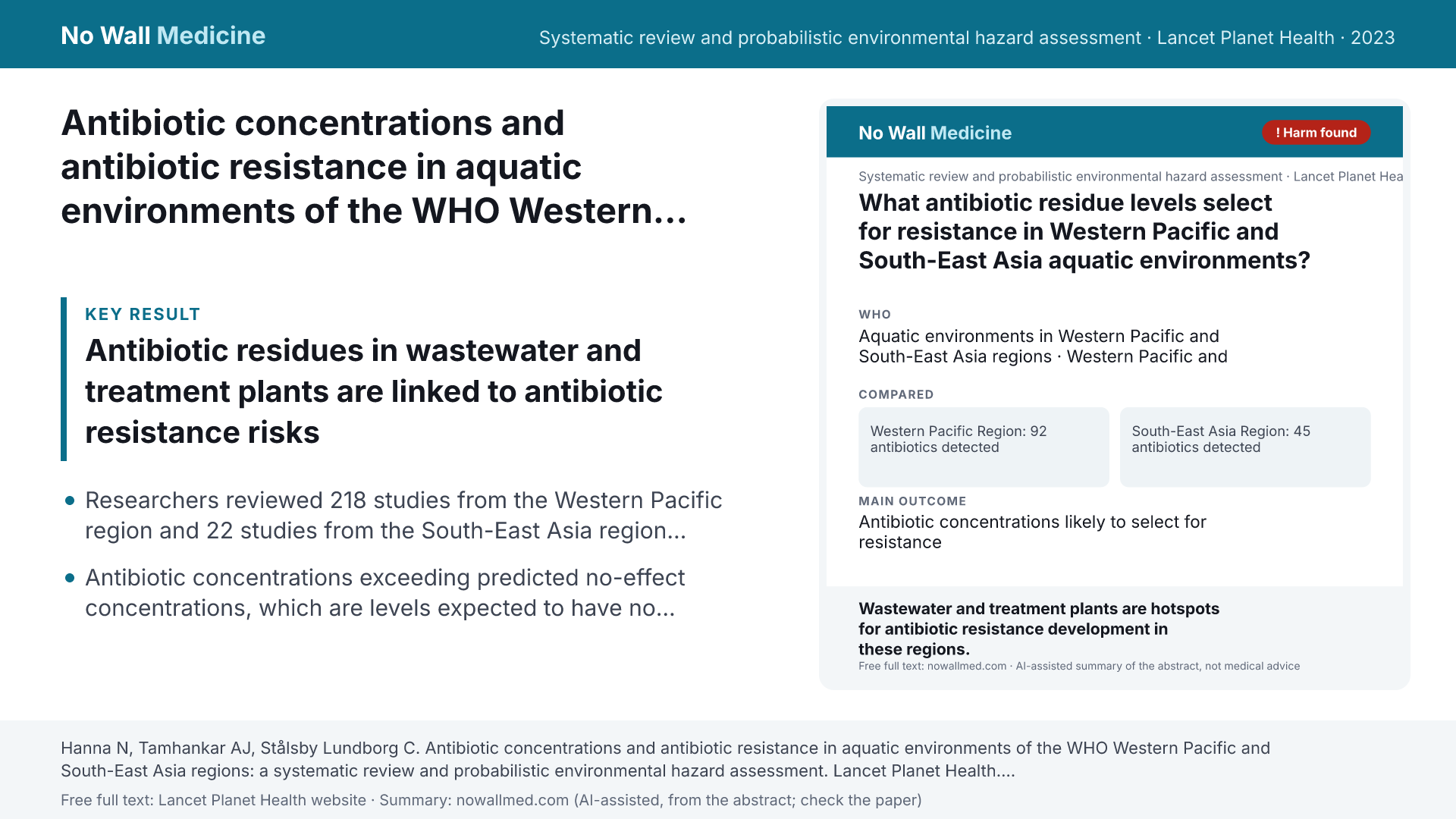
Antibiotic residues in wastewater and treatment plants are linked to antibiotic resistance risks
Antibiotic concentrations and antibiotic resistance in aquatic environments of the WHO Western Pacific and South-East Asia regions: a systematic review and probabilistic environmental hazard assessment
Systematic review and probabilistic environmental hazard assessmentHarm found
What antibiotic residue levels select for resistance in Western Pacific and South-East Asia aquatic environments?
Who
Aquatic environments in Western Pacific and South-East Asia regions · Western Pacific and South-East Asia regions, including China and India
Compared
Western Pacific Region: 92 antibiotics detected
South-East Asia Region: 45 antibiotics detected
Main outcome
Antibiotic concentrations likely to select for resistance
Bottom line: Wastewater and treatment plants are hotspots for antibiotic resistance development in these regions.
Funded by: Swedish Research Council
Lancet Planet Health · 2023-01-07Download image
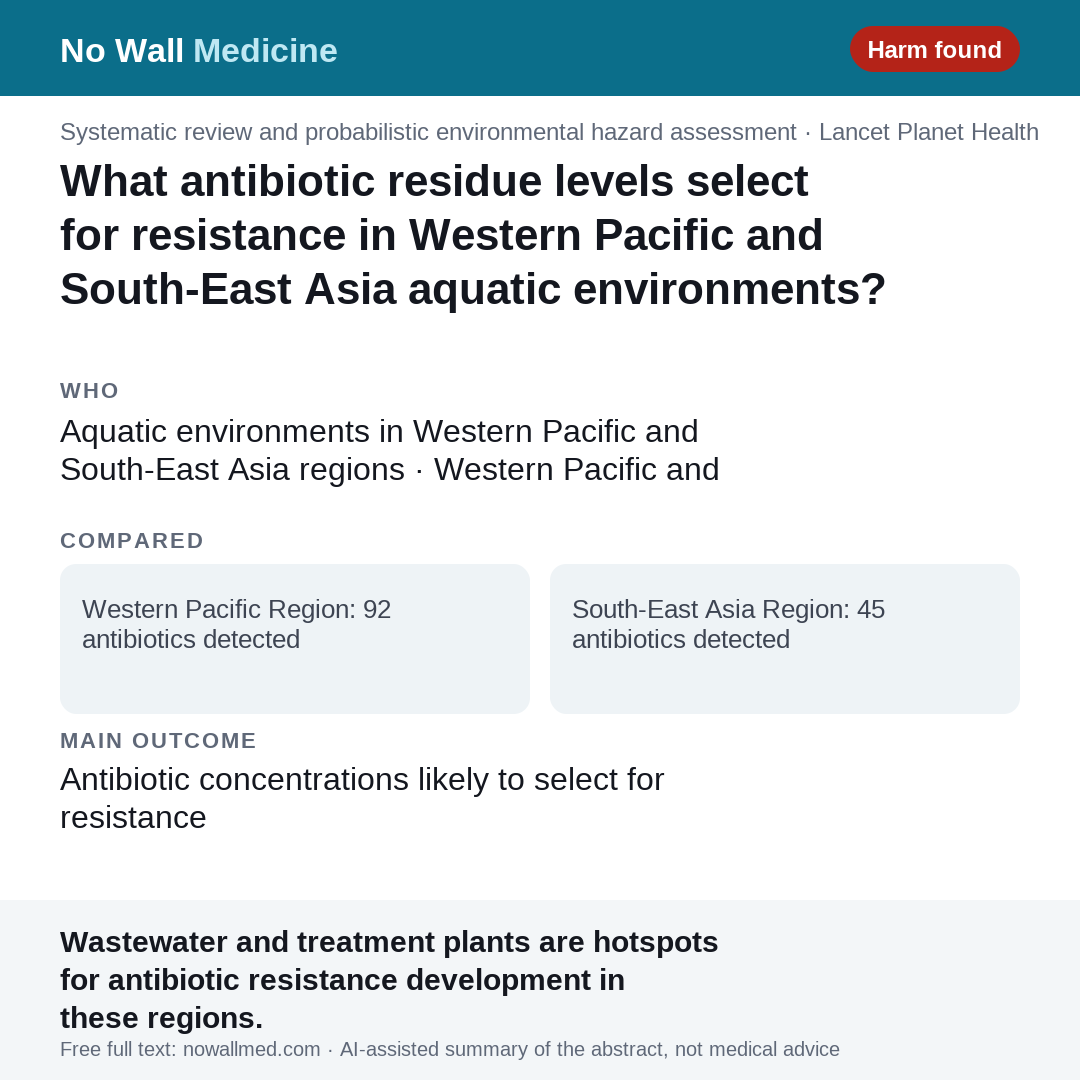
Clinical question: What antibiotic residue levels select for resistance in Western Pacific and South-East Asia aquatic environments?
Why it matters: It is unknown which specific antibiotic residue levels in aquatic environments are likely to select for resistance and which sources contribute most to this risk.
Key points
- Researchers reviewed 218 studies from the Western Pacific region and 22 studies from the South-East Asia region regarding antibiotic levels in water.
- Antibiotic concentrations exceeding predicted no-effect concentrations, which are levels expected to have no biological effect, were most likely found in wastewater and treatment plants.
- In the Western Pacific region and China, ciprofloxacin concentrations in drinking water were associated with a 62.5% risk for the development of resistance.
Headline and key points written with AI from the paper’s abstract, with every number checked against it. Read the paper before relying on them.
Was this summary helpful?
Abstract
Background
Antibiotic resistance poses human health risks, and there are concerns about the effect of environmental antibiotic residues in the selection and spread of antibiotic resistance. The aim of this study was to identify antibiotic residue levels that are likely to select for resistance and relative contributions from different aquatic sources, of various aquatic environmental compartments of the WHO Western Pacific region (WPR) and the WHO South-East Asia region (SEAR), including in China and India. Methods
A systematic review of empirical studies that measured antibiotic concentrations in aquatic environments, published between 2006 and 2019, and a probabilistic environmental hazard assessments approach, were used to identify antibiotic concentrations that are likely to select for resistance in various aquatic environmental compartments of the WPR and SEAR, including in China and India. The assessment involved the use of measured environmental concentrations and predicted no-effect concentrations (PNECs). Findings
The systematic review found 218 relevant studies of 5230 screened from the WPR and 22 relevant studies of 2625 screened from the SEAR; some of these relevant studies were largely from China (n=168) and India (n=15). 92 antibiotics in the WPR and 45 in the SEAR were detected in various aquatic compartments. Antibiotic concentrations that most likely exceeded PNECs (0-100%) were observed in wastewater, and influents and effluents of wastewater treatment plants. Antibiotic concentrations that most likely exceeded PNECs were also observed in aquatic environmental compartments. The highest risk for the development of resistance was in tap or drinking water of the WPR and China for ciprofloxacin (62·5%). The relative contributions of potential sources of antibiotic contamination in waterways, such as hospitals, municipals, livestock, and pharmaceutical manufacturing, was determined for each antibiotic. Interpretation
The concentrations of antibiotic residues found in wastewater and wastewater treatment plants of the WPR and SEAR make them potential hotspots for the development of antibiotic resistance, which creates human health risks from environmental exposure via drinking water. These findings can help decision makers to target risk reduction measures against environmental residues of priority antibiotics in high-risk sites, and help to focus research efforts in these world regions. Funding
Swedish Research Council.
Abstract reproduced under the article’s CC BY licence.
Subject terms
Cite this article
Hanna N, Tamhankar AJ, Stålsby Lundborg C. Antibiotic concentrations and antibiotic resistance in aquatic environments of the WHO Western Pacific and South-East Asia regions: a systematic review and probabilistic environmental hazard assessment. Lancet Planet Health. 2023. doi:10.1016/S2542-5196(22)00254-6
Spotted a mistake? Suggest a correction