Visual abstractsVisuals
Randomized trialGut Microbes · Nov 21, 2026

Antibiotic effects on gut-derived short chain fatty acid pools in healthy volunteers

Shremo Msdi A, Ayele H, Begum K, Hu C, Jo J, Alam MJ, et al
Gastroenterology & HepatologyAdult
Randomized clinical trialHarm found
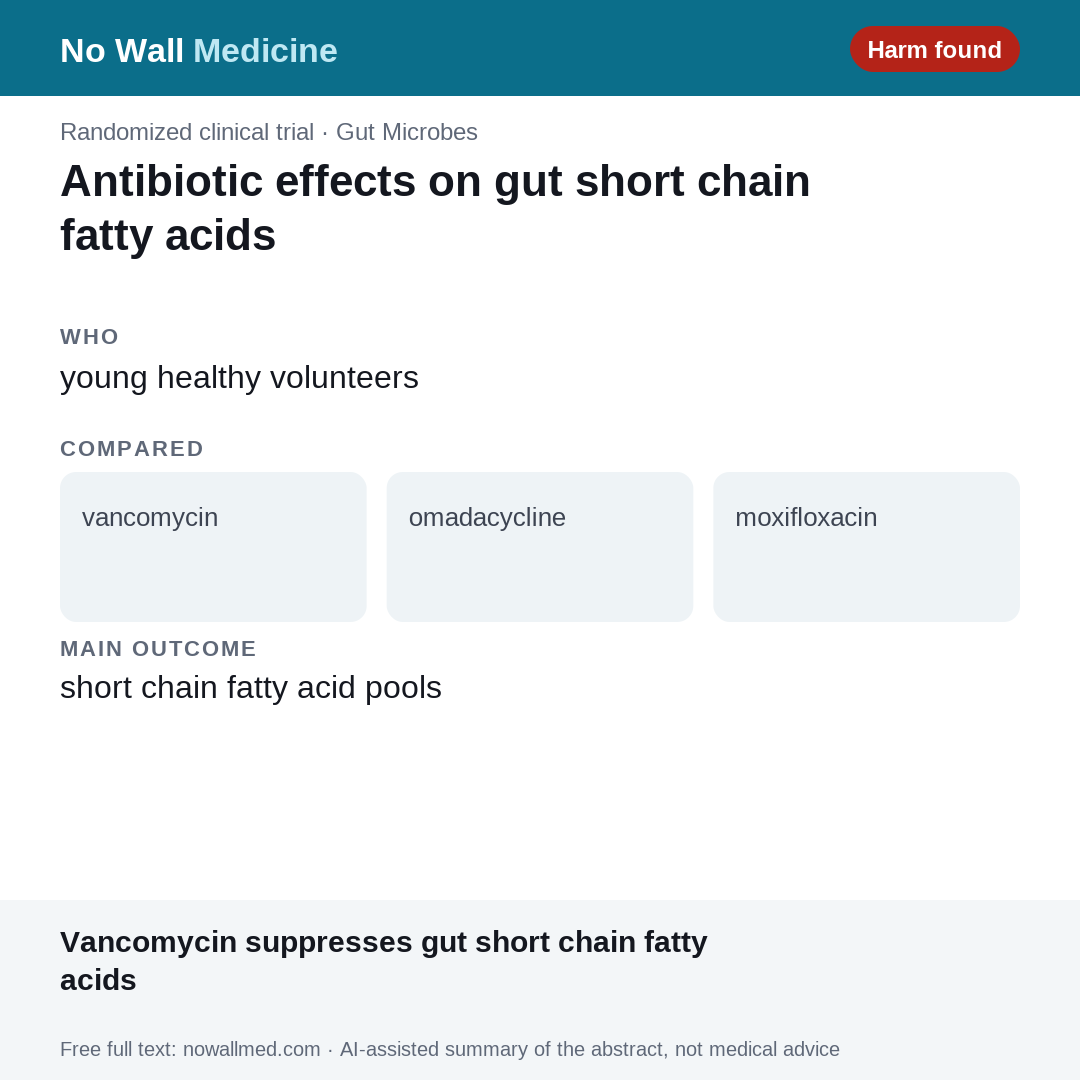
Antibiotic effects on gut short chain fatty acids
Who
young healthy volunteers
Compared
vancomycin
omadacycline
moxifloxacin
Main outcome
short chain fatty acid pools
Bottom line: Vancomycin suppresses gut short chain fatty acids
Gut Microbes · 2026-11-21Download image
Read the full paper free at the publisher ↗

Abstract

Short-chain fatty acids (SCFAs) are vital microbial metabolites that maintain gut health and immune function. Despite the established deleterious effect of antibiotics on anaerobic bacteria in the gut, the longitudinal effects of antibiotics on SCFA pool dynamics remain poorly characterized in humans. This study aimed to characterize depletion and recovery of linear and branched SCFAs and to explore microbial taxa associated with changes to SCFA pools after antibiotic exposure. This was a secondary analysis of a phase 1, randomized, nonblinded clinical trial in young healthy volunteers given a 10-day course of oral vancomycin, omadacycline, or moxifloxacin. Fecal samples were collected at baseline, during antibiotics, and follow-up visits for SCFA determinations and amplicon-based microbiome characterizations. Mixed effects models demonstrated that vancomycin produced global suppression of SCFAs pool relative to baseline, indicating broad suppression of microbial fermentation. Although all antibiotics reduced SCFA levels during treatment, vancomycin associated changes were most evident for branched SCFAs vs. comparators. Vancomycin shifted the fermentation balance by disproportionately suppressing linear SCFAs, reflected by a lower linear-to-branched SCFA ratio. In parallel, Clostridiales abundance declined most markedly after vancomycin, with more moderate reductions after omadacycline and moxifloxacin. Moxifloxacin and omadacycline but not vancomycin showed early recovery of butyrate-production capacity by qPCR. In this longitudinal analysis of healthy volunteers, vancomycin caused global suppression of microbial fermentation, with marked depletion of linear and branched SCFAs consistent with disproportionate suppression of fiber fermentation relative to amino acid fermentation.

Topics

Humans; Fatty Acids, Volatile; Anti-Bacterial Agents; Feces; Adult; Male; Female; Young Adult; Healthy Volunteers; Gastrointestinal Microbiome; Vancomycin; Bacteria

DOI: 10.1080/19490976.2026.2765066 · PubMed: 43066545

Spotted a mistake? Suggest a correction

More in Gastroenterology & Hepatology

ResearchJHEP Rep · Nov 21, 2026 · Gastroenterology & Hepatology

Low public awareness of liver cancer risk factors found in survey

Low public awareness of hepatocellular carcinoma risk factors

ResearchJHEP Rep · Nov 21, 2026 · Gastroenterology & Hepatology

Pre-emptive TIPS reduces further decompensation after gastric variceal hemorrhage

Pre-emptive TIPS Reduces Further Decompensation Following Gastric Variceal Hemorrhage: A Real-World Multicenter Analysis

ResearchJHEP Rep · Nov 21, 2026 · Gastroenterology & Hepatology

Tenofovir associated with lower hepatocellular carcinoma risk than entecavir

Comparative risk of hepatocellular carcinoma among people with chronic hepatitis B treated with tenofovir or entecavir: A population-based linkage study
Meta-analysisVisual abstractHepatol Commun · Nov 20, 2026 · Gastroenterology & Hepatology

Liver stiffness decreased by 2.76 kPa after 56 days of alcohol abstinence

Alcohol abstinence and liver stiffness by vibration-controlled transient elastography: A systematic review and meta-analysis

ResearchHepatol Commun · Nov 20, 2026 · Gastroenterology & Hepatology

Immunosuppressive monocytes promote infection in patients with alcohol-associated hepatitis