Continuous antibiotic prophylaxis was associated with fewer first urinary tract infections in infants with vesicoureteral reflux
Antibiotic Prophylaxis in Infants with Grade III, IV, or V Vesicoureteral Reflux
Randomized, open-label trialBenefit found
Does continuous antibiotic prophylaxis prevent first urinary tract infection in infants with vesicoureteral reflux?
Who
292
Infants 1 to 5 months old with grade III, IV, or V vesicoureteral reflux · 39 European centers
Compared
continuous antibiotic prophylaxis: 31 participants (21.2%)
no treatment: 52 participants (35.6%)
Main outcome
occurrence of the first urinary tract infection
Result: hazard ratio 0.55 (95% CI 0.35 to 0.86)
Bottom line: Continuous antibiotic prophylaxis significantly reduces the risk of first urinary tract infection in infants with high-grade vesicoureteral reflux.
Funded by: Italian Ministry of Health and others
NEJM · 2023-09-12Download image
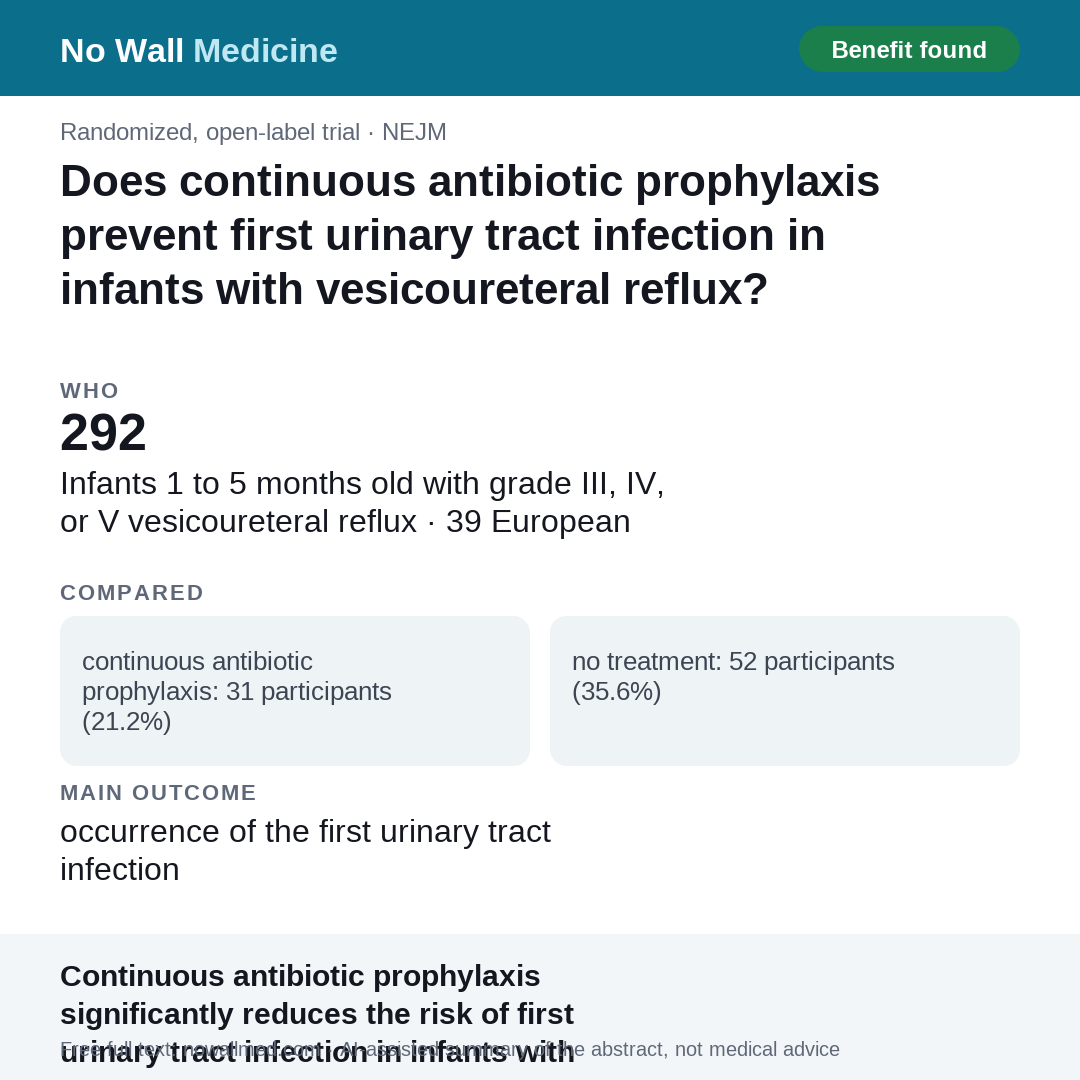
Clinical question: Does continuous antibiotic prophylaxis prevent first urinary tract infection in infants with vesicoureteral reflux?
Why it matters: The efficacy of continuous antibiotic prophylaxis in preventing urinary tract infections in infants with grade III, IV, or V vesicoureteral reflux is controversial.
Key points
- Researchers studied 292 infants aged 1 to 5 months with grade III, IV, or V vesicoureteral reflux, a condition where urine flows backward from the bladder to the kidneys.
- A first urinary tract infection occurred in 21.2% of the prophylaxis group compared to 35.6% in the untreated group over 24 months.
- The prophylaxis group had more frequent antibiotic resistance and non-Escherichia coli organisms in their infections, though kidney scarring and kidney function did not differ substantially.
Headline and key points written with AI from the paper’s abstract, with every number checked against it. Read the paper before relying on them.
Was this summary helpful?
Subject terms
Cite this article
Morello W, Baskin E, Jankauskiene A, Yalcinkaya F, Zurowska A, Puccio G. Antibiotic Prophylaxis in Infants with Grade III, IV, or V Vesicoureteral Reflux. NEJM. 2023. doi:10.1056/NEJMoa2300161
Spotted a mistake? Suggest a correction
Top studies every Monday
The week’s key trials and guidelines in your specialties, plus any topics you follow. By email, free.
Get the weekly digest