Anticoagulation Among Patients Hospitalized for COVID-19 : A Systematic Review and Prospective Meta-analysis
Systematic review and prospective meta-analysisBenefit found
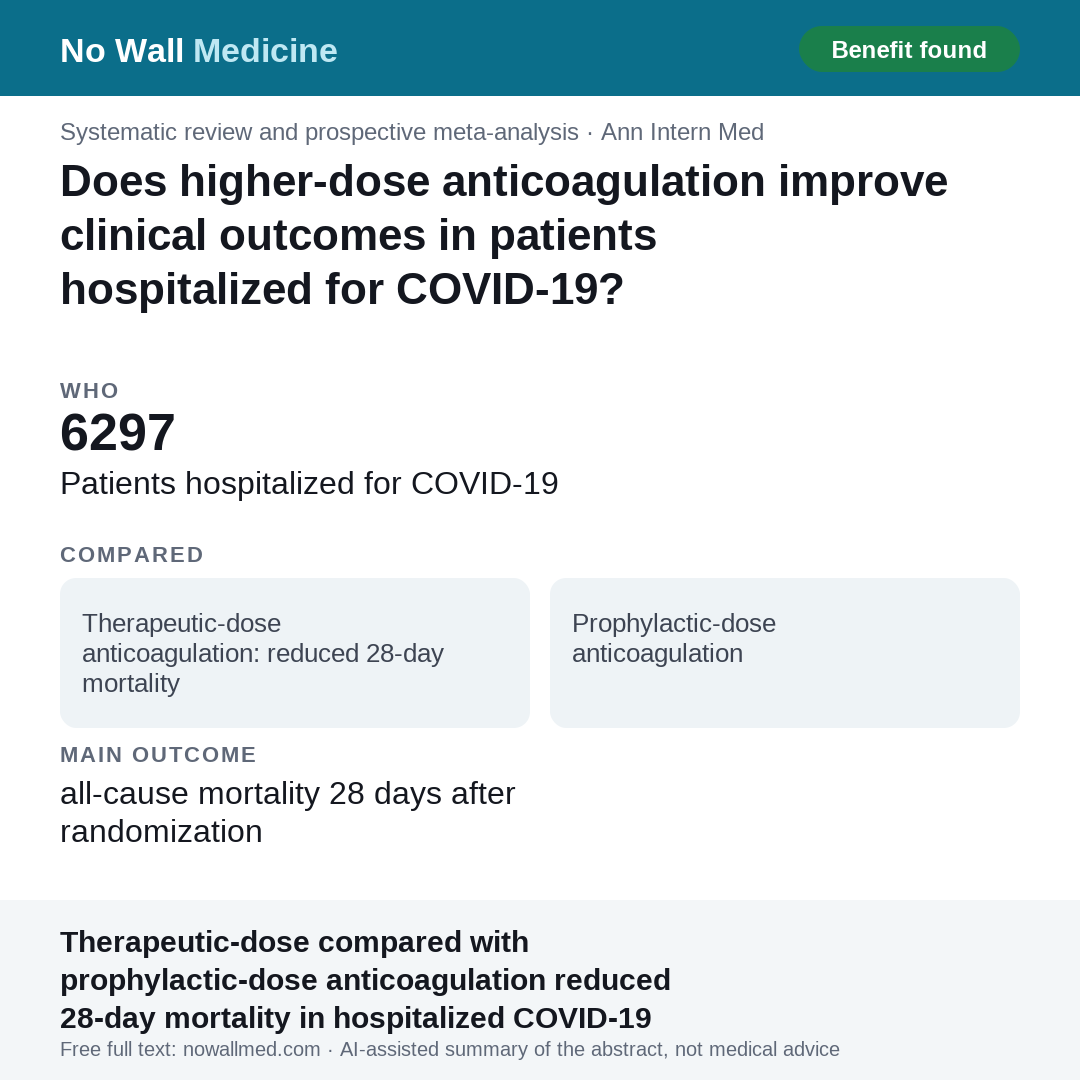
Does higher-dose anticoagulation improve clinical outcomes in patients hospitalized for COVID-19?
Who
6297
Patients hospitalized for COVID-19
Compared
Therapeutic-dose anticoagulation: reduced 28-day mortality
Prophylactic-dose anticoagulation
Main outcome
all-cause mortality 28 days after randomization
Result: OR, 0.77 (95% CI, 0.64 to 0.93)
Bottom line: Therapeutic-dose compared with prophylactic-dose anticoagulation reduced 28-day mortality in hospitalized COVID-19 patients.
Limitation: some analyses were limited in power
Ann Intern Med · 2024-12-24Download image
Clinical question: Does higher-dose anticoagulation improve clinical outcomes in patients hospitalized for COVID-19?
Abstract
Background
Reported results of clinical trials assessing higher-dose anticoagulation in patients hospitalized for COVID-19 have been inconsistent. Purpose
To estimate the association of higher- versus lower-dose anticoagulation with clinical outcomes. Data sources
Randomized trials were identified from the World Health Organization's International Clinical Trials Registry Platform and ClinicalTrials.gov with no restriction by trial status or language. Study selection
Eligible randomized trials assigned patients hospitalized for COVID-19 to higher- versus lower-dose anticoagulation. Data extraction
20 eligible trials provided data in a prospectively agreed format. Two further studies were included based on published data. The primary outcome was all-cause mortality 28 days after randomization. Secondary outcomes were progression to invasive mechanical ventilation or death, thromboembolic events, and major bleeding. Data synthesis
Therapeutic- compared with prophylactic-dose anticoagulation with heparins reduced 28-day mortality (OR, 0.77 [95% CI, 0.64 to 0.93]; I 2 = 29%; 11 trials, 6297 patients, of whom 5456 required low or no oxygen at randomization). The ORs for 28-day mortality were 1.21 (CI, 0.93 to 1.58; I 2 = 0%) for therapeutic-dose compared with intermediate-dose anticoagulation (6 trials, 1803 patients, 843 receiving noninvasive ventilation at randomization) and 0.95 (CI, 0.76 to 1.19; I 2 = 0%; 10 trials, 3897 patients, 2935 receiving no or low oxygen at randomization) for intermediate- versus prophylactic-dose anticoagulation. Treatment effects appeared broadly consistent across predefined patient subgroups, although some analyses were limited in power. Higher- compared with lower-dose anticoagulation was associated with fewer thromboembolic events, but a greater risk for major bleeding. Conclusion
Therapeutic-dose compared with prophylactic-dose anticoagulation reduced 28-day mortality. Mortality was similar for intermediate-dose compared with prophylactic-dose anticoagulation and higher for therapeutic-dose compared with intermediate-dose anticoagulation, although this comparison was not estimated precisely. Primary funding source
No direct funding. (PROSPERO: CRD42020213461).
Topics
Cite this article
WHO Rapid Evidence Appraisal for COVID-19 Therapies (REACT) Working Group, Vale CL, Godolphin PJ, Fisher DJ, Higgins JPT, McAleenan A. Anticoagulation Among Patients Hospitalized for COVID-19 : A Systematic Review and Prospective Meta-analysis. Ann Intern Med. 2024. doi:10.7326/ANNALS-24-00800
Spotted a mistake? Suggest a correction