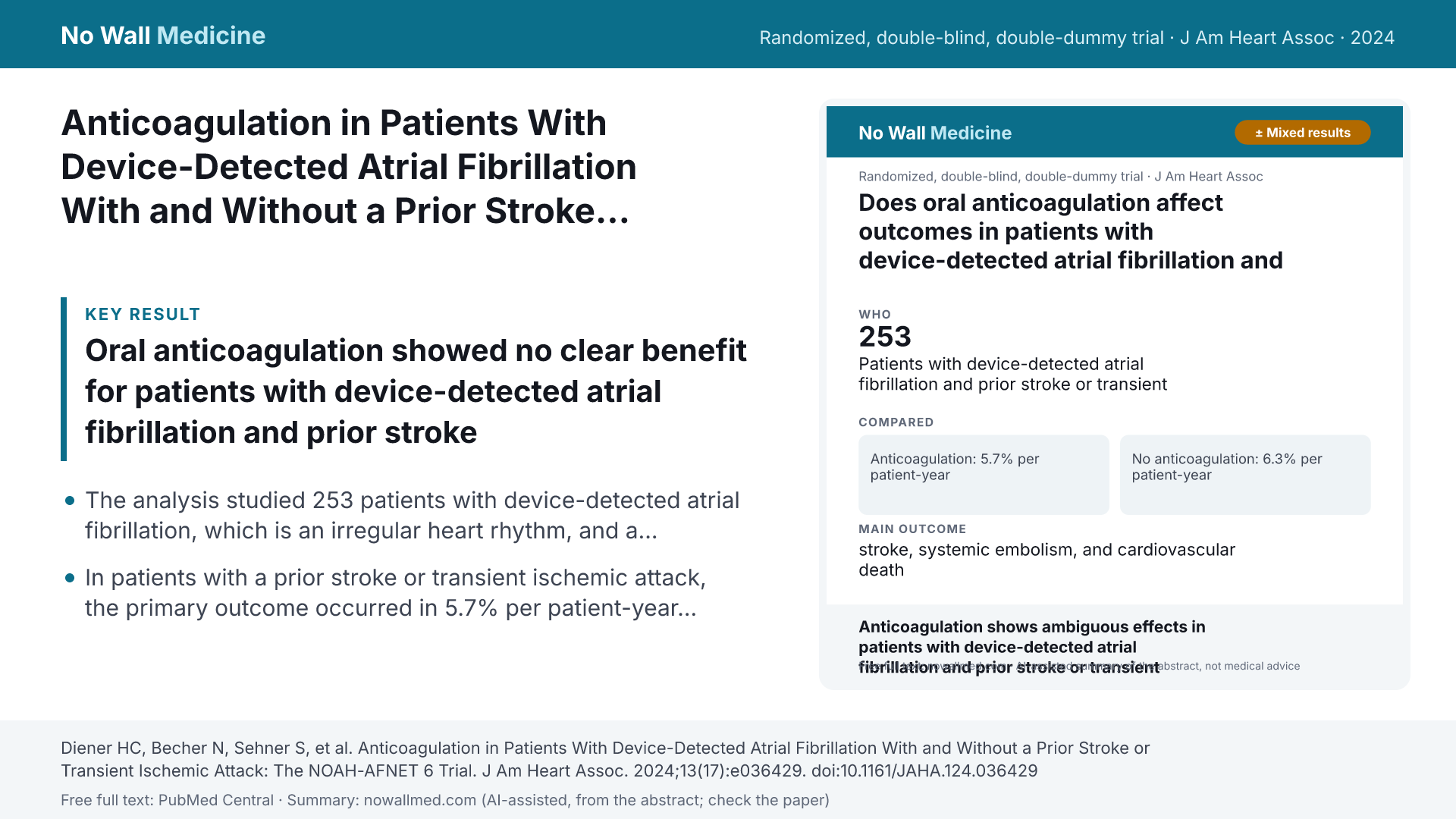
Oral anticoagulation showed no clear benefit for patients with device-detected atrial fibrillation and prior stroke
Anticoagulation in Patients With Device-Detected Atrial Fibrillation With and Without a Prior Stroke or Transient Ischemic Attack: The NOAH-AFNET 6 Trial
Secondary analysis of a trialMixed results
Does oral anticoagulation affect outcomes in patients with device-detected atrial fibrillation and prior stroke or TIA?
Who
253
Patients with device-detected atrial fibrillation and prior stroke or transient ischemic attack
Compared
Anticoagulation: 5.7% per patient-year
No anticoagulation: 6.3% per patient-year
Main outcome
stroke, systemic embolism, and cardiovascular death
Bottom line: Anticoagulation shows ambiguous effects in patients with device-detected atrial fibrillation and prior stroke or transient ischemic attack.
J Am Heart Assoc · 2024-08-27 · Save PNG
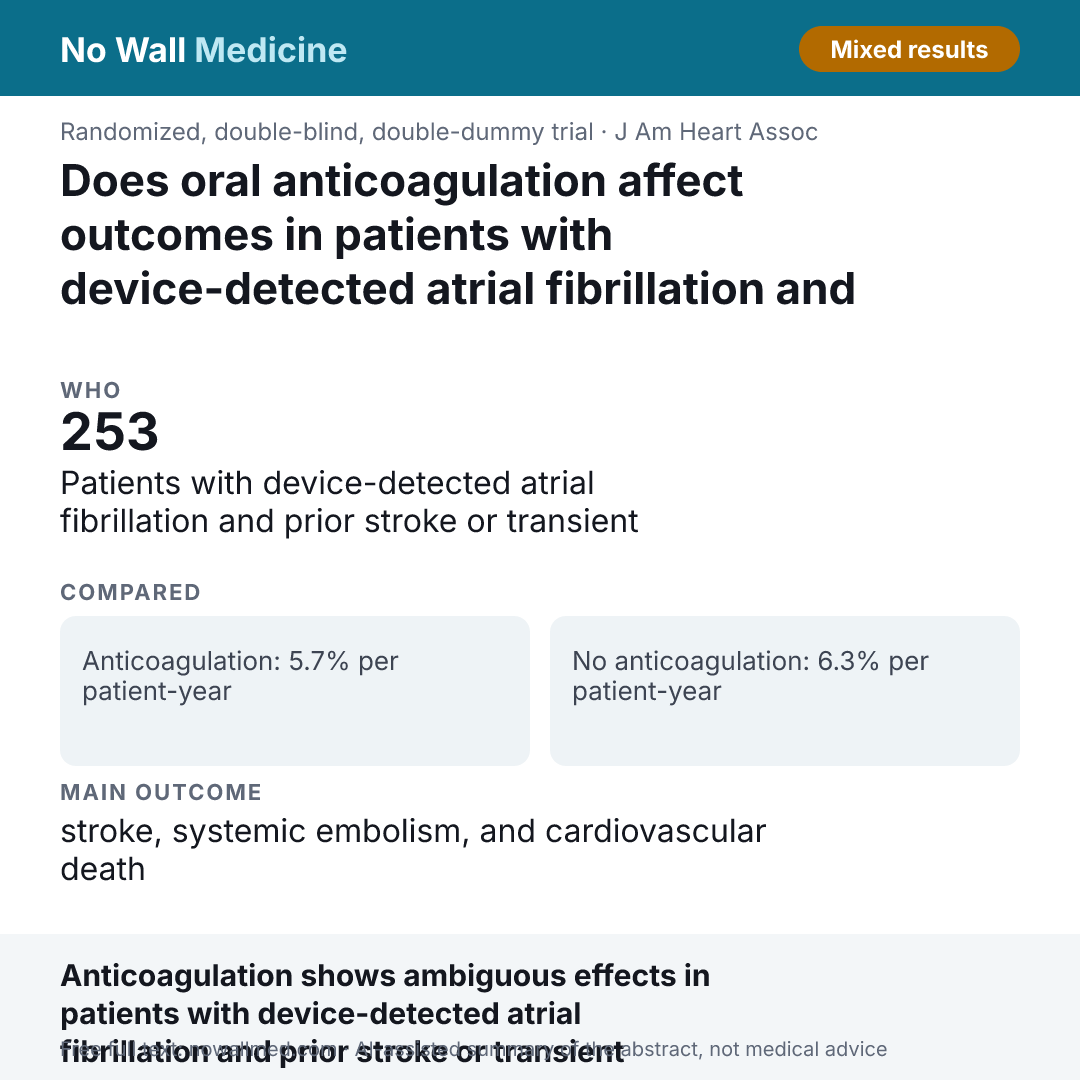
Clinical question: Does oral anticoagulation affect outcomes in patients with device-detected atrial fibrillation and prior stroke or TIA?
Key points
- The analysis studied 253 patients with device-detected atrial fibrillation, which is an irregular heart rhythm, and a history of stroke or transient ischemic attack (a temporary period of stroke-like symptoms).
- In patients with a prior stroke or transient ischemic attack, the primary outcome occurred in 5.7% per patient-year with anticoagulation compared to 6.3% per patient-year without it.
- Major bleeding events were numerically higher in the anticoagulation group with 8 out of 122 patients compared to 2 out of 131 patients in the group without anticoagulation.
Limitation the authors note: This was a hypothesis-generating analysis with a low rate of stroke in the group not receiving anticoagulation.
Headline and key points written with AI from the paper’s abstract, with every number checked against it. Read the paper before relying on them.
Was this summary helpful?
Subject terms
Headline, design, result, key points, caveat and citation as plain text.
Cite this article
Diener HC, Becher N, Sehner S, et al. Anticoagulation in Patients With Device-Detected Atrial Fibrillation With and Without a Prior Stroke or Transient Ischemic Attack: The NOAH-AFNET 6 Trial. J Am Heart Assoc. 2024;13(17):e036429. doi:10.1161/JAHA.124.036429
Spotted a mistake? Suggest a correction