Regional citrate anticoagulation was associated with longer filter life and less bleeding than unfractionated heparin
Anticoagulation options for continuous renal replacement therapy in critically ill patients: a systematic review and network meta-analysis of randomized controlled trials
Network meta-analysis of 37 randomized controlled trialsBenefit found
Which anticoagulation options are most effective for continuous renal replacement therapy?
Who
2648
Critically ill patients with acute kidney injury
Compared
Regional citrate anticoagulation: MD 12.0 (95% CI 3.8 to 20.2)
Unfractionated heparin
Main outcome
Filter lifespan
Result: MD 12.0 (95% CI 3.8 to 20.2)
Bottom line: Regional citrate anticoagulation is preferred over unfractionated heparin for prolonging filter lifespan in critically ill patients.
Limitation: Only a single study evaluated Regional-unfractionated heparin plus Prostaglandin I2.
Crit Care · 2023-06-07Download image
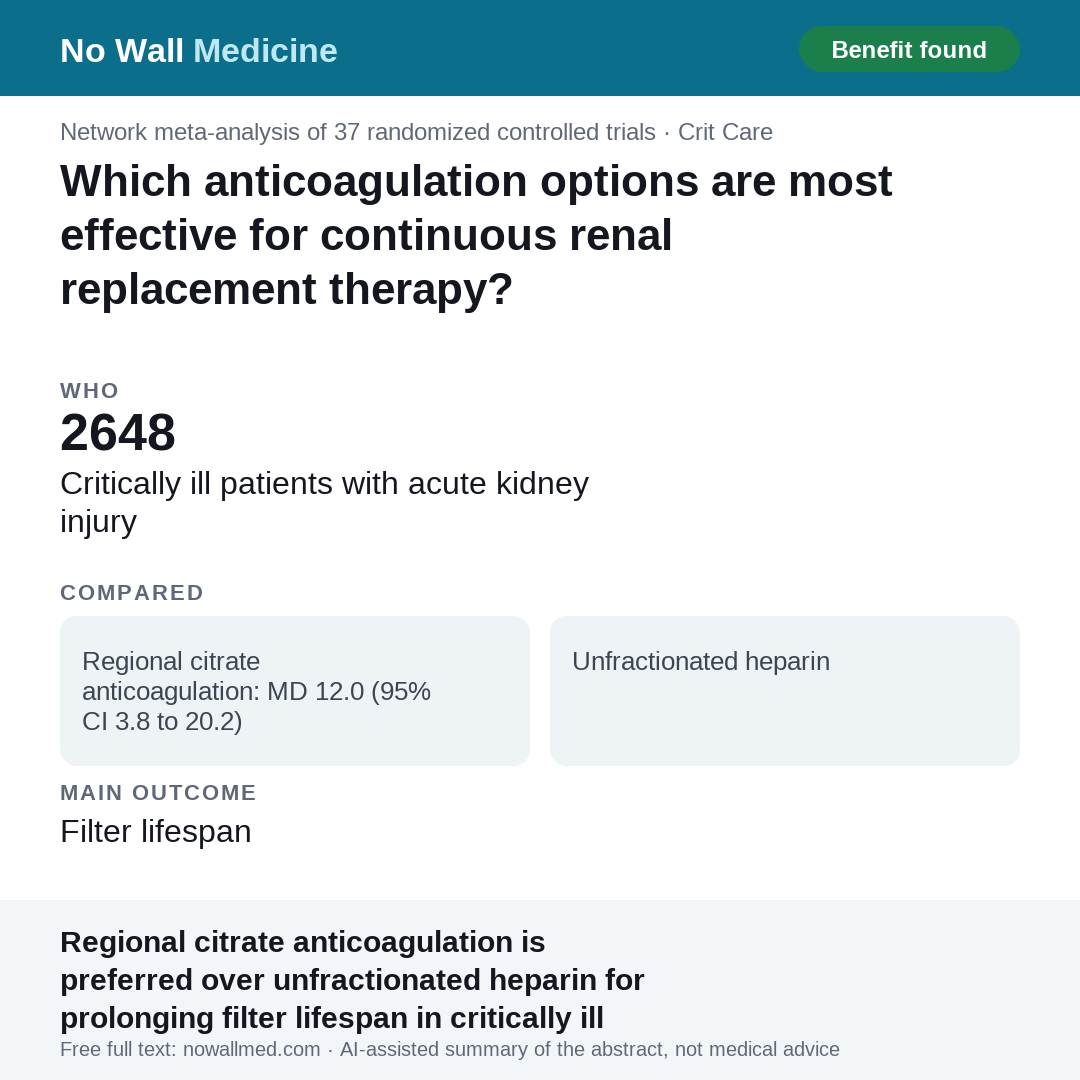
Clinical question: Which anticoagulation options are most effective for continuous renal replacement therapy?
Why it matters: It was unknown which anticoagulation strategy is most effective and safe for preventing blood clots in the circuits used during continuous renal replacement therapy.
Key points
- Researchers analyzed 37 randomized controlled trials involving 2648 participants to compare different blood-thinning strategies during continuous renal replacement therapy.
- Compared to unfractionated heparin, regional citrate anticoagulation was associated with a longer filter lifespan (MD 12.0, 95% CI 3.8 to 20.2) and a lower risk of bleeding.
- No statistically significant differences were observed between most options regarding all-cause mortality, length of intensive care unit stay, or kidney function recovery.
Limitation the authors note: The analysis of regional unfractionated heparin plus prostaglandin I2 was limited because only a single study with 46 participants was included.
Headline and key points written with AI from the paper’s abstract, with every number checked against it. Read the paper before relying on them.
Topics
Cite this article
Zhou Z, Liu C, Yang Y, Wang F, Zhang L, Fu P. Anticoagulation options for continuous renal replacement therapy in critically ill patients: a systematic review and network meta-analysis of randomized controlled trials. Crit Care. 2023. doi:10.1186/s13054-023-04519-1
Spotted a mistake? Suggest a correction
Top studies every Monday
The week’s key trials and guidelines in your specialties, plus any topics you follow. By email, free.
Get the weekly digest