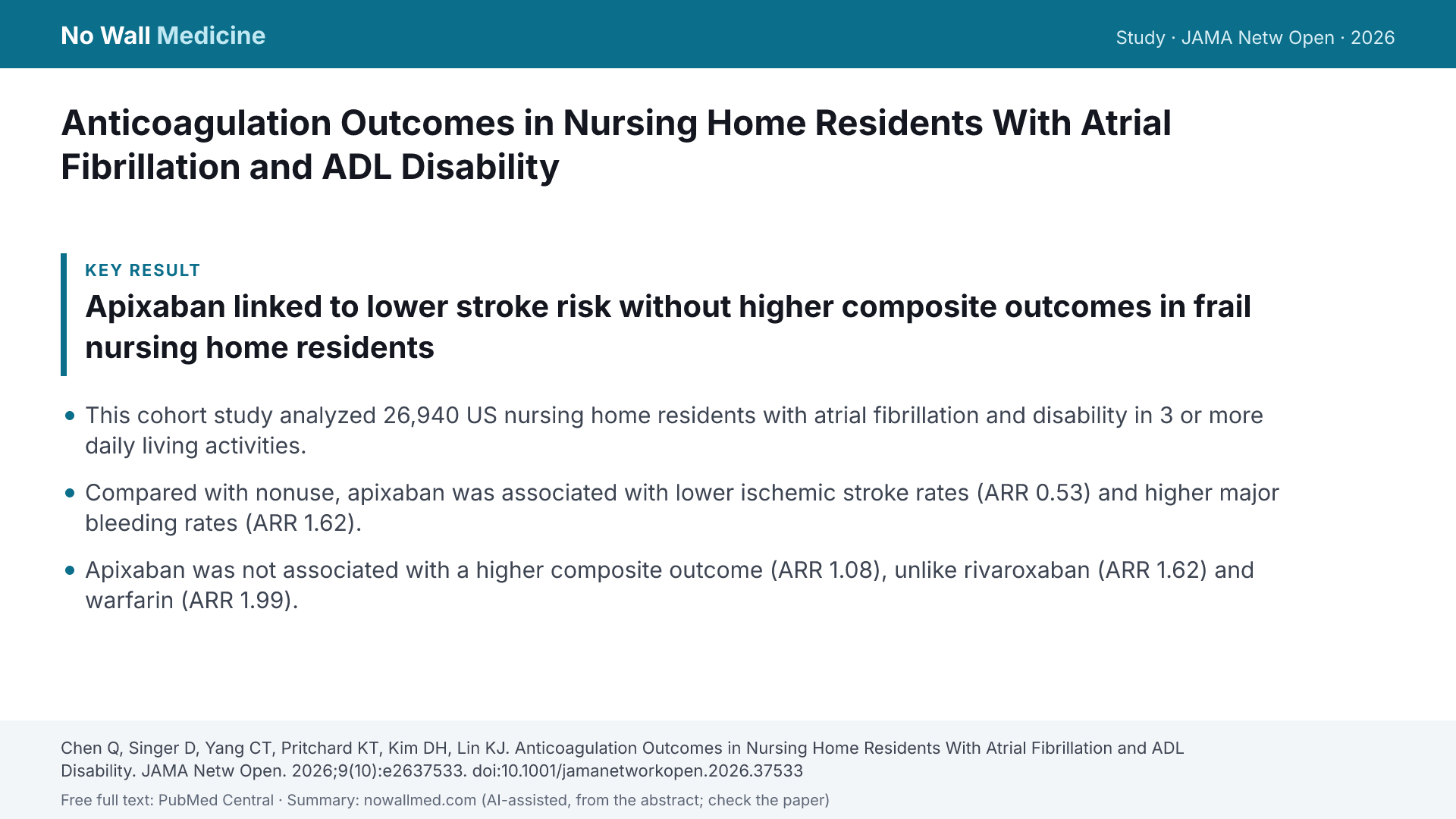
Apixaban linked to lower stroke risk without higher composite outcomes in frail nursing home residents
Anticoagulation Outcomes in Nursing Home Residents With Atrial Fibrillation and ADL Disability
Why it matters: The net benefit of anticoagulation is uncertain for frail nursing home residents because they face high risks of both bleeding and death.
Key points
- This cohort study analyzed 26,940 US nursing home residents with atrial fibrillation and disability in 3 or more daily living activities.
- Compared with nonuse, apixaban was associated with lower ischemic stroke rates (ARR 0.53) and higher major bleeding rates (ARR 1.62).
- Apixaban was not associated with a higher composite outcome (ARR 1.08), unlike rivaroxaban (ARR 1.62) and warfarin (ARR 1.99).
Study type: Observational study: it can show a link, but not prove that one thing causes another.
Headline and key points written with AI from the paper’s abstract, with every number checked against it. Read the paper before relying on them.
Was this summary helpful?
Subject terms
Headline, design, result, key points, caveat and citation as plain text.
Cite this article
Chen Q, Singer D, Yang CT, Pritchard KT, Kim DH, Lin KJ. Anticoagulation Outcomes in Nursing Home Residents With Atrial Fibrillation and ADL Disability. JAMA Netw Open. 2026;9(10):e2637533. doi:10.1001/jamanetworkopen.2026.37533
Spotted a mistake? Suggest a correction