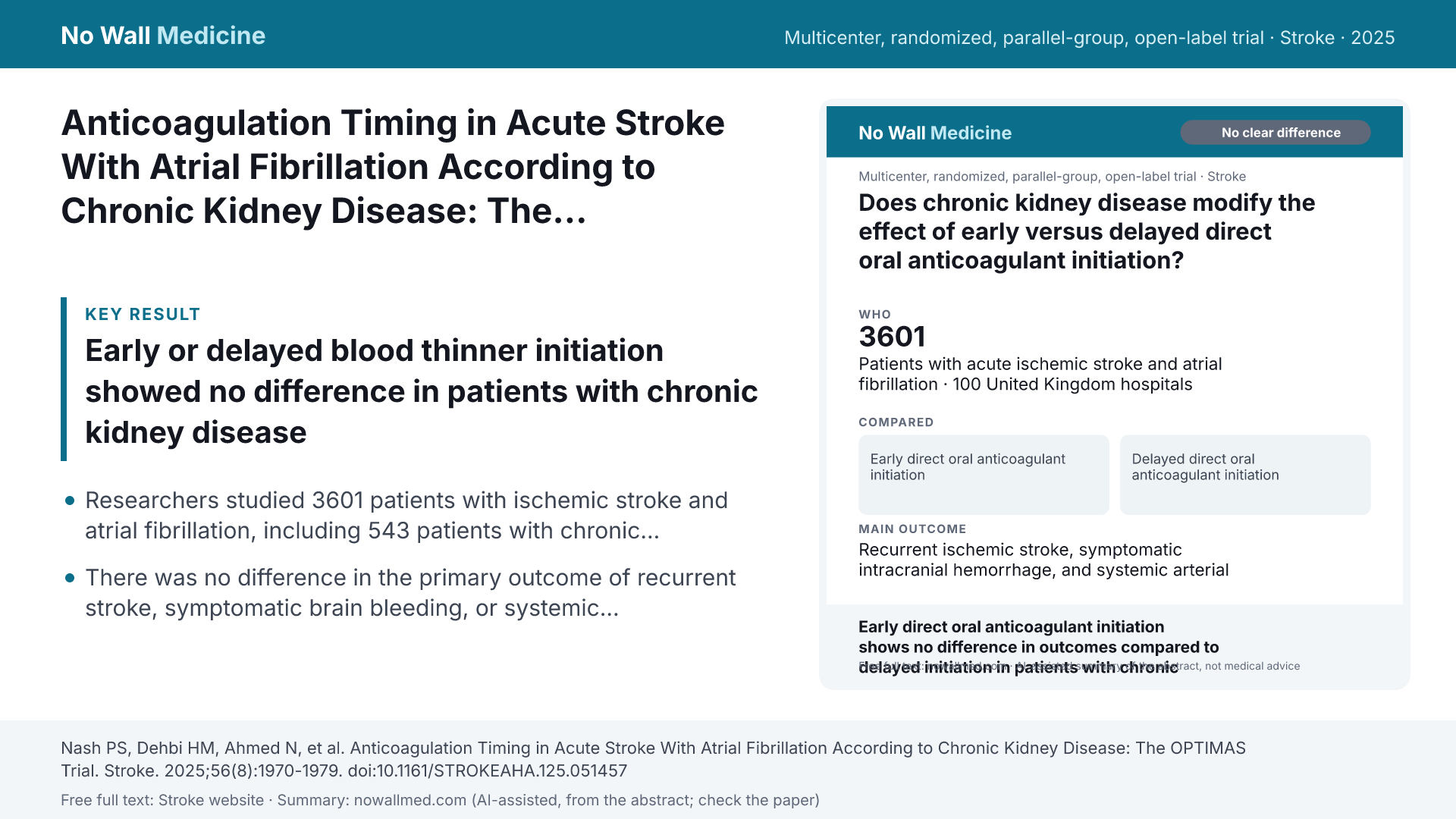
Early or delayed blood thinner initiation showed no difference in patients with chronic kidney disease
Anticoagulation Timing in Acute Stroke With Atrial Fibrillation According to Chronic Kidney Disease: The OPTIMAS Trial
Multicenter, randomized, parallel-group, open-label trialNo clear difference
Does chronic kidney disease modify the effect of early versus delayed direct oral anticoagulant initiation?
Who
3601
Patients with acute ischemic stroke and atrial fibrillation · 100 United Kingdom hospitals
Compared
Early direct oral anticoagulant initiation
Delayed direct oral anticoagulant initiation
Main outcome
Recurrent ischemic stroke, symptomatic intracranial hemorrhage, and systemic arterial embolism
Result: odds ratio 1.01 (95% CI 0.67-1.51) in normal kidney function; odds ratio 0.90 (95% CI 0.36-2.25) in chronic kidney disease
Bottom line: Early direct oral anticoagulant initiation shows no difference in outcomes compared to delayed initiation in patients with chronic kidney disease.
Stroke · 2025-05-22Download image
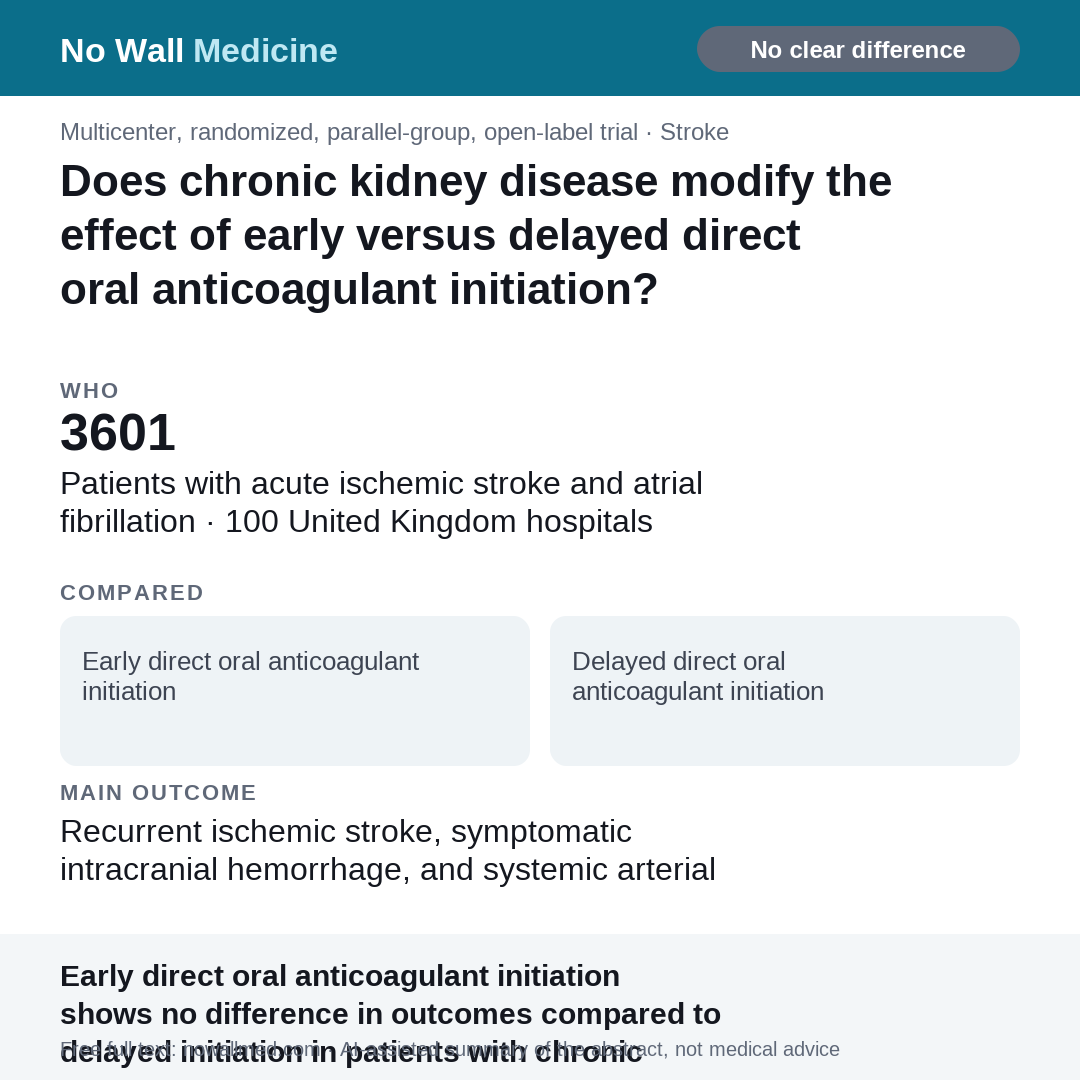
Clinical question: Does chronic kidney disease modify the effect of early versus delayed direct oral anticoagulant initiation?
Why it matters: It is unclear if the safety and efficacy of early direct oral anticoagulant initiation changes for patients with chronic kidney disease following an acute ischemic stroke.
Key points
- Researchers studied 3601 patients with ischemic stroke and atrial fibrillation, including 543 patients with chronic kidney disease, comparing early versus delayed direct oral anticoagulant initiation.
- There was no difference in the primary outcome of recurrent stroke, symptomatic brain bleeding, or systemic embolism between early and delayed treatment in patients with or without kidney disease.
- No modification of treatment effect was found for individual outcomes including ischemic stroke, symptomatic intracranial hemorrhage, or all-cause mortality based on kidney function status.
Headline and key points written with AI from the paper’s abstract, with every number checked against it. Read the paper before relying on them.
Was this summary helpful?
Subject terms
Cite this article
Nash PS, Dehbi HM, Ahmed N, Arram L, Best JG, Balogun M. Anticoagulation Timing in Acute Stroke With Atrial Fibrillation According to Chronic Kidney Disease: The OPTIMAS Trial. Stroke. 2025. doi:10.1161/STROKEAHA.125.051457
Spotted a mistake? Suggest a correction