Anticoagulation shows similar stroke prevention to antiplatelets for most patients with embolic stroke of undetermined source
Anticoagulation vs Antiplatelets Across Subgroups of Embolic Stroke of Undetermined Source: A Meta-Analysis of Randomized Controlled Trials
Meta-analysis of 7 randomized controlled trialsNo clear difference
Is anticoagulation more effective than antiplatelet therapy for secondary ischemic stroke prevention in ESUS?
Who
14804
Patients with embolic stroke of undetermined source
Compared
Anticoagulation: RR 0.91
Antiplatelet therapy
Main outcome
Recurrent ischemic stroke
Result: RR 0.91 (95% CI 0.80-1.05)
Bottom line: Empiric anticoagulation is not beneficial for all patients with embolic stroke of undetermined source.
Limitation: Large prospective studies within subgroups are needed to validate findings.
Neurology · 2024-10-04Download image
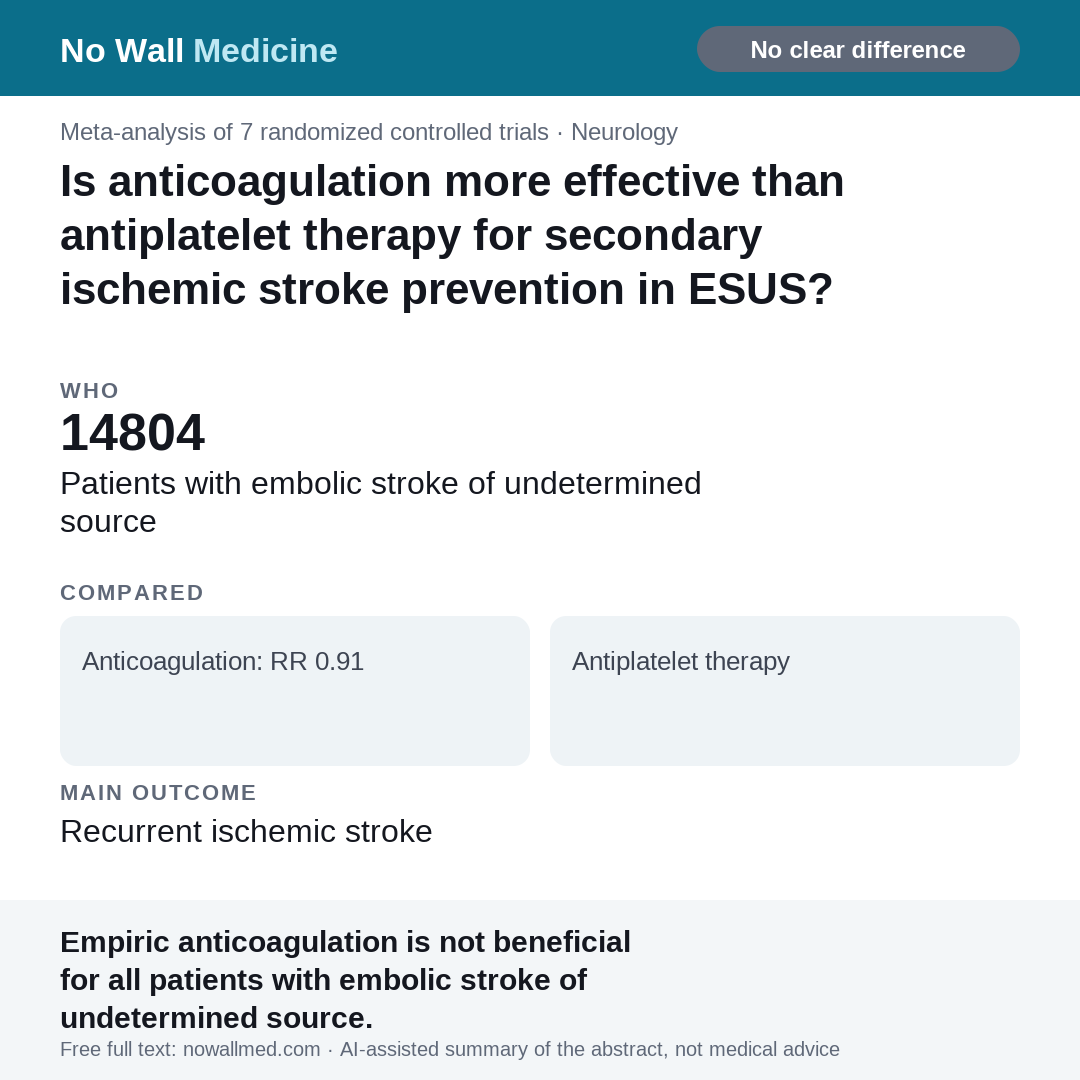
Clinical question: Is anticoagulation more effective than antiplatelet therapy for secondary ischemic stroke prevention in ESUS?
Why it matters: It is unknown which treatment strategy is most effective for different subgroups of patients with embolic stroke of undetermined source.
Key points
- Researchers analyzed 7 randomized controlled trials involving 14,804 patients to compare anticoagulation with antiplatelet therapy for preventing recurrent ischemic stroke.
- Anticoagulation was associated with a similar rate of recurrent ischemic stroke compared to antiplatelet therapy (RR 0.91, 95% CI 0.80-1.05).
- In patients with a patent foramen ovale, a hole in the heart, anticoagulation was associated with a lower risk of ischemic stroke (RR 0.59, 95% CI 0.35-0.98).
Limitation the authors note: Large prospective studies within embolic stroke of undetermined source subgroups are needed to validate these findings.
Headline and key points written with AI from the paper’s abstract, with every number checked against it. Read the paper before relying on them.
Was this summary helpful?
Subject terms
Cite this article
Ghannam M, Al-Qudah AM, Alshaer QN, Kronmal R, Ntaios G, Childs CA. Anticoagulation vs Antiplatelets Across Subgroups of Embolic Stroke of Undetermined Source: A Meta-Analysis of Randomized Controlled Trials. Neurology. 2024. doi:10.1212/WNL.0000000000209949
Spotted a mistake? Suggest a correction
Top studies every Monday
The week’s key trials and guidelines in your specialties, plus any topics you follow. By email, free.
Get the weekly digest