Combining repetitive transcranial magnetic stimulation with SSRIs was associated with better depression outcomes than sham treatment
Antidepressant class and concurrent rTMS outcomes in major depressive disorder: a systematic review and meta-analysis
Systematic review and meta-analysisMixed results
Does antidepressant class affect outcomes when administered concurrently with repetitive transcranial magnetic stimulation?
Who
848
Patients with major depressive disorder
Compared
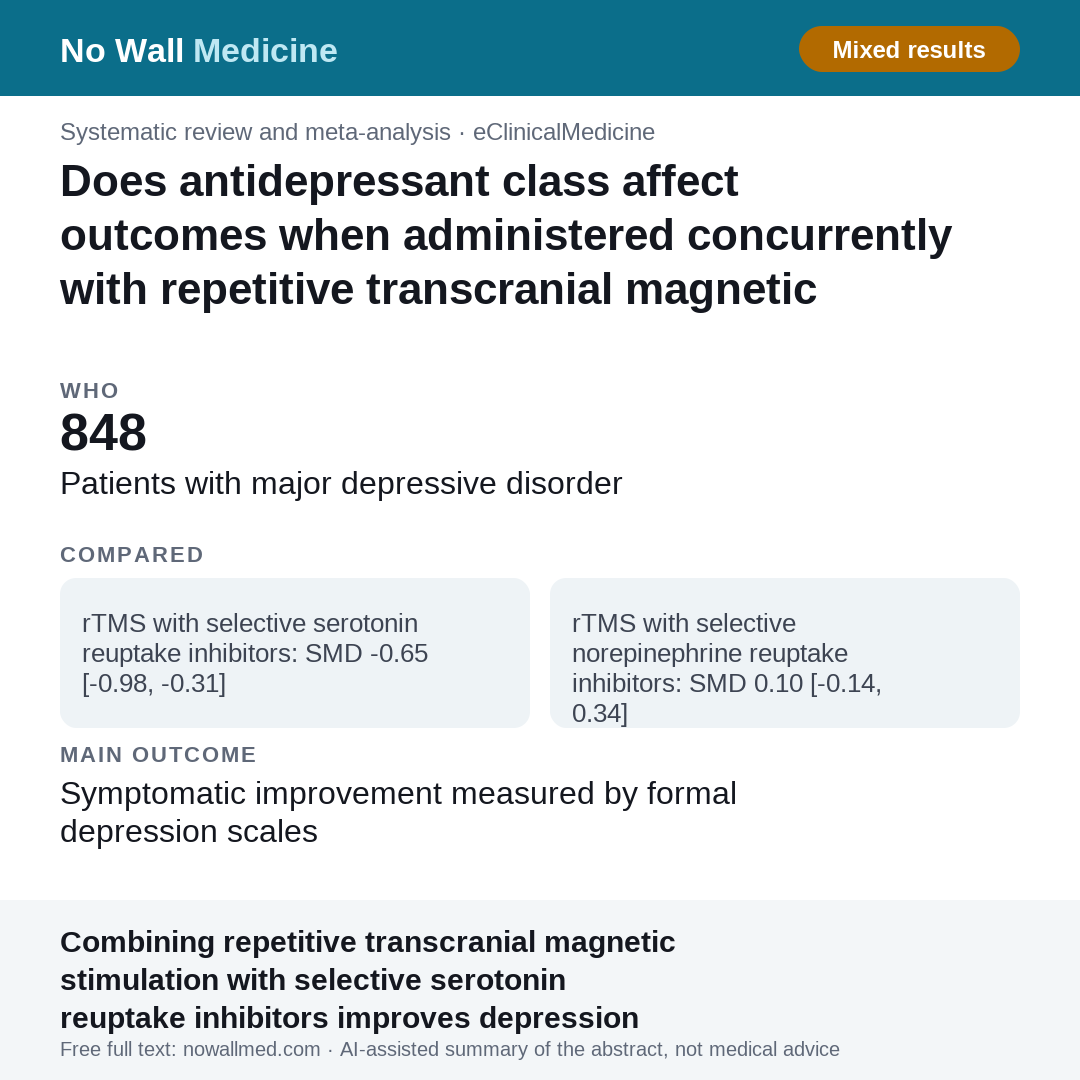
rTMS with selective serotonin reuptake inhibitors: SMD -0.65 [-0.98, -0.31]
rTMS with selective norepinephrine reuptake inhibitors: SMD 0.10 [-0.14, 0.34]
Main outcome
Symptomatic improvement measured by formal depression scales
Result: SMD -0.65 [-0.98, -0.31] for SSRIs
Bottom line: Combining repetitive transcranial magnetic stimulation with selective serotonin reuptake inhibitors improves depression scores, but selective norepinephrine reuptake inhibitors show no additive benefit.
Limitation: Some analyses demonstrated high heterogeneity, influenced by an SSRI trial with a high effect size.
Funded by: Sandra Black Centre for Brain Resilience & Recovery and Sunnybrook Foundation
eClinicalMedicine · 2024-07-27Download image
Clinical question: Does antidepressant class affect outcomes when administered concurrently with repetitive transcranial magnetic stimulation?
Why it matters: It is unknown whether different classes of antidepressants provide different levels of clinical efficacy when used alongside repetitive transcranial magnetic stimulation for depression.
Key points
- Researchers analyzed 14 randomized clinical trials involving 848 participants with major depressive disorder to compare different antidepressant classes used with repetitive transcranial magnetic stimulation.
- Combining repetitive transcranial magnetic stimulation with selective serotonin reuptake inhibitors was associated with lower depression scores (SMD -0.65 [-0.98, -0.31], p = 0.0002) and higher response and remission rates.
- No additive benefit was found when combining repetitive transcranial magnetic stimulation with selective norepinephrine reuptake inhibitors (SMD 0.10 [-0.14, 0.34], p = 0.42).
Limitation the authors note: The overall risk of bias for the included studies ranged from low to high, and some analyses demonstrated high heterogeneity.
Headline and key points written with AI from the paper’s abstract, with every number checked against it. Read the paper before relying on them.
Cite this article
Zaidi A, Shami R, Sewell IJ, Cao X, Giacobbe P, Rabin JS. Antidepressant class and concurrent rTMS outcomes in major depressive disorder: a systematic review and meta-analysis. eClinicalMedicine. 2024. doi:10.1016/j.eclinm.2024.102760
Spotted a mistake? Suggest a correction
Top studies every Monday
The week’s key trials and guidelines in your specialties, plus any topics you follow. By email, free.
Get the weekly digest