Antimicrobial susceptibility profiles of invasive bacterial infections among children from low- and middle-income countries in the Western Pacific Region (WPRO) - a systematic review and meta-analysis
Systematic review and meta-analysisHarm found
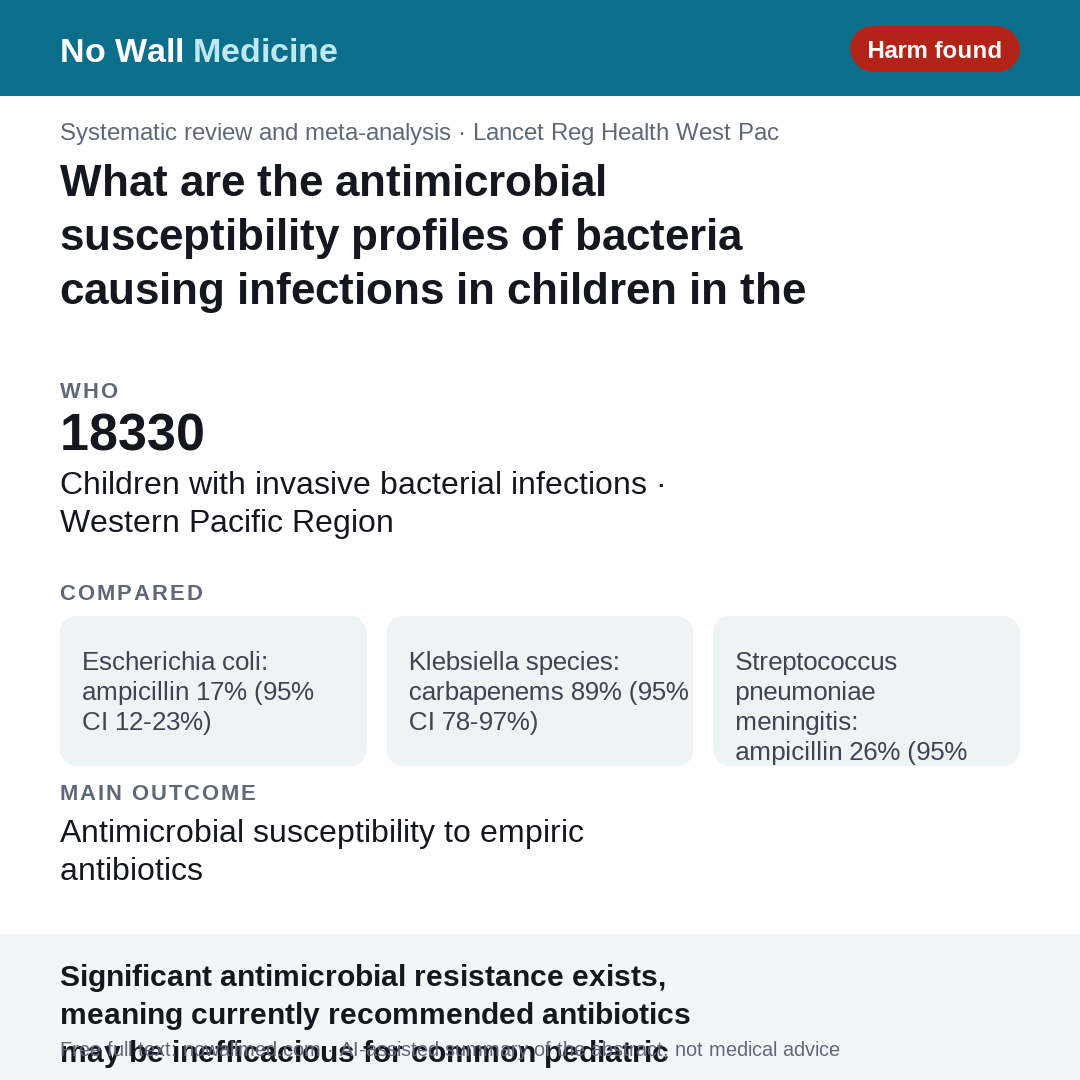
What are the antimicrobial susceptibility profiles of bacteria causing infections in children in the Western Pacific?
Who
18330
Children with invasive bacterial infections · Western Pacific Region
Compared
Escherichia coli: ampicillin 17% (95% CI 12-23%)
Klebsiella species: carbapenems 89% (95% CI 78-97%)
Streptococcus pneumoniae meningitis: ampicillin 26% (95% CI 11-44%)
Main outcome
Antimicrobial susceptibility to empiric antibiotics
Bottom line: Significant antimicrobial resistance exists, meaning currently recommended antibiotics may be inefficacious for common pediatric infections in this region.
Funded by: Australian Government and Wellcome Trust
Lancet Reg Health West Pac · 2024-08-31Download image
Clinical question: What are the antimicrobial susceptibility profiles of bacteria causing infections in children in the Western Pacific?
Abstract
Background
Antimicrobial resistance increasingly impacts paediatric mortality, particularly in resource-constrained settings. We aimed to evaluate the susceptibility profiles of bacteria causing infections in children from the Western Pacific region. Methods
We conducted a systematic review and meta-analysis of bacteria responsible for common infections in children. We included studies published from January 2011 to December 2023 (PROSPERO CRD42021248722). Pooled susceptibilities were evaluated against empiric antibiotics recommended to treat common clinical syndromes. Findings
Fifty-one papers met inclusion criteria, incorporating 18,330 bacterial isolates. Of available published data, only six countries from the region were represented. Escherichia coli revealed a pooled susceptibility to ampicillin of 17% (95% CI 12-23%, n = 3292), gentamicin 63% (95% CI 59-67%, n = 3956), and third-generation cephalosporins 59% (95% CI 49-69%, n = 3585). Susceptibility of Klebsiella spp. to gentamicin was 71% (95% CI 61-80%, n = 2323), third-generation cephalosporins 35% (95% CI 22-49%, n = 2076), and carbapenems 89% (95% CI 78-97%, n = 2080). Pooled susceptibility of Staphylococcus aureus to flucloxacillin was 72% (95% CI 58-83%, n = 1666), and susceptibility of Streptococcus pneumoniae meningitis isolates to ampicillin was 26% (95% CI 11-44%, n = 375), and 63% (95% CI 40-84%, n = 246) to third-generation cephalosporins. Interpretation
The burden of antimicrobial resistance among bacteria responsible for common infections in children across the Western Pacific region is significant, and the currently recommended World Health Organization antibiotics to treat these infections may be inefficacious. Strategies to improve the availability of high-quality data to understand the burden of antimicrobial resistance in the region are necessary. Funding
The study was supported by an Australian GovernmentNational Health and Medical Research Council Investigator Grant. This research was funded in part by the Wellcome Trust [220211/Z/20/Z]. For the purpose of Open Access, the author has applied a CC BY public copyright licence to any Author Accepted Manuscript version arising from this submission.
Cite this article
Moore N, Ashley EA, Dickson BFR, Douangnouvong A, Panyaviseth P, Turner P. Antimicrobial susceptibility profiles of invasive bacterial infections among children from low- and middle-income countries in the Western Pacific Region (WPRO) - a systematic review and meta-analysis. Lancet Reg Health West Pac. 2024. doi:10.1016/j.lanwpc.2024.101177
Spotted a mistake? Suggest a correction
Top studies every Monday
The week’s key trials and guidelines in your specialties, plus any topics you follow. By email, free.
Get the weekly digest