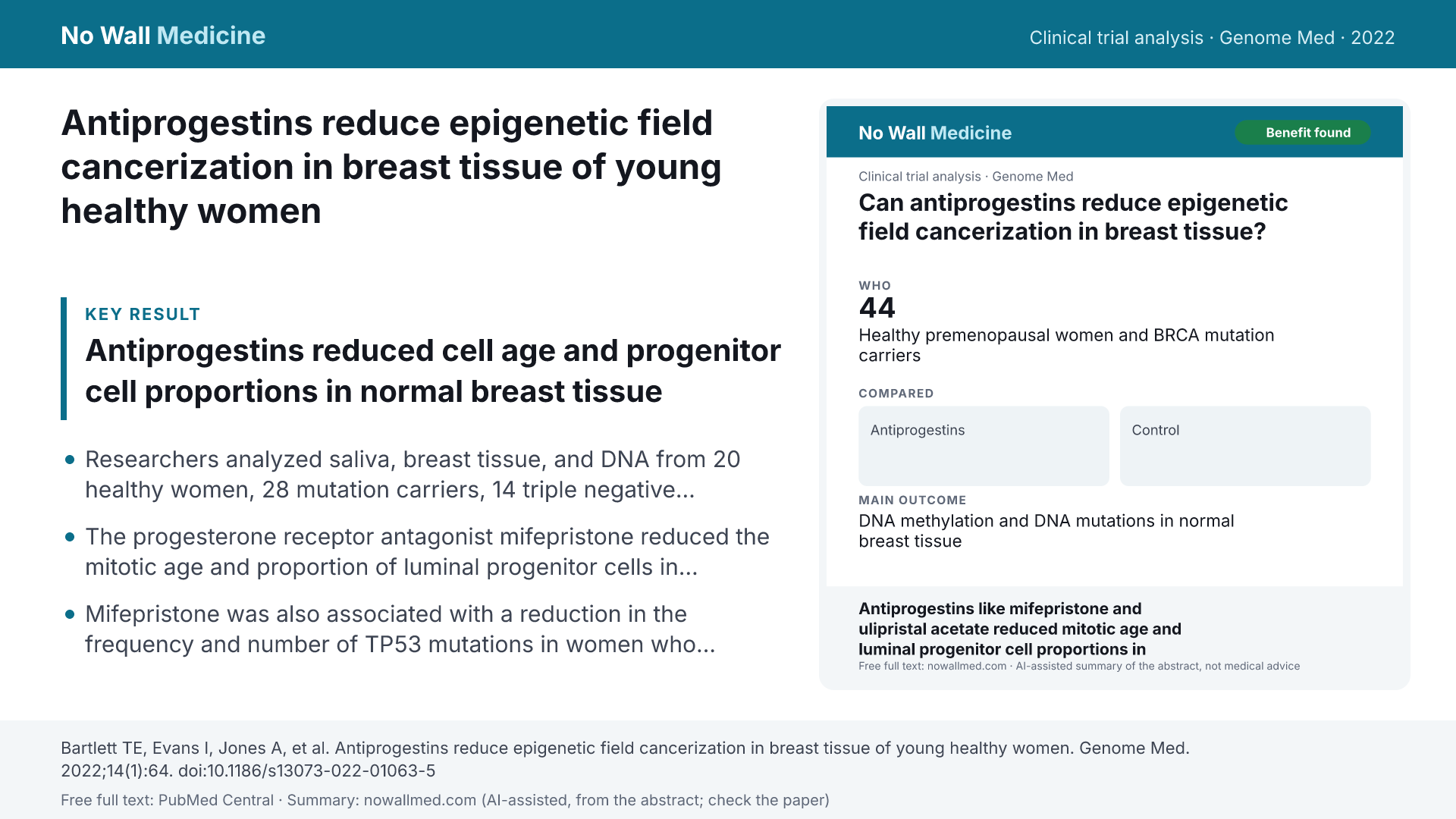
Antiprogestins reduced cell age and progenitor cell proportions in normal breast tissue
Antiprogestins reduce epigenetic field cancerization in breast tissue of young healthy women
Clinical trial analysisBenefit found
Can antiprogestins reduce epigenetic field cancerization in breast tissue?
Who
44
Healthy premenopausal women and BRCA mutation carriers
Compared
Antiprogestins
Control
Main outcome
DNA methylation and DNA mutations in normal breast tissue
Bottom line: Antiprogestins like mifepristone and ulipristal acetate reduced mitotic age and luminal progenitor cell proportions in normal breast tissue.
Genome Med · 2022-06-15Download image

Clinical question: Can antiprogestins reduce epigenetic field cancerization in breast tissue?
Why it matters: It was unknown if blocking progesterone signaling could prevent the development of features that promote breast cancer formation in humans.
Key points
- Researchers analyzed saliva, breast tissue, and DNA from 20 healthy women, 28 mutation carriers, 14 triple negative breast cancer patients, 31 hormone receptor positive patients, and 44 clinical trial participants.
- The progesterone receptor antagonist mifepristone reduced the mitotic age and proportion of luminal progenitor cells in all control women and in 64% of BRCA1/2 mutation carriers.
- Mifepristone was also associated with a reduction in the frequency and number of TP53 mutations in women who responded to the treatment.
Headline and key points written with AI from the paper’s abstract, with every number checked against it. Read the paper before relying on them.
Was this summary helpful?
Subject terms
Cite this article
Bartlett TE, Evans I, Jones A, et al. Antiprogestins reduce epigenetic field cancerization in breast tissue of young healthy women. Genome Med. 2022. doi:10.1186/s13073-022-01063-5
Spotted a mistake? Suggest a correction