Antipsychotic drugs were associated with small improvements in cognition compared to placebo in schizophrenia patients
Antipsychotic Drugs and Cognitive Function: A Systematic Review and Network Meta-Analysis
Systematic review and network meta-analysisNo clear difference
What is the association between various antipsychotics and cognition in schizophrenia spectrum disorders?
Who
9525
Participants with schizophrenia spectrum disorders
Compared
Antipsychotics: small effect sizes
Placebo
Main outcome
change in overall cognition score
Bottom line: Antipsychotics are not procognitive drugs and no individual antipsychotic was clearly better than placebo.
JAMA Psychiatry · 2024-10-16Download image
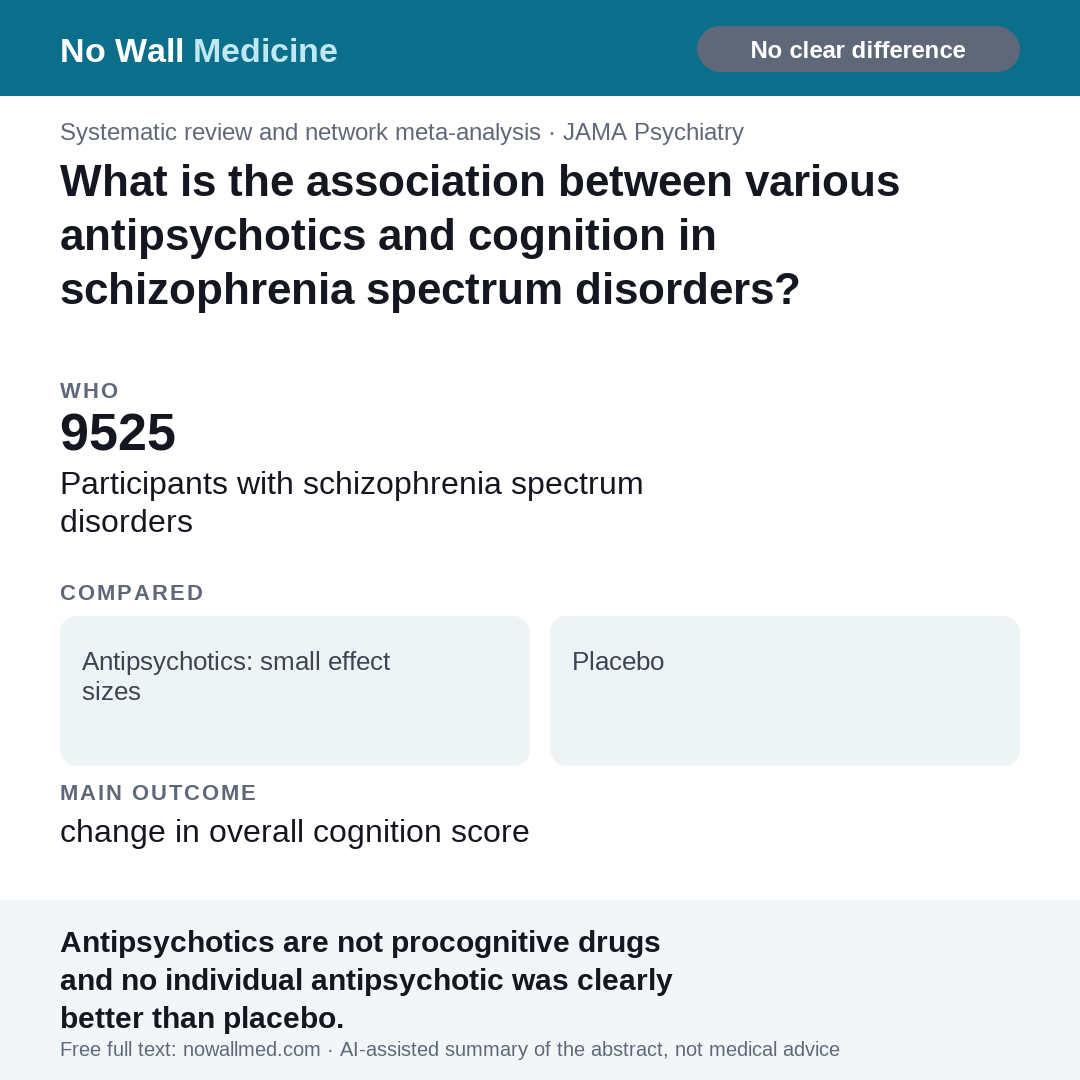
Clinical question: What is the association between various antipsychotics and cognition in schizophrenia spectrum disorders?
Why it matters: It was unknown whether different antipsychotic drugs differ in their effects on cognition or if they are associated with cognitive performance compared to placebo.
Key points
- Researchers analyzed 68 randomized clinical trials involving 9525 participants with schizophrenia spectrum disorders to compare various antipsychotics against placebo.
- No individual antipsychotic was associated with a clearly better outcome than placebo, but antipsychotics as a group showed small effect sizes.
- First-generation dopamine antagonists haloperidol (SMD, 0.04) and fluphenazine (SMD, 0.15) along with clozapine (SMD, 0.12) ranked low in cognitive outcomes.
Limitation the authors note: The data reviewed in this study are relatively sparse.
Headline and key points written with AI from the paper’s abstract, with every number checked against it. Read the paper before relying on them.
Topics
Cite this article
Feber L, Peter NL, Chiocchia V, Schneider-Thoma J, Siafis S, Bighelli I. Antipsychotic Drugs and Cognitive Function: A Systematic Review and Network Meta-Analysis. JAMA Psychiatry. 2024. doi:10.1001/jamapsychiatry.2024.2890
Spotted a mistake? Suggest a correction
Top studies every Monday
The week’s key trials and guidelines in your specialties, by email. Free.
Get the weekly digest