DOAC plus P2Y12 inhibitor reduced bleeding risk after heart procedure
Antithrombotic therapy after percutaneous coronary intervention in patients with atrial fibrillation: an individual patient data network meta-analysis
Individual patient data network meta-analysisMixed results
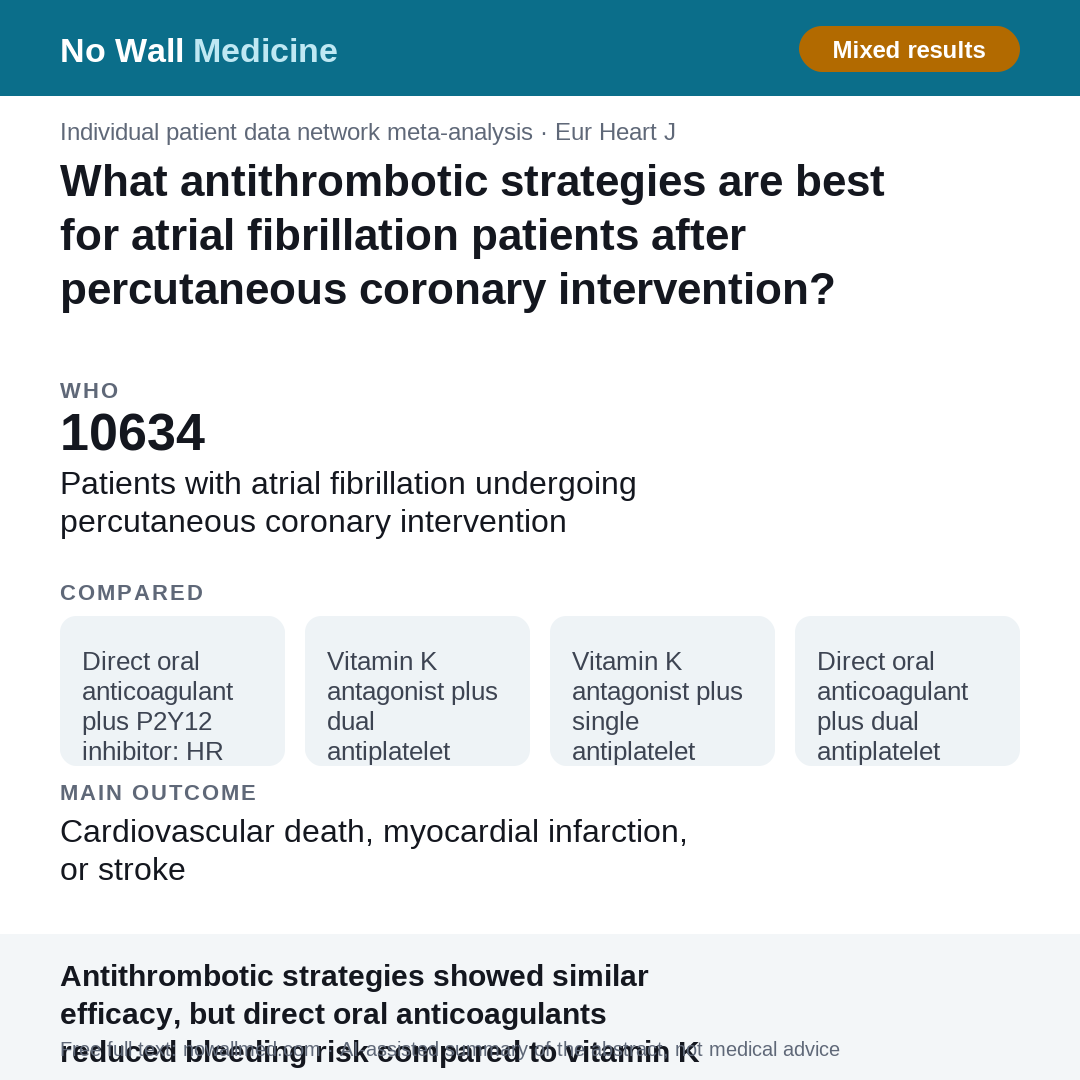
What antithrombotic strategies are best for atrial fibrillation patients after percutaneous coronary intervention?
Who
10634
Patients with atrial fibrillation undergoing percutaneous coronary intervention
Compared
Direct oral anticoagulant plus P2Y12 inhibitor: HR 1.16 (95%CI 0.97-1.41)
Vitamin K antagonist plus dual antiplatelet therapy: Reference
Vitamin K antagonist plus single antiplatelet therapy: HR 1.14 (95%CI 0.85-1.54)
Direct oral anticoagulant plus dual antiplatelet therapy: HR 0.99 (95%CI 0.75-1.30)
Main outcome
Cardiovascular death, myocardial infarction, or stroke
Result: HR 1.16 (95%CI 0.97-1.41)
Bottom line: Antithrombotic strategies showed similar efficacy, but direct oral anticoagulants reduced bleeding risk compared to vitamin K antagonists.
Limitation: A modest increase in risk with single compared with dual antiplatelet therapy cannot be excluded.
Eur Heart J · 2026-08-30Download image
Clinical question: What antithrombotic strategies are best for atrial fibrillation patients after percutaneous coronary intervention?
Why it matters: Doctors have had limited trial evidence on antithrombotic therapy after heart procedure in patients with atrial fibrillation
Key points
- 10,634 patients with atrial fibrillation undergoing heart procedure were studied.
- DOAC plus P2Y12 inhibitor had similar cardiovascular risk to other treatments at 1 year.
- DOAC plus P2Y12 inhibitor reduced risk of major bleeding and intracranial hemorrhage.
Limitation the authors note: The study had a limited ability to exclude a modest increase in risk with single compared to dual antiplatelet therapy
Headline and key points written with AI from the paper’s abstract, with every number checked against it. Read the paper before relying on them.
Spotted a mistake? Suggest a correction
More in Cardiology
Clonal hematopoiesis mutations linked to higher atrial fibrillation risk in cancer populations
Association of Clonal Hematopoiesis Mutations With Incident Atrial Fibrillation: A Systematic Review and Meta-Analysis
Deep learning model detects aortic stenosis from finger-cuff pressure waveforms accurately
Aortic Valve Stenosis Screening Using Deep Learning on Noninvasive Arterial Pressure Waveforms
Spontaneous coronary artery dissection affects younger women more often than expected
Spontaneous coronary artery dissection: implications for women's health, clinical care, and future research
Early lipid-lowering strategies may reduce atherosclerotic cardiovascular disease risk
Lipid-Lowering Strategies in the Era of Early Atherosclerosis Detection: 2026 ACC Scientific Statement: A Report of the American College of Cardiology