Antithrombotic Therapy in Patients With Infective Endocarditis: A Systematic Review and Meta-Analysis
Systematic review and meta-analysisMixed results
Does antithrombotic therapy impact clinical endpoints in patients with infective endocarditis?
Who
12,151
Patients with infective endocarditis
Compared
Prior or ongoing antithrombotic therapy
No antithrombotic therapy
Main outcome
In-hospital cerebrovascular events
Result: OR: 1.10 (95% CI: 0.56-2.17) for anticoagulation
Bottom line: Antithrombotic therapy did not increase cerebrovascular events, but anticoagulation decreased in-hospital mortality and antiplatelets decreased systemic thromboembolism.
Limitation: Results should be interpreted cautiously showing the necessity of a randomized setup.
JACC Adv · 2023-12-19Download image
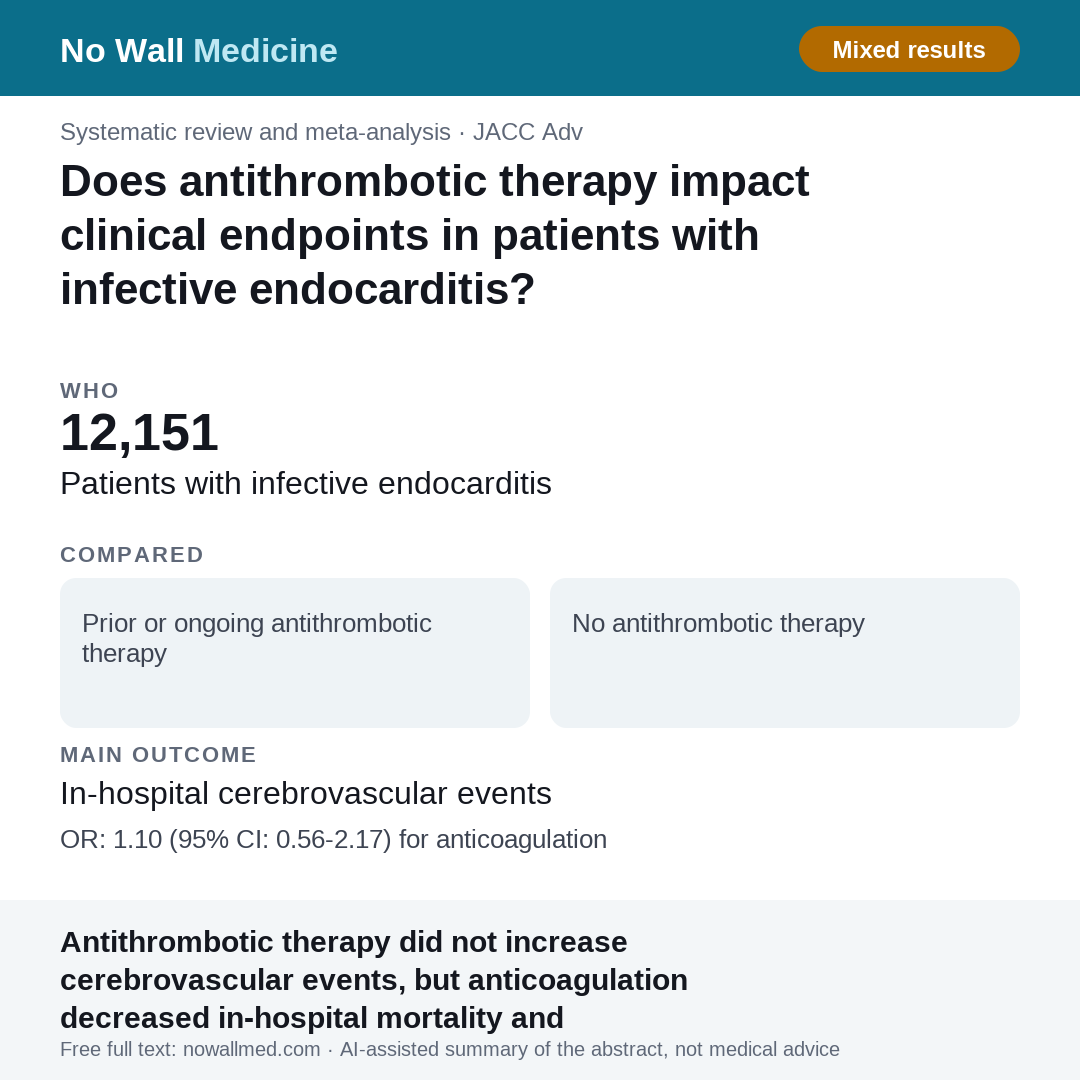
Clinical question: Does antithrombotic therapy impact clinical endpoints in patients with infective endocarditis?
Abstract
Background
Antithrombotic therapy (ATT) in patients with infective endocarditis (IE) is challenging. Objectives
The authors evaluated the impact of anticoagulant and antiplatelet therapy on clinical endpoints in IE patients. Methods
We performed a systematic review and meta-analysis comparing IE patients with prior and/or ongoing use of ATT vs those without any ATT during IE course. Primary outcome was reported in-hospital cerebrovascular events. Secondary outcomes were in-hospital mortality, intracranial hemorrhage (ICH), systemic thromboembolism (ST), and mortality within 6 months. Results
Twelve studies, with a total of 12,151 patients, were included. The primary endpoint was not different comparing 10,115 IE patients with or without prior anticoagulation (OR: 1.10; 95% CI: 0.56-2.17; P = 0.77) or comparing 838 IE patients with or without prior antiplatelet (OR: 0.90; 95% CI: 0.61-1.33; P = 0.61). In-hospital mortality was lower in IE patients with prior anticoagulation compared to those without (OR: 0.74; 95% CI: 0.57-0.96; P = 0.03). There was no difference in reported ICH rates between patients with or without prior anticoagulation (OR: 0.54; 95% CI: 0.27-1.09; P = 0.09) or between patients with or without prior antiplatelet (OR: 0.35; 95% CI: 0.11-1.10; P = 0.07). The rate of ST was lower in IE patients with prior antiplatelet therapy compared to those without (OR: 0.53; 95% CI: 0.38-0.72; P < 0.01). Conclusions
ATT in IE patients was not associated with higher frequency of cerebrovascular events or ICH. Moreover, we found that the use of anticoagulation was associated with decreased in-hospital mortality and the use of antiplatelets was associated with decreased ST. Due to the limitations of this study, these results should be interpreted cautiously showing the necessity of a randomized setup.
Cite this article
Caldonazo T, Musleh R, Moschovas A, Kirov H, Franz M, Haeusler KG. Antithrombotic Therapy in Patients With Infective Endocarditis: A Systematic Review and Meta-Analysis. JACC Adv. 2023. doi:10.1016/j.jacadv.2023.100768
Spotted a mistake? Suggest a correction
Top studies every Monday
The week’s key trials and guidelines in your specialties, plus any topics you follow. By email, free.
Get the weekly digest