Statin use is associated with a shift in aortic stenosis types in patients with homozygous familial hypercholesterolaemia
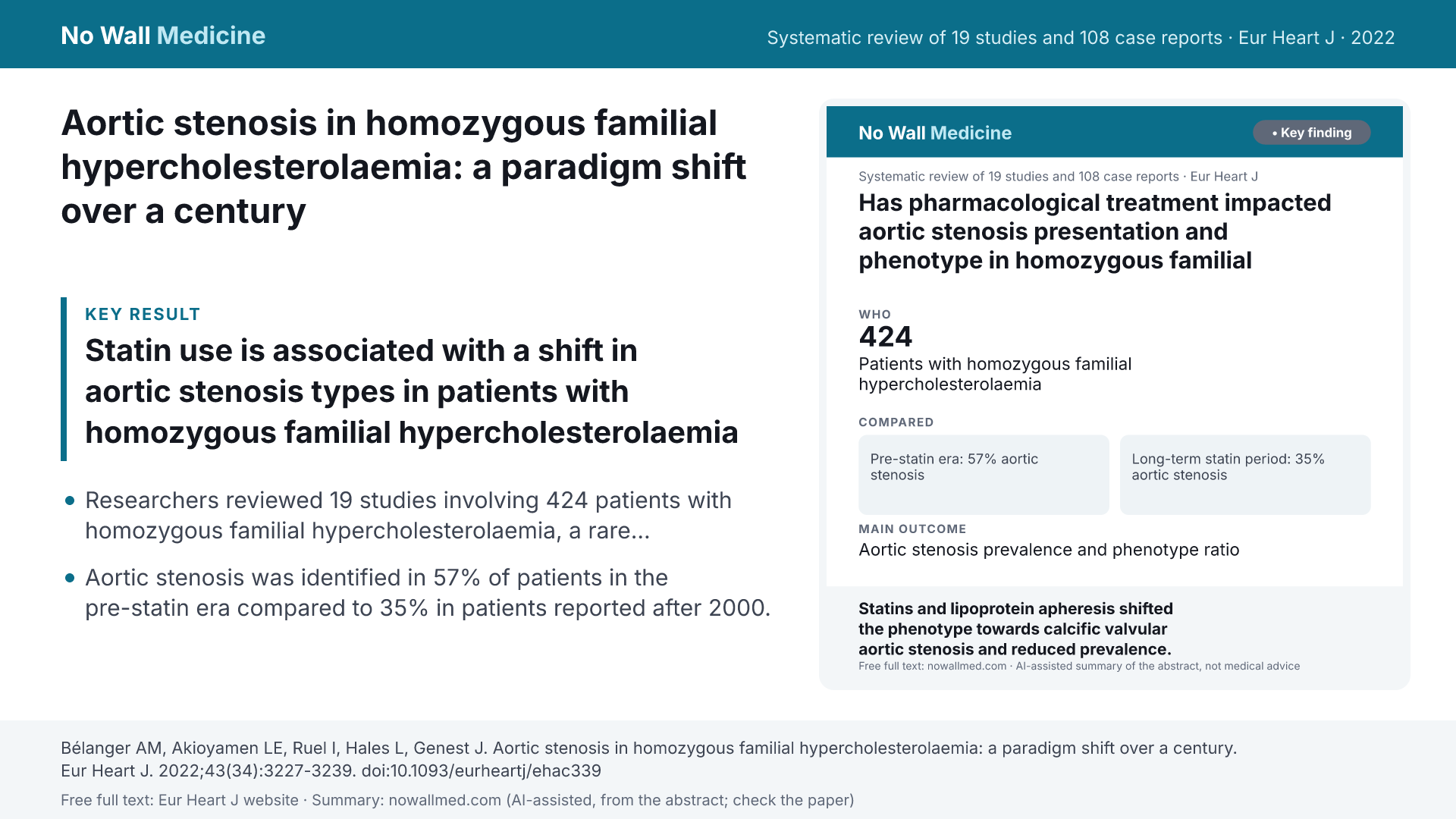
Aortic stenosis in homozygous familial hypercholesterolaemia: a paradigm shift over a century
Systematic review of 19 studies and 108 case reportsKey finding
Has pharmacological treatment impacted aortic stenosis presentation and phenotype in homozygous familial hypercholesterolaemia?
Who
424
Patients with homozygous familial hypercholesterolaemia
Compared
Pre-statin era: 57% aortic stenosis
Long-term statin period: 35% aortic stenosis
Main outcome
Aortic stenosis prevalence and phenotype ratio
Bottom line: Statins and lipoprotein apheresis shifted the phenotype towards calcific valvular aortic stenosis and reduced prevalence.
Eur Heart J · 2022-07-02 · Save PNG
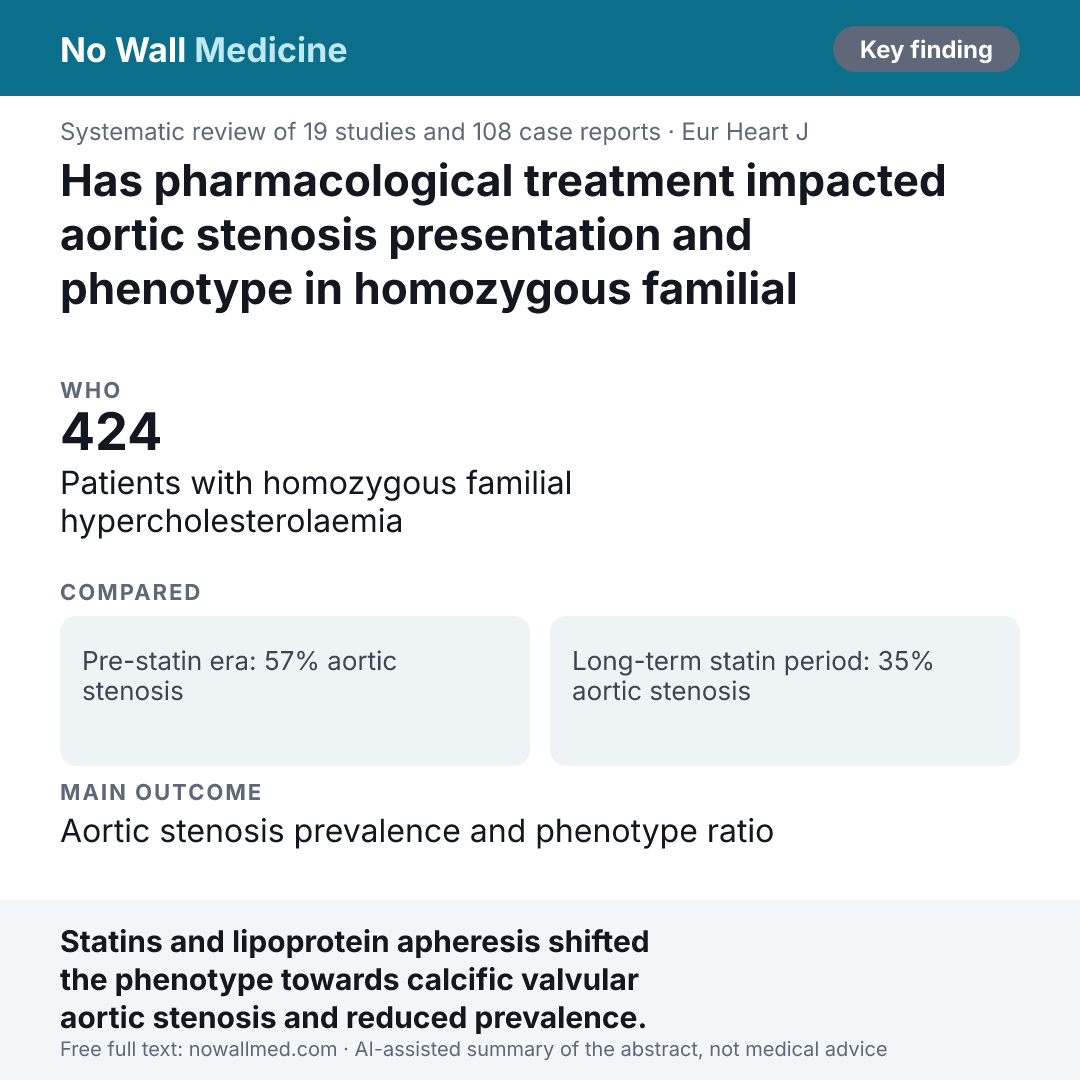
Clinical question: Has pharmacological treatment impacted aortic stenosis presentation and phenotype in homozygous familial hypercholesterolaemia?
Key points
- Researchers reviewed 19 studies involving 424 patients with homozygous familial hypercholesterolaemia, a rare genetic condition causing extreme cholesterol levels.
- Aortic stenosis was identified in 57% of patients in the pre-statin era compared to 35% in patients reported after 2000.
- The ratio of supravalvular aortic stenosis to valvular aortic stenosis shifted from 47:53 in patients not on statins to 10:90 in patients on long-term statins.
Limitation the authors note: The included studies were limited to cross-sectional or retrospective designs and case reports.
Headline and key points written with AI from the paper’s abstract, with every number checked against it. Read the paper before relying on them.
Was this summary helpful?
Subject terms
Headline, design, result, key points, caveat and citation as plain text.
Cite this article
Bélanger AM, Akioyamen LE, Ruel I, Hales L, Genest J. Aortic stenosis in homozygous familial hypercholesterolaemia: a paradigm shift over a century. Eur Heart J. 2022;43(34):3227-3239. doi:10.1093/eurheartj/ehac339
Spotted a mistake? Suggest a correction